Tuesday, 21 July 2020

Cure for nettle stings, cuts, colds and gearragrúiscín!

In the summer months, children all over Ireland went barefoot, casting off their winter boots and setting their feet free. 
Remember the line from the popular song, 'Galway Bay',  'And watch the barefoot gasoons at their play'. 

However many of them suffered a 'gearragrúiscín', or foot-cut, while walking or playing barefoot, but thankfully, there was a readily available cure in every field, which everyone knew about.

Ribwort Plantain, 'Plantago lanceolata', is a very common weed all over Ireland. In the Irish language, it is known as 'Slánlus', though in the english, in Ireland and UK, it is known variously as ribwort plantain, ribleaf, and lamb's tongue.

Though commonly found in America, it is not native to there, having been introduced there by Europeans.

Here in Ireland, it has been used for probably thousands of years as a curative plant with antihistamine qualities.


Drank in a tea, or broth, it was good for a cold, or a sore throat, and applied directly to the skin, it heals cuts, stings and bruises. It's the best leaf to rub on a nettle sting, (not dock-leaves, which apparently are only a placebo, and only psychologically effective! Yep, go figure, they lied to us!)

'Slánlus' is mentioned in the Irish Schools Collection (1938) under 'cures'. in nearly every county. Here's a mention from Tankardstown, county Tipperary. 'Slánlus leaf bruised and mixed with unsalted butter will heal a cut.' And from Cruit Island, county Donegal. 'Slánlus:- Nuair atá duine geartha agus é ag cuir fola cuireann an slanlus stad leis. Fasann sé achan áit fríd na cuibhreann.' and from Clifden, county Galway. 'When barefoot children in harvest time suffer from 'gearragrúiscín' i.e. a painful cutting under a toe or toes caused by 'coinlíns' in the field, the best cure is to apply raw 'Slanlus' (or Paddy's cabbage) and bandage. Slanlus is the handy application for all kinds of cuts. The clean leaf is pressed into the gushing blood where it soon sticks fast. It is not removed until the wound heals.'
Nowadays, I am reliably informed that the buds when eaten taste just like mushroom. Chefs use the leaves and buds when making mushroom soup, apparently. (note to self, 'ask J. P. McMahon about 'Slánlus')

'Slánlus' or Ribwort has achieved popularity in America as a panacea for many ailments. Take some of this info below with a grain of salt, but, yes, don't ever look at those thin ribbed leaves, and brown headed stalks with the white crown in your weed patch in disdain again.  

'Plantain has often been the go-to remedy for hikers plagued by mosquitos. Because it draws toxins from the body with its astringent nature, plantain may be crushed (or chewed) and placed as a poultice directly over the site of bee stings, bug bites, acne, slivers, glass splinters, or rashes. Bandage the area and allow the plantain to work its magic for 4-12 hours. Plantain may also be used to create a balm for emergency kits, or an infusion used as a skin or general wash. It is also a notable, soothing remedy for hemorrhoids.

Plantain is renowned for its healing effect on the digestive system. This is especially useful for anyone who has been damaged by antibiotics, anti-inflammatory or pain medications, food allergies, or Celiac disease. Both leaves and seeds specifically target the digestive system for healing. The leaves may be steeped as tea, added to soups, or dried with a sauce similar to kale chips. The seeds – a type of psyllium – can be ground or soaked for bulk mucilage or absorbable fibre, which, consumed before meals, may help with weight loss.

Because plantain is a gentle expectorant and high in silica, an infusion can be helpful for lung problems, coughs, and colds.
Plantain is almost a panacea for the human body, treating everything from all menstrual difficulties, all digestive issues, to nearly all skin complaints, and even arthritis. Add to salads, chew to ease thirst, or enjoy in stir fries. This versatile wild vegetable will keep you in good health for years to come! '


Ribwort Plantain - Slanlús - Plantago lanceolata.

And you, waybread, mother of worts,
Open from eastward, powerful within,
Over you chariots rolled,
Over you queens rode,
Over you brides cried,
Over you bulls belled;
All these you withstood,
And these you confounded,
So withstand now the venom that flies through the air,
And the loathed thing which throughout the land roves.

From Niall Mac Coitir's book Irish Wild Plants.

Plantain, being one of the nine sacred herbs to the Alglo Saxons was held in high esteem.

Known to the native Americans as white mans foot print, this humble weed follows us everywhere. You can't get away from it, but why would you want to!

An ancient cure for many ailments.

Plantain is our go to herb for wounds of any kind, simply chew it up and put it on or make it into a salve to have at hand. Plantain will miraculously draw out poisons, stanch bleeding, quell infection, reduce pain and heal. So much so that it is reputed in America as a cure for snake bite, saving lives!

Plantain proves to be equally as powerful taken internally, working its way around the body and infusing us with its healing properties. Drawing poisons and infection from the body, plantain diligently assists urinary, respiratory, digestive and other systems prone to infection.
A gentle expectorant and mild emollient, soothing mucus membranes.
A powerful anti-inflammatory and moderate astringent, helping to restore connective tissue and tonify.
Plantain works well in combination with other herbs.

Best used fresh Plantain can be gathered from spring to late autumn. It can be eaten fresh (although not to everybody's taste), brewed into a tea, tinctured, left over night to steep, frozen for later use or soaked in oil for use in salves.

*One must be careful using Plantain with other medicines as it may clear them out of the body, suspending their actions.

Thursday, 9 July 2020

A Skull in Connemara

Inishbofin, is an island off the west coast of county Galway and many Galway city folks have relatives there, or have spent a holiday there. This beautiful little island off Cleggan is in the news this week in a dramatic fashion, in an article that appeared in The Kerryman newspaper.

Martin McDonagh's darkly disturbing play, 'A skull in Connemara' was all about the not uncommon practice of recycling graves and relocating and destroying the bones and skulls of the dead, including coincidentally, the skull of the wife of the main character, who was suspected of murdering her twenty years earlier. Grim stuff indeed!
Back in the late 19th and early 20th century Craniometry, Phrenology and Physiognomy (look them up), were all part of a now-discredited, broad pseudo-science called Eugenics, which some of the greatest scientists and thinkers in the then academic world subscribed to, or at least dabbled in. It was a natural follow-on to the then darling of the press, and hotly dispute, 'Darwin's theory of evolution'.
In the end, thankfully, there was very little evidence to show that ancient or indigenous peoples, or physically different peoples or individuals were inferior, or prone to traits such as violence, laziness, lunacy, sexual deviancy and much more. Nor was there a superior race, an Aryan bloodline, that were naturally pre-determined and pre-destined to rule all others on earth.
It is not well known for instance that for decades, all emigrants (Irish included) who passed through Ellis Island on their way to a new life in America, were routinely measured, classified and described in a Eugenistically-inspired and informed manner, classifying millions of people passing through those halls, as likely or less-likely to succeed, or to contribute to America, or to end up in jail, or commit murder or rape. Imagine how that would play out today?
Yet traces of that thought process and theory still linger on in emigration policies and the treatment of indigenous peoples all over the world.
Henry Ford was a fan of Eugenics, but so also were many of the thought-leaders of the world. Hitler capitalised on this fascination about race, and predetermination, and the rest is unfortunately, a tragic history.
The theft of the skulls from Inishbofin and the Blaskets by a curious and over-zealous research student was neither unusual, nor at the time, criminal, but certainly, by our standards it was wrong, wrong then, and wrong now. And those skulls are just the tip of the iceberg, with millions of bones and 'samples' languishing in drawers and files in every university and museum of the world, bought or stolen or borrowed from grave-sites and others.

So yes, the skulls ought to be repatriated and re-interred in their home islands of Bofin and Blasket, with great respect and reverence, but also with a bit of pomp and pride, in the full knowledge that those skulls played a small but important role in debunking the whole idea of superior races and other racist theories. We can learn a lot from the past, mistakes are just another lesson.


Thursday, 2 July 2020

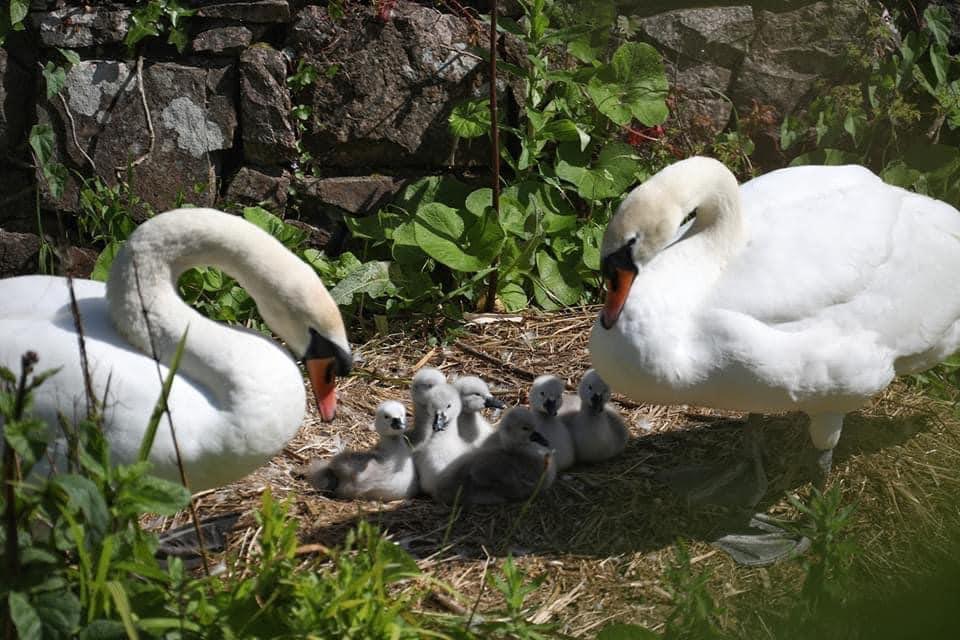
Swans and Cygnets

Swans and Cygnets. Galway, the 'city of the tribes', could just as easily be known as the 'city of the swans', we have so many of them on the waterways around town. But nature can be a cruel and heartless mistress. In the first photo, a grey crow is caught on camera snatching a young cygnet on a river in Cork (photo Finbar Buckley). The Grey crow, or Hooded crow (Corvus cornix) is a constant scavenger, eating everything from carrion to molluscs and everything in between. It is also an opportunistic predator and will eat mice, frogs, insects, young birds and even a baby swan.

Cygnets are at their most vulnerable in their first 8 weeks, when they are subject to being opportunistically preyed upon by grey-crows, herring gulls, herons, and even otters, mink or seals. The survival rate to adulthood of a swan clutch is less than 50% on Galway’s canals and Corrib river catchment each year. This clutch of 7 cygnets hatched on the canal behind the cathedral. Another clutch of 6 hatched on the canal at Mill Street.


Swan nests are usually on river banks or islands, a loose pile of reeds and grasses. The eggs, six or seven usually, though as many as ten, are laid in March/April and hatch in April/May. The female swan (pen) and the male swan (cob) take turns minding the nest, incubating the eggs. After 35 days of incubation, the cygnets all hatch within one day, and a day later they are swimming on the water beside their watchful parents. Sometimes they hitch a ride under the adults wings. The cygnet grows fast, but stays grey/brown for a year before their white plumage comes in, and then they have to learn to fly.


Galway hosts as many as 100 swans in the swan colony on the Corrib estuary by the Claddagh during the summer. We even have a swan-warden looking after their welfare. Please do not feed them white bread or mouldy bread as it gives the swans a condition known as Pink Feather which can prove fatal.
While they are numerous, only two or three pairs of swans nest in the city and raise young families each year. Most of the Galway swans over-winter on inland lakes where they have shelter from coastal storms and better grazing.


(Photos of swans and cygnets in Galway by Chaosheng Zhang who works at NUIG and takes and shares the most amazing photos. Photo of cygnets hitching a ride on the swan's back, by Andrea Whelan).

It is such a treat to see the swans each year, and I am truly fortunate to see them so often during my Walking Tours of Galway.

Tuesday, 26 May 2020

The Cracked Plate

A friend of mine, an archeologist, Christy Cunniffe recently posted some small shards of broken pottery, locally known as 'chaney' that he'd come across when excavating in the bog behind an old farmhouse in the Callows, a flood plain on the river Shannon, near Clonfert, county Galway. He loved the colour and the patterns on the broken, unidentifiable pieces. Were they old? Were they cups, plates, vases or bowls? He didn't know, but he loved the idea that people living in these relative poorer homes, had some semblance of colour in their lives, a century or more ago.
I love this quote by Perry Randall, an Irish-American archeologist, based in Texas. 'In my archaeological experience (mostly early Islamic and Nabatean) there are few things that make one feel connected to the past more than holding a pottery shard. Even more than jewelry, human remains, or other precious items. There is something about the commonality of broken pottery that transcends the ages and resonates in the fingertips. I have seen two-thousand year old fingerprints on broken pieces of pottery and been amazed' Give me broken pottery anytime, eh! 
Anyway, It got me thinking, and writing.
Most 18th and 19th century Irish farm-houses had little or no pottery, and even less cutlery, and let's face it, the vast majority of us Irish fitted into that 'poorer' category, whether living in the towns or in the countryside, Ireland and the people in it were impoverished, victims of a devastating and demoralising colonial system, we were barely subsisting as a people in the 19th century. Fully 90% of Irish tenant farmers were living on less that 4 acres of land in the 1840's. There was no money for rent, not to mention any at all for fancy pottery. Whatever money we had, we needed it to send our sons and daughters away from this hell, to a better life in America, England, or anywhere.
Our mugs, if we had them, were pewter, horn or of turned, wood, and our plates were usually wooden chargers, not made of pottery at all. There may have been a tin or enamel bowl, and the lid of the big black pot served just as well, if you needed a bowl or platter. There are lots of stories of the pot of potatoes being tumbled out onto a wicker or willow basket, or 'Sciob', and it was the survival of the fittest after that.
By the late 19th century, after the devastation of 'Famine' and social improvements owing to the actions of the Land League agitation, the lot of the Irish farmer was improving. They were finally able to own their land, build proper housing and live something approaching a 'comfortable' life.
With the secure and better housing, came huge improvements in living standards and tableware became both common and desirable. Houses that previously had no 'luxuries' now had tables and chairs, and dressers laden with delph. The good delph, the plates and cups and saucers, was kept high up on the dresser's shelves, used only when visitors were expected, or for the weddings, wakes and stations., The everyday mugs, and the chipped plates, were kept lower down on the dresser, with the mixing bowl for the bread-making, handy and accessible. A cup of tea never tasted so good as when poured from the whiskey bottle into the big blue and white striped mug when the hay was made or the turf saved.
By the mid-19th century England had literally hundreds of potteries churning out dinnerware and decorative pottery for practical and even decorative purposes and the price of a cup or plate was now affordable with the mass-production that occurred in the industrial revolution. Delph was now common and expected in houses, no more scrabbling in the 'sciob' for a potato, now we used knives and forks and spoons, and plates and cups, just like the posh folk, up in the 'Big Houses'. 


The favourite colours of delph in rural Irish farmhouses were 'blue and white' and 'brown and white' delph. Amongst the.favourite patterns was the 'Willow' pattern. It was a blue and white transfer-printed composite design which brought together Buddhist imagery, pagodas, landscapes, birds and trees from Chinese porcelain. The pattern is said to be woven around a romantic story of star-crossed lovers eloping together. Imagine the scandal in the kitchens of Ireland if that got out! (See below)
The other blue and white popular pattern was the Dutch 'Delft' or 'Delftware', from the town of Delft in Holland, and from which we get the anglicised word delph. Their firing-process was borrowed from the Chinese, and the favoured patterns were typically eastern and oriental scenes, brought to Holland by the Dutch East India Trading company in the 16th century. Later on, the Dutch ceramists copied versions of Dutch masterpieces, especially the ubiquitous Dutch windmill design.
While the Delft pottery dates back to the 16th century, by the early 18th century, the new Dutch monarch in England (yes, the same King William of Orange, of the battles of the Boyne and Aughrim fame), encouraged a 'technology transfer' as it were, from Holland to England, and the previously secretive tin-glazed Dutch/Chinese earthenware 'method' and the same designs, were soon being mass produced in potteries all over England, but especially in Stoke on Trent, in Staffordshire, which became the world's greatest conglomeration of potteries in the 19th century, with nearly 150 pottery manufacturers.
The better-known brands of pottery were probably Wedgewood, Denby, Aynsley, Spode, Coalport and Royal Doulton, but they were expensive, well beyond the means and imagination of the average household in Ireland. Yet by 1920, there were many, many other companies producing affordable tableware for the masses, exporting their now 'English pottery' all across the British Empire and to America. Johnson Brothers (there were four brothers) from Stoke-on-Trent produced a huge range of tableware from the 1880's onwards and their patterns, including Willow, Windmill and English castles were very popular in Ireland.
Eventually, these very popular Willow, Windmill and Castle printed (not hand-painted) designs were knocked off by just about every pottery, in blue and white, green and white, and brown and white glazes, so that by the 1950's, we were 'glazed-over' with full sets of tea- and dinner-ware in nearly every house in the country.

Our kitchen dressers were laden down with dozens of pieces of the good and the plain delph that we used, jugs, and plates, and saucers and fine china cups, Toby jugs, and milk jugs, and stripey mugs for the tae, so much so, that there was hardly room for the copy of Old Moore's Almanac and the Sacred Heart picture, there was so much crockery. Looking back on it now, so much of the delph on display had been paid for by remittances from our emigrant sons and daughters, the trappings of their new-found wealth, and source our comfort, Thank God.
And when the cracked cup or plate finally broke, or had so many chips off it that even the dog wouldn't be found dead licking the scraps off-of it, the shards or ‘chaineys’, got chucked into the bog or the drain, or the foundations of the shed, waiting for some latter-day archeologist or treasure-hunter to unearth them, reconnect the pieces like a Grecian urn, and marvel at the lives that had touched it or eaten or drank out of it in the past.
Broken pottery to some, a relic of past glory to another! Irish poet Oliver Goldsmith, wrote about such broken crockery in 'The Deserted Village' which he wrote in 1770. When describing the village tavern, now ruined and deserted, he speaks of the fine tableware that the tavern used, and kept, even when smashed.
'While broken tea-cups, wisely kept for shew,
Ranged o'er the chimney, glistened in a row.
Vain transitory splendours! Could not all
Reprieve the tottering mansion from its fall!'
While today the younger folk favour plain pottery, or simple designs for their tableware, I'd say that there isn't a farmhouse in Ireland without at least one big platter, the family heirloom, still taking pride of place on the sideboard, or in the china cabinet, although ironically, the plates themselves are more likely to be the 20th century knock-off of the original Delft patterns, more 20th century than 19th or 18th, less valuable, but nonetheless family treasures.
The Old Willow Pattern Dish
'Two pigeons flying high.
A Chinese vessel sailing by.
A weeping willow hanging o’er
A bridge with three men, if not four.
A Chinese temple, here it stands,
Seems to cover all the land.
Apple trees with apples on,
a pretty fence to end my song.
It stood on the old kitchen dresser for years.
A silent witness to the joys and the tears.
The comings and goings of four generations,
the pain and the sadness and some celebrations.
It shared the shelves with the threshing mugs,
the dinner plates and the fancy jugs.
While a hen hatched her eggs in the cupboard below,
and the delph all shone in the firelight glow.
Big floury spuds heaped up in a mound
were on the table when the dinner came ‘round.
There was bacon and cabbage and buttermilk too,
and that old willow pattern dish gleamed white and blue..
It saw great grandmother come home as a bride,
crossing the threshold at great grandfather’s side.
It saw the joys and the laughter gay,
when the neighbours came on threshing day.
It saw the joys at weddings and births,
and witnessed the heartache at a visit from death.
It watched the day the exiles departed,
leaving those left at home so broken hearted.
Then it saw them return to visit a while,
saw grand children come with a laugh and a smile.
On house dance nights in days of yore,
it saw half sets knock sparks from that old kitchen floor.
Heard the music and rhyme ring out loud and clear.
Saw the exile’s song cause a silent tear.
It watched the turf fire burning bright
when the neighbours called to chat at night.
It saw in the rafters the ‘auld Fenian gun’,
and the hurried visits from men on the run.
At Easter ‘16, it saw men march away.
Sean didn’t return. Granny’s hair turned grey.
It was laid on the table with buttered brown bread
when the ‘Tans’ came looking for poor Uncle Ned.
They smashed all the fancy jugs on the floor,
but poor Ned had left home the evening before.
But now the old house is no more.
Gone are the people, the half sets, the floor.
No photographs hang on the old kitchen walls,
only ghosts from the past now come to call.
The dresser has long since crumbled to dust.
The old fan on the hearth is all covered in rust,
But the old dish survives in a new modern home,
a link with the past and of days that are gone.
If it only could talk, what a lot we would learn,
of an age that’s now past, and will never return'
KMCD.
*The Old Willow Pattern Dish* arranged by Kevin McDermott
(I was sent this poem by Kevin McDermott. I think captures so much of what the delph and the dresser meant to so many.over the years. Kevin McDermott recorded this poem on a CD some years ago, I am hoping to get the audio posted soon)


My favourite platters are not the perfect ones on the dresser's top shelf, but rather the one that has been cracked, perhaps through careless use, or domestic 'incident'. Voices had been raised, tears spilled, the moment of the accident never forgotten, nor the culprit found, but some time later, the pieces had been saved and the platter had been repaired by some 'tinkering tradesman', the repair done on the crack with a metal washer and some wire! There is one, a big serving platter, with a wire-repair, in O'Connors Pub in Salthill Galway, where I do my 'Fireside Tours', the shortest walking tour in Ireland. 
What's your favourite piece of delph?
Brian Nolan, Galway Walks, May 26, 2020