Monday, 20 January 2020

I can't believe it's not butter!

Forgotten stashes of dark yellow butter are sometimes found buried in bogs in Ireland, preserved for thousands of years, secreted away in times of plenty, to bide the maker over times of scarcity or hunger.

Though a thousand years old, or more, the butter is still edible and has, I am told, a unique flavour of the bog it was buried in. I don't doubt that!


(Photo is of bog butter discovered in Galway, none the worse for having spend two thousand years under the bog).


They say that the butter takes the flavour of the grass or plants in the field the cow grazes in also. And I don't doubt that either.

(Photo; This is a leather firkin or barrel that was found a few years ago in a bog in Kildare)Today, Kerrygold, the butter brand owned by Irish dairy farmers, has become the first Irish food brand to reach the momentous milestone of exceeding an annual retail value of $1 billion of exports. Be it ever so humble, butter pays the Irish handsomely, even today.


We Irish have had a long love-affair with our butter for thousands of years. During the 18th and 19th centuries we infected every corner of the world with our butter infatuation and an unlikely industry sprang up. One of our biggest exports for over two hundred years was Irish Country or salted butter. Cork, a bustling port, had a 'Butter Market' or 'Butter Exchange', exporting butter of a very high quality to all parts of the British Empire from around 1700. Cork, a major shipping port, controlled 66% or Irish butter exports to Europe and 80% to America and especially to the Caribbean.

Butter was transported to Cork by horse and cart from as far away as Limerick and Kerry to the Cork market for export on ships. Cork merchants supplied much of the British Empire with staples, salted beef fn pork, salted fish, and salted butter. Farm-made butter was transported by farmers by horse cart to the market for sale. Hundreds of carts made long journeys every week to sell butter through the Butter Exchange. The road from Killarney to Cork is called 'the butter road' for this reason.


Some butter buyers bought up locally-produced butter in the far-flung outlying towns, like Dingle, Listowel and Caherciveen, too far for a farmer to drive a horse and cart in one day. These were unofficial butter markets like the one in the photograph. The same happened in Clare and Tipperary and as far north as Galway, Donegal and Sligo.

The men milked the cows, but the women made the butter. It was a laborious job, loading the separated cream from fresh milk into recently sterilised wooden churns and turning or pounding the churned cream, to separate the fat form the skimmed milk, and make butter.

There were lots of 'pisheogs' or superstitions attached to churning. If a stranger entered a house while churning was going on he or she had to lend a hand or they would be accused of 'stealing the butter'.

There were churning songs and rhymes too, that went with the ritual.

Milk had a short shelf life, of maybe 3 or 4 days. Butter could last a year or longer. Salted butter could last a decade. Selling home-made butter was the only way many farmers survived, fed their families and paid their rent. Butter moment was the staple of the 19th century farm.


Butter jobbers (middlemen-buyers) would buy the butter locally from the farmers at these local markets, without much competition, setting the price as they saw fit, and no doubt getting a good bargain. That bulk-bought butter was then carted in wooden casks or firkins (a firkin is a 1/4 barrel, with a volume of 10.8 gallons), to Cork, where the butter was graded by quality and sold on for a profit for the middle-man.


Unfortunately by the late 19th century butter production had been mechanised and standardised in much of the world and the market for Irish butter dwindled. Centrifuge-separated blended milk-fat made a more standard butter, that was less salty and had less moisture. Salty butter went out of fashion. New packaging, indeed individual pounds of butter were packed and branded. The old firkin measure fell out of favour for the smaller, lighter, branded packaging.

By 1894 a co-operative movement was founded in Cork, the IAOS (Irish Agricultural Organisation Society) that would revolutionize dairy production in Ireland and provide the farmer with a fair price for milk. The immediate effect of the co-ops was that locally-made butter began to die out and big co-op dairies began collecting milk from farmers for the industrial production of milk, butter, cheese etc.


The Cork Butter Exchange closed in 1924. It was located in the building called 'The Firkin Crane', a beautiful still extant building, erected in 1855. It was a rotunda or round, domed building, that housed the crane or weighing scales that was used to measure the quantity of butter in each 'firkin' or cask.


Butter made from the milk of Kerry cows, was famed for that particular cow's high milk-fat content and deep yellow colour. Kerry's golden butter was the preferred or 'gold standard' for butter all over the world for two hundred years or more, and was sold at a premium.

Kerry Foods branded their premium and very popular butter pat as 'Kerry Gold', and the rest is history. We still love our butter, though the cholesterol scare has frightened many away from one of our oldest and healthiest foods.

Firkins of butter ready for export at the Butter Exchange in Cork


A wooden firkin, or quarter barrel, or 9 imperial gallons. Butter was sold by the firkin, which weighed 56 pounds (25 Kilograms). 


My favourite treat? Piping-hot new season potatoes, still in their jackets, swimming in melted butter. One big golden mush of paradise!

Friday, 17 January 2020

Touring Connemara in 1914 by rail and by charabanc

A pre-1924 MGWR Touring Car, or charabanc ("char-à-banc", usually in Ireland it is pronounced sharabang), en-route somewhere between Clifden and Westport, although the photo says Recess, suggesting that perhaps the touring party were being taken to the Recess Hotel, partially visible in the background, or to the Recess Railway Station. 

No white lines in the middle of the road back then, probably around 1914. It prompted me to write this little story. Sit back and enjoy. 


From 1895 to 1935 Galway city was connected to Clifden by the Midland Great Western Railway line. The MGWR had some 538 miles (866 km) of rail, linking Connacht to Leinster, with lines ending in Westport and Clifden, which towns were in turn, linked by touring car. This particular car in the photo connected the two train termini, Clifden and Westport, so rail passengers could go by train to one, or the other town, and then, connect to return home on the other train line, via a 'jaunt' on the charabanc 'touring car'.
Charabancs. Funny word eh! The name derives from the French, char à bancs or "carriage with wooden benches". It had 'benched seats' arranged in rows, looking forward, commonly used for large parties, whether as public conveyances or for excursions. It had a retractable canvas roof and the side windows were made of mica (a thin layer of quartz-like stone). The motorised touring car took over from the Bianconi horse-drawn carriages that had plied the roads of Ireland until the arrival of rail and eventually motorised horseless cars.

If you look closely, you will see that the touring car's registration plate number is 'IM 180'. For you young 'uns out there, car registrations in Ireland were done alphabetically by county. So Antrim was IA, Armagh IB, and eventually, Galway IM. Them when IM was all allocated, they want to AIM, then BIM, and so on to ZIM. Later on, maybe in the late 1960's Galway went to ZM, then AZM, BZM etc... until all that system was scrapped in the 1990's and we went to the current registrations of just G.
I happen to have access to the Irish Motor Directory for the year 1914 for cars and motor-cycles registered in Ireland. Nationwide (32 counties) in 1914 there were a total of 20,211 cars and 4,438 motor-cycles. Galway had only 189 cars and 163 motor-cycles registered in the county in 1914. Northern Ireland, Dublin and Cork had the bulk of all cars in the country.
If you look closely at the page below, you will see the entries for IM 179, IM 18o and IM 181. They are three char-a-bancs, and all three are registered to the Midland G. W. Railway in Broadstone (now Phibsboro in Dublin) where the registered office of the MGWR was located.
This page of car registrations from the Irish Motor Directory in Galway in 1914, showing IM 180 the charabanc owned by the MGWRy which is shown in the old photo at the top of this story. 
It's not often that I get to tie one piece of evidence to another..I'm actually kinda chuffed! 

The other car and motor cycle owners on this page are quite interesting including The Right Hon Lord Killannin of Spiddal, J. A. B. Trench of Clonfert, Harry Usher of Loughrea, Tom Cawley of Cawleys in Craughwell (motor-cycle), Maurice Sweeney of Loughrea, and James J. Ward of Eyre Square (the former two had garages and several cars). 

By far the most interesting car-owner listed on this page is the notorious land agent, landlord and Galway Sheriff, Mr. F. M. Shawe-Taylor of Castle Taylor, Ardrahan, (IM 165) who was killed in an IRA ambush on the way to Galway on the 3 of March 1920. The killing took place at Egans Pub in Cashla, near to Carnmore Cross. This in turn led to an increased RIC and military presence in the area, more and more unrest, shootings and reprisals which brought in the dreaded Black and Tans and Auxilliaries to the area, leading directly to the death of RIC constable Timothy Horan in an ambush at Castledaly, the Black and Tan shooting of innocent civilian Ellen Quinn at Kiltartan (1 November 1920), a pregnant mother of six and a tenant of Lady Gregory; murder by the Black and Tans in Galway of Fr. Michael Griffin (14 November 1920); killing of Tom Egan and the gruesome torture and murder of the two brothers from Beagh, Gort, Patrick and Harry Loughnane. In addition, there were numerous incidents of violence, many of which were recorded with horror by Lady Gregory in her journal, who remarked that "the country has gone wild since the killing of Frank Shawe-Taylor." I guess he had no luck with that car!

Anyway, I digress. Back to the Connemara Charabancs. I think it's likely that the three touring cars (IM 179, IM 18o and IM 181) were based in garages in Westport and Clifden, so as to meet all trains. The days of grand touring were upon us and the novelty of seeing the 'Wild West' of Ireland by train and charabanc must have been irresistible. The poster even mentions going to Achill, so the third car was likely based there. These posters were put up in railway stations and rail carriages all over Ireland and were no doubt, very effective marketing, long before the Irish Tourist Board started to promote Connemara. I love the 'Book of Kells' font and artwork on the poster.
It has to be appreciated however, that touring on such a vehicle through Connemara in 1914 would have been uncomfortable, cold, bumpy (imagine the roads), noisy, slow and sometimes dangerous, as the touring cars were quite high and when loaded with passengers, were apt to list too far on sharp bends and sometimes tipped over. 
The charabancs were phased out by the mid 1920's, though these saw service in Connemara right up until 'The Emergency' or WWII in 1939.

And now for the trivia piece of the story. I don't know if any Irish charabanc survived, but if I am not mistaken, the bench seats from one of these three charabancs ended up in Ryans Hotel in Cong, as part of the bar furniture. They were there fairly recently. They may still be there for all I know! This photo shows Ryans Hotel on the right, around 1910.


The Galway-Clifden railway line can be see paralleling the road, on the lake shore. (The lake is called Glendollagh) This is probably roughly where the 'Connemara Giant' statue sits, outside Joyce's Craft Shop in Recess in Connemara today. The car is travelling in the direction of Galway I think.
And that folks, is all she wrote. 

I hope you enjoyed this story which was prompted by my seeing the photo of the touring car by the lake on Whites Auctions pages. 

That's it...I'm off for a pint. Brian Nolan.

Wednesday, 4 December 2019

Island of Saints and Scholars, oh, and Churches, Shrines and Relics

Ireland had an incredibly large and interesting collection of religious shrines, relics, ceremonial and religious artifacts, chalices, crosses, bells, monstrances, reliquaries, books, manuscripts and psalters dating from the arrival of St. Patrick in the fifth century, through the following one thousand years of Christianity. 
In its heyday, in the 9th century, Ireland was churning out books and monks in equal numbers, re-christianising dark-ages Europe 


(see 'How the Irish Saved Civilisation', by Thomas Cahill). 

Unfortunately for us many of the trappings of that immensely rich christian era have not survived to today. We lost a lot of our religious shrines, relics and artifacts when the Vikings raided our monastic settlements in the 9th and 10th centuries. They were plundering for low-hanging fruit and Ireland was an orchard of same for them. While monasteries and abbeys were generally under the protection of the local Irish chieftain or king, there was no natural enemy, save a local dispute and indeed many inter-Irish rivalries resulted in raids that  were focussed on plundering the wealth of our own abbeys and convents, just as the vikings did. 

Some monastic settlements built tall round towers, iconic, pointy-topped, stone towers, perhaps to provide a crows-nest for lookouts to identify raiding parties while still some way off. Other round towers, with their only door situated some thirty feet up the tower, accessible by a retractable ladder, served as safe-houses, immune from attack, providing protection both for the monks and for their treasured objects, which included true treasures, from gem encrusted chalices to richly decorated manuscripts. 


The Vikings were indiscriminate, opportunistic raiders, taking plunder in every form, from portable treasure, to irreplaceable books, to hostages and slaves. Mind you, lest you think we Irish were all saints, many Irish under-lords were no better in their day, striking terror into the villages along the Welsh coast in the 5th and 6th centuries, enslaving their captives, including one rather famous one, St. Patrick.


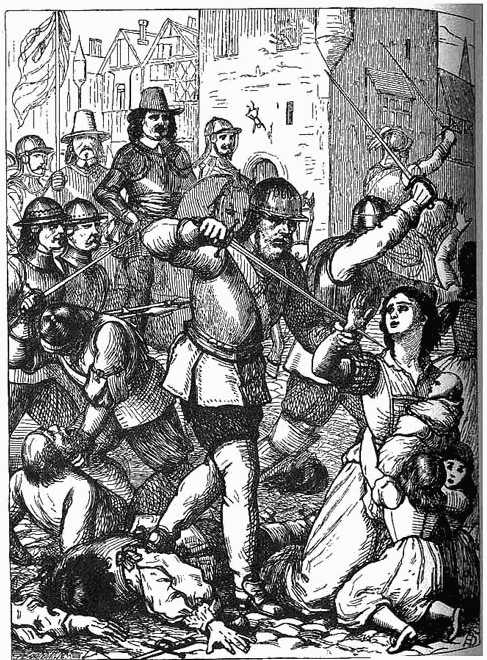
We lost even more of our ecclesiastical treasure during the reigns of Henry VIII, Elizabeth I, James I and Charles I. Monasteries with their fertile land, fish-filled lakes and brimming coffers became targets for opportunistic soldiers and civil servants in the enforced dissolution of the monasteries, destruction of the mother church and introduction of the new, imposed state-controlled established church, anglicanism.
Image result for cromwellian religious hatred
Then finally, in the late 17th and early 18th century, came the total destruction of the old Irish order and our unique dare I say it, the non-European system of government, alliances and land use, all swept away by the English resulting in the killing of half the population in war and famine, the confiscation at gun-point of all the lands of Ireland, the destruction of the old Irish agricultural system based on cattle,  the enclosure of our fields for cultivation and rent, and finally, he slaughter of the relics, in a systematic and deliberate theft or destruction of the symbols of our christianity, idolatry to the invader, during the Cromwellian and Williamite pogrom, leading to the complete subjugation of Ireland to British Rule, and including the complete proscription of the Catholic religion during the Penal Laws. 


What had survived through the earlier difficult centuries with the help of Irish and Norman patronage, was now swept away entirely, lost forever, our past glory, gone, without trace. Churches allover Ireland burned, stripped of their glass and lead and timbers and carvings. A thousand years of Irish christianity and all that was associated with it, demonised, destroyed, stolen, eradicated.
Yet, despite these incredible odds, some church artifacts have survived, showing us just exactly how incredibly sophisticated and learned were our fore-fathers.
Image result for cross of cong
The Book of Kells, The Cross of Cong, the Ardagh Chalice, St. Patrick's Bell, and so many more gloriously executed items that survived, and now define our past relationship with God. 
Some were plundered, but survived being broken up, or melted down. Some were hidden in churches and homes, protected from destruction, but cosseted from view. Others were lost, perhaps in times of danger or attack, or simply hidden and mislaid. Either way, we are fortunate that so much has survived. We can gaze in awe at the astonishing skill and faith of our forebears. The Derrynaflan Chalice is one amazing example. 

So also is this item below, the Moylough Belt. Moylough, in the southern part of County Sligo, was under the protection and support of the O'Connors, the last high kings of Ireland and a family who more than many, oversaw the creation and ultimate survival of  so much of our church history
Just imagine if you lived in that era. What was Ireland like? Imagine what the people were like? That's the sort of conversation I have with my guests on my Walking Tours of Galway ... and hey, everyday is a school day! (Nah, school was never like this). 

Brian Nolan, Galway Walks - Walking Tours of Galway www.galwaywalks.com or @Galwaywalks on Twitter and Instagram 

The Moylough Belt
"Dating from the 8th century AD, the Moylough belt shrine is one of the great treasures of early Ireland. Fashioned out of bronze and silver, it was found in 1945 by Mr John Towey as he dug turf on his father’s farm at Moylough, Co. Sligo. Slicing through the soft peat, he unexpectedly hit something hard at depth of c. 4 feet below the surface. Presuming it was a large stone, John bent down and cleared away the soil with a small garden trowel. To his amazement, what was revealed was not a stone, but instead, a glistening, metallic object. The Moylough belt shrine had been discovered.


The belt consists of four bronze segments, each of which enclose a strip of plain leather. The bronze sections are richly decorated and are also hinged together, so that the components are flexible. This means that the belt could, if desired, be placed around the waist. Indeed, wear patterns visible on its surface suggest that it was often worn/used.
Each of the bronze segments contain a centrally placed medallion featuring a ‘Celtic cross’, while their ends are further ornamented with panels of stamped silver foil or openwork bronze. The most elaborate decoration is seen on the two front segments, which take the form of a false buckle and buckle plate. These are embellished with silver foil, glass and enamel, as well as animal and bird head motifs.
This beautiful artefact more than likely represents a shrine that was specifically made to encase the leather segments. It is these simple leather strips then, and not the costly casing, that are the real treasure. They were probably associated with a local saint and must have been important relics to have been so richly adorned.
Photos: National Museum of Ireland
Sources
Duignan M.V. in O’Kelly, M. J. 1965 ‘The Belt-Shrine from Moylough, Sligo’ in The Journal of the Royal Society of Antiquaries of Ireland, Vol. 95, No. 1/2, Papers in Honour of Liam Price.
O Floinn, R. 2003 ‘The Moylough Belt-shrine’ in J. Fenwick (ed.) Lost and Found, discovering Ireland’s past, Wordwell, Bray"

Monday, 2 December 2019

The Emergency

Military ‘attack’ on Loughrea, February 18, 1943. The report in the Connacht Tribune on the 18th of February 1943 reads as follows; "From 2p.m. to 6p.m. on last Sunday, large-scale exercise in which all of the voluntary services of the district took part, were carried out in Loughrea. The town was “attacked” at 3 o’clock from all sides by L.D.F. units from neighbouring villages, while units from the town defended. Incidents arising from these engagements brought the L.S.F. into action and this branch had a busy time dealing with attempted “bank robberies”, “looting of food depots”, etc."
I think this photograph may have been taken on that day the mock invasion 'exercise' took place. 
The photo reminds me of that BBC TV series, 'Dad's Army'. It was taken outside the Court House on the Fair Green, by the lake in Loughrea. It shows the Loughrea LDF, or Local Defence Force, taken some time during 'The Emergency'. The 'Emergency is the Irish euphemism for WW2. Most cars were banned from the roads for the duration of the war. Travel was severely restricted. Food and other necessities such as tobacco and tea were rationed. Men and some women, who did not toe the line or were known firebrands were interned in the Curragh military camp without trial. Strangers, were all treated with suspicion, as potential spies. The army was beefed up and our borders and ports protected. We were at war in all but fact. 
As a country, we Irish tried to stay out of the war, though it waged all around us for 6 years. We remained 'Neutral' during the second world war, mainly because our government under Eamon DeValera could not countenance or stomach the idea of Irish men fighting for the Union Jack, only 20 years after our own war of revolution against the British and then our Civil War, which like all civil wars, was not civil in any way. Suffice it to say, while the Irish love a good fight, this fight (WW2) was not ours. 

Some men from Loughrea went to Northern Ireland or took the boat to England and signed up for military service, and while the country officially vilified them, privately, many Irish people supported or even envied them, despite the danger, they wanted to see an end to Hitler's tyranny and were willing to risk their lives to see that it happened. Loughrea had a history of fighting, having had many men serving in the British regiments in WWI, or engaged in the Volunteers during our war of independence and our civil war. Loughrea even had men volunteering to fight in the Spanish Civil War, on both sides. By 1943, fully half of Loughrea's men-folk were enlisted in the professional Irish Army, or were volunteers in the LDF, the volunteer local defence force (later the FCA). I remember my dad telling me that the LDF group he joined in Tynagh and Duniry placed huge trunks of trees across large fields in the locality to deny the enemy a landing field for aircraft, much to the annoyance of the local farmers. 

All across Ireland LDF men were engaged in making sure that house lights were covered at night so that overflying aircraft would not be able to identify which part of Ireland they were flying over. More were tasked with taking down and hiding all local signposts, or worse, putting them back up in entirely irrelevant places, or pointing them in the wrong direction. They even painted over the names on schools and halls, so that the invaders wouldn't be able to orient themselves in an invasion. Others were keeping watch should aircraft attempt to land, or catching any spies who may have been abroad on the roads at night. It gave folks a sense of being involved...don't forget Europe was at war and though we were neutral, many men felt we should have been involved, on the British side, though a minority were republican and German sympathisers. Thus, by definition, the expected invaders would be Germans, not British. Ironic eh!

Dermot Harrison (RIP) who owned a drapery shop on Main Street in Loughrea, once told me of the night in April 1944 that Loughrea was 'invaded', though this attack was not a planned LDF exercise. 
The LDF in Loughrea only had one 303 Lee Enfield rifle in their 'arsenal', and though a relic from the British army in WWI, it was still a lethal weapon. Some of the LDF men had shotguns and 22 rifles, but there was only one big gun in town, and everyone of the men wanted to be carrying that weapon when the invasion actually happened. Consequently, that sole 303 rifle was rotated amongst the volunteers, passed by rota, from one LDF member to another LDF member each night, to the person who was to be the nightwatch sentry, 'on duty' that night. To add insult to injury, they also only had one clip of five 303 bullets as ammunition for said Lee Enfield, and there were strict instructions from 'on high' that those five bullets should only be fired if the town was in 'mortal danger'. 


And so it came to pass on that April night in 1943 that it was Paddy Bowes' turn to stand guard. (Bowes house is now Beatty's, beside AIB, and formerly Nolan's, my parents home for 50 years). Paddy Bowes was not your average guy, in fact one could say Paddy Bowes was prone to excitement, and certainly not to be trusted with even a toy pistol, not to mind a Lee Enfield Mark III 303 rifle with a range of 2 miles.

Dermot Harrison described to me the absolute shock and terror of being woken from his slumber around 4am by a volley of shots from a few doors up the street, Paddy Bowes's house. It had finally happened, the long threatened German invasion of Ireland had started and Loughrea was in the thick of it. And wouldn't you know it, Paddy Bowes was the lucky man 'on duty' with the 'big gun'. Dermot related to me the thrill he felt, the adrenaline rushing through him as he tripped down the stairs in his under-clothes and out into pitch dark Main Street, ready to do his bit and die for Mother Ireland, or at least surrender gracefully, hopefully the latter.  

Up and down the town the story was the same as the brave, and the not so brave LDF men leapt out of their comfortable Main Street beds, bidding goodbye to their still slumbering wives, while gainfully pulling up trousers and galoisses, and grabbing hurley sticks or broom handles or kitchen knives, before rushing out onto the street as they's been drilled to do, to mount a defense and stop the Nazi invaders in their tracks at the entrance to the town at West Bridge or Bride Street, only to find a wide-eyed Paddy Bowes, in his undershirt, barefoot, still waving the rifle around, and obviously delighted with himself, thumping his chest, totally on a high. 

Men gathered around Paddy on the rapidly filling street, excited, relieved that the danger had passed, leaning into the knot of men, and him telling anyone who'd listen that he'd gotten two of the bastards, shooting one right between the eyes, the other in the back, loosing off the remaining three bullets in the clip, before the third one fled over a gate into the laneway behind Sweeney's hardware. 

"I got them lads, I got them, killed two of them winged another!' A great hurrah from the men, though some were still nervous, still expecting that a squad of German stormtroopers would round Brogan's corner any minute, or worse, a tank and they'd be looking for vengeance, out for blood, all because of trigger-happy Bowes.

Finally some order began to descend. An NCO from the Hibernian Bank arrived on the street, and it was noted by some that like all NCO's, he hadn't been first to answer the call, to risk all for the town. No, he'd waited 'til the worst of the fighting was over before coming to claim the credit, and the rifle!. He cleared a path to the now famous Paddy Bowes and in officer fashion, took the rifle from Paddy's hands. 'I'll take that Bowes, Good man, now, which way did they go, how many did you see, where are the bodies of the two dead Germans?' 

"Germans? Germans? Whaddya mean Germans?
It's cats I shot, not krauts, I shot the bleddy tom cats on McInerney's roof, had me awake all night with their squealing and wailing! Well they won't be doing that again, no-sir-ee ... bang, bang, bang, ya should've seen 'em fly, deadly, jeez I'm buzzin'!' 

Well, I dunno if Paddy Bowes is in that old LDF photo or not, but if he is, then it was definitely pre-April 1944.

Photo credit to Laurence Smyth for the LDF photo via Loughrea Memories on Facebook. 

Monday, 4 November 2019

The Dead, Love, Loss and Licence.

Michael Furey's burial place is immortalised in the last lines of James Joyce's short story, 'The Dead'. Michael was Greta Conroy's first love and was the foil for her husband, Gabriel Conroy's jealousy in Joyce's beautifully poignant short story, which was the final story in his first published book of short stories, 'Dubliners'.
Later in her own autobiography, Nora Barnacle (James Joyce's wife), who lived at 4 Bowling Green, opposite St. Nicholas Church, mentioned her first teenage crush on a young Galway boy, Michael Bodkin, who died on the 11th February 1900 of 'consumption' or 'TB' in the Galway Fever Hospital, in what later became 'The Men's Club' in NUIG and is now the 'Centre for Global Women's Studies'.
Michael Bodkin is buried in the family vault Rahoon Cemetery and there is a plaque to this connection there, and Joyce's poem, 'She Weeps over Rahoon'. There was a plaque at Richardson's Pub on Eyre Square, beside which, in a small sweet shop on Prospect Hill, he had lived and where Nora visited him. He was older than her and probably blissfully aware of her interest in him, but nonetheless, Joyce personified this young love between Nora and Michael Bodkin in the strained relationship he so perfectly described in 'The Dead', between the fictionalised, but easily recognisable, Greta Conroy and Michael Joyce.
These final lines refer to a grave in Oughterard, where Nora's father was buried, having long been estranged from her mother in Bowling Green. Joyce loved the song 'The Lass of Aughrim', having heard Nora Barnacle's mum sing it in the little house on Bowling Greet in 1909, and that song, tellingly also appears in 'The Dead', so typical of Joyce to turn the knife, again and again. Have a listen to these last lines from 'The Dead', it's very short and very beautiful and James Joyce and Nora Barnacle's own relationship, and their relationship with Dublin, Galway and Ireland are resonated in every line.


The last Lines of 'The Dead' .... see https://youtu.be/A_-KlGCSCJE

Friday, 1 November 2019

The ghost 'lady' of Long Walk, Galway

The ghost 'lady' of Long Walk. 
In October 2012, the Galway Independent (another Galway ghost newspaper) reported that photographer Jonathan Curran was “freaked” when he noticed he'd captured the image of a lady in a cloak when taking photographs of the end of Long Walk (beside where the mud-dock is). He took 12 other pictures and the ghost 'nun' did not appear in any of them, just in the one photo. The long Walk, he decides, was 'haunted'!

Since then the 'paranormalists' in the city have debunked the photo, rounding on the photographer for his ghostly photo-shop stunt. But was he trying to pull the wool over our eyes, or did he actually inadvertently capture the spectral image of a woman from another ear. 

That is what our ancestors believe that 'Samhain' was all about, where spirits could slip through the crack between the fabric joint at the end of the old year, where it met the beginning of the new year. Could the spirit have been seen through this ethereal tear between the two years, just for one split second, becoming visible to us humans, and the photographer, a glimpse of the otherworld, that parallels ours, a continuous, perpetual reliving of our world, and theirs, with occasional glimpses of one from the other? Who knows, maybe that is what ghosts are, faint and random glimpses from their timezone to ours, from another life, a parallel, and previous one, where the cracks have appeared in their zone, and through the cracks we catch a glimpse, the ghostly images we see sometimes reported,especially at Halloween. 

Whatever this photo is, the garb she is wearing is unmistakably a Kinsale or Kerry or Galway cloak, which were worn by Irish women, to cover their indoor clothes, protecting them from the dust and dirt of 19th century Ireland, and providing them with shelter from the weather and perhaps a bit of anonymity too, especially if she'd prefer to remain out of sight, unrecognised, given the male-dominated nature of our society two hundred years ago, much as a burqa or hijab provides to women in the more closed muslim society today. 

Was this a ghost, or a fake? If it was a ghost was she a victim, or just a phantom? Was she drowned, murdered, a suicide, an accident, or was she simply slipping out of her 19th century cottage to enjoy the tidal effect on the constant in our world and her's, in Galway, the river Corrib? 

I guess we will never know. 


With thanks to Alan Micheal Fahy and Galway Memories for prompting this story. Galway Walks, Walking Tours of Galway. Haunted Tours. Ghost Tours. Horrible History Tours.

Monday, 21 October 2019

Pádraic Ó Conaire

Pádraic Ó Conaire, 
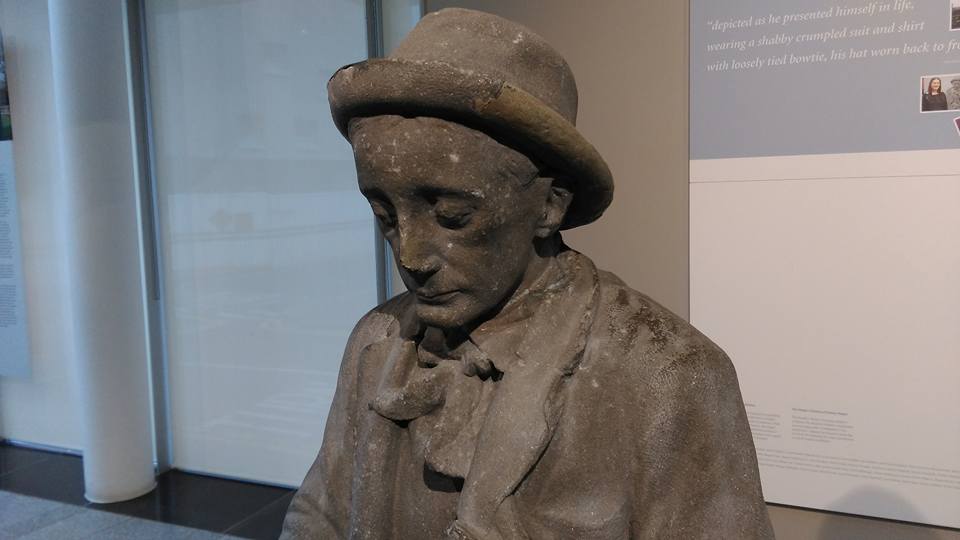
(28 February 1882 – 6 October 1928), was only 46 when he died suddenly in Dublin while visiting his employer, The Gaelic League. Born in his father's house, a bar on the docks in Galway, he was orphaned by age 11 and moved to his uncle's house in Rosmuc where he became fluent in Irish. He moved to London in 1899 and started writing in the Irish language there. He married, had 4 children and moved back to Galway in 1914, writing many books and stories, he was perhaps the first modern writer of fiction in Irish. The then Taoiseach Eamon De Valera had the first statue of him erected in Eyre Square in 1935, which was removed for safety to the Galway museum some 15 years ago after being decapitated by some over-friendly students, and was only replaced by the new green statue in the square two years ago. 


I missed his exact anniversary, 6 October, but wanted to mark this largely forgotten Galway writer's 91st anniversary with a post and a few photos. I must confess, I never warmed to the few pieces of his huge trove to work that I read in my student days, but perhaps I will revisit and try again. He lived for a short while in Salthill, roughly where The Nest is located now. He is settled into the square now, though sometimes I think he is pining for the two cannons that used to flank his old statue in the square, but now grace the lawn in front of City Hall today, neither frightening our politicians, city civil servants, nor even wayward Connacht supporters! I think they'd look great planted either side of him, protecting his flanks, painted the same verdis green, they might perhaps scare away the students, and the drug-dealers and make a rather unique, heroic tryphich! 


A paean for the forgotten.

'Cannon to right of them,
Cannon to left of them,
Cannon in front of them
Volleyed and thundered'


Yes, if they move the cannons back, I promise to read all of Padraic's books. 

Deal?

With apologies to Alfred Lord Tennyson.