Friday, 11 September 2020

The Avengers

Diana Rigg (20 July 1938 – 10 September 2020), passed away yesterday, leaving those of us of a certain age, and of a certain sex, totally bereft.

She was the original pin-up girl for my generation, with her sultry looks and her daringly revealing cat-suit, she fairly set our hearts to racing. She played Emma Peel in the TV series 'The Avengers', and she, and her 007-partner, John Steed, played by Patrick Macnee, always got their man, and us too, every time, in that long-running, 51 episode, BBC spy-series which ran from 1961-69, leaving an indelible mark on our deeply-troubled and pubescent imaginations.
A few years ago, I asked a school-boy friend of mine, Pat Kilboy, the old chestnut, as to whether he dreamed in 'Black and White', or in 'Colour'?
I was hearkening back to the days of Black and White TV, which was standard issue in Ireland, well into the early 1970's, and not just that, we also only had one TV channel, RTE 1.
His answer to my question was ...well, very specific to the time we lived in. His dad had a few cows whose milk sustained the growing and extended Kilboy family. That was not uncommon in towns and villages all around Ireland in the late-1960's. Many families were self-sufficient in ways that are alien to us today, having their own vegetables, pigs (bacon), chicken, and milk.
Pat, the eldest child, used to be tasked to go to the pasture, a mile or so outside town, at the top of Mount Pleasant hill, where his dad's cows were grazing and bring them into town, to their back-yard milking parlour, where they would spend the night. They would be walked back to the field the following morning, again by Pat, before he went to school.
Needless to add, all chores, then and now were just that, chores, inconvenient ones at that, and always had to be done at awkward or unsuitable times, for us busy kids at least. I had to walk my dad's greyhounds, up and down that same Mount Pleasant hill, racing dogs in training, walked at a fast pace, hardly stopping to sniff a lamp-post, and in doing so, Pat and I often said hi, and bye, as we escorted our very different charges, in opposite directions before our breakfast or after our tea-time.
I was a few years younger than Pat, who was perhaps 12 years of age when The Avengers series started to be shown on our single-channel TV service, an event that changed our lives, completely.
His answer to my half-in-jest question about his dreaming patterns went like this;
"I dreamed mostly of Diana Rigg (Avengers). We had 3 cows for milking to be brought in to town in winter evenings. I bet the ass off them going down Mount Pleasant to be in time for the Avengers. Me dad wondered why the milk yield was down. If he saw them running with udders flying he'd wonder no more."
Which meant of course, that Pat, and I, and many's another boy in Loughrea, dreamed happily, in glorious B&W.
Rest in Peace, Diana Rigg, and thank you, your job here is done.

Thursday, 10 September 2020

Collecting Kelp, Connemara, 1911


 This painting titled 'Collecting Kelp, Connemara' was painted in 1911 by William H. Bartlett, ROI, (1958-1932) and was sold at auction in 2015 for €10,000, considerably more than that ever earned by the kelp-gatherers of old.

A 'weed drag', is a type of long-handled, bent-tine, fork used for clearing rivers and lakes of weed. Seaweed gathering also utilised a drag fork like this, even today. Along the Connemara coast, in shallow bays and rocky inlets and islands, a variety of seaweed called kelp was cut above the root with a knife/saw attached to a long pole, and it then floated free. The buoyant kelp was gathered into floating piles or rafts, called 'cleimins', and towed, or poled to shore, or, if further out, on an island or deeper water, the weed was dragged into the boat with the special bent fork, brought to shore and spread along piers or walls to dry.
Harvesting seaweed on the Atlantic shore was hard and cold work, standing waist-deep in Autumn seawater, out below the low-water mark, cutting the seaweed by hand, and gathering it into bundles to be floated to shore. From there, someone had to carry the cut seaweed in bundles from the foreshore, up to the place where it was to be dried, before it was collected and loaded onto boats to be processed in Galway to extract iodine and potash. Men usually did the cutting and harvesting of the seaweed, while the women and children had the task of hauling the heavy, cold, wet, sea-sodden, smelly seaweed inshore. No seaweed baths needed for those hardy folk.
When the seaweed had dried it was burned in-situ, in sheltered rocky areas, to produce alkali or iodine. Alkali was an important and necessary commodity in the soap, glass and textile industries and
was manufactured from the burned ashes of vegetable substances (potash, kelp and barilla). Iodine became important for the advances in medicine and photography in the 19th century.
Archaeological evidence for the kelp industry includes kilns, drying-walls and storehouses which are found all along the Atlantic coastline from Wexford to Antrim.
From the 1850's the dried kelp was transferred by boat, usually Galway 'Hookers', from the scores of harbours along the coast, and from the Aran islands, to the Claddagh quay, and then carried onwards on smaller boats, through the locks on the Eglinton Canal into the Corrib, and on to Menlo where the Galway Iodine Works was located. There it was burned and iodine was extracted. The remainder, ash mainly, was used as fertiliser, and also used in the photographic, munitions, bleaching, glass-making, soap-making, ceramics, salt and linen industries.
The business of converting seaweed to iodine was very labour and fuel intensive, quite polluting, and was subject to.and later on victim of, competition from European and S. American sources of potash.
After WWI synthetic iodine replaced seaweed iodine, and that seaweed-based industry became obsolete. Seaweed was also harvested and burned locally, to produce fertiliser, though that practice has also died out, and was never really sufficiently financially rewarding to be sustainable.
Seaweed is still harvested in Connemara, and elsewhere on the Irish coastline, and is used to produce ingredients for cosmetics and food-additives. It is now collected 'wet' and does not have to be dried on the walls along the coast. Controversy still surrounds the sale of seaweed-collecting rights in Connemara to a Canadian cosmetics company, Arramara, around 2014.
You can buy seaweed to eat, Dulse and Carrigeen, to enjoy at home, from several Irish companies, healthy and worth supporting. You could also go for a seaweed bath, Leenane and Enniscrone are two of several locations on the west coast where such baths are offered today. Indeed Salthill, Galway was originally a victorian seaweed spa town, where folks took the salt air and the baths, for health in the late 19th century. The seaweed baths were where Seapoint now stands.


Brian Nolan

Tuesday, 4 August 2020

Canary in the Coal-mine - The demise of the Irish Pub


Canary in the coal-mine! The demise of the Irish Pub.
Dessie O'Brien, whose pub in Kilrickle, between Loughrea and Aughrim, like thousands of others around the country, is Covidly-closed until the 1st of September, at least.
This man has put his all into keeping a beautiful, historic, culturally important rural pub alive. Over the past few years he has absorbed the missing grocery, the out of business newsagent, the the closed post office, and the non-existent coffee shop in the little village into his pub, re-inventing his welcoming hostelry as a catch-all, sell-all, serve-all, help-all 'general store and pub', a haven to provide a place of welcome and support for the good people of this rural hinterland, forgotten and by-passed, consigned to the rural dung-heap, so maligned by urban politicians, upwardly mobile urban civil servants and uncaring urban media.
Yet the people remain the same, strong, resilient, faithful, christian, talented, industrious, hard-working, friendly, community-oriented country folk, who like nothing better than to throw off the cares of a long day tending their farms (or double-jobbing to keep their farms), by popping into their 'local', for a pint and a chat, a friendly catch-up, a physical and conversational interaction, a local news bulletin not covered by RTE or GalwayBayFM, a face-to-face dialogue with a real, not a virtual 'friend'.
Psychologically, this pub (and all the others like it) is on the front-line, it is the tipping point, the fracture-joint, the point of no-return, for rural Ireland.
This crisis is akin in every way to the worthy efforts to 'save the corncrake and the curlew'. The rural pub is now firmly on the endangered list, threatened with imminent extinction!
Who cares you say! Who indeed... but mark my words, when these unimportant, unassuming, unnecessary rural pubs fail, close and disappear, and the dust settles, you will then be able to see the long line of dominoes tilt, and tip, and fall, bringing with them a treasury of cultural and community icons, the traditional music, song and dance scene, the art of story-telling, the local history buffs, the animal husbanders, the quaint cottiers, the characters, the quiet men, the wise women, the happy-go-lucky kids, the drop-outs and the geniuses, the cute hoors and the spiritual believers, the farmers, and the farm-hands, the hermits and the herb-growers, all of whom form and inform the very essence of rural Ireland, all of whom rely on the soon-to-be forgotten Irish Pub.
My words aside, this two photograph speaks volumes.The poignancy of these two images of Dessie O'Brien's empty, closed pub in Kilrickle brought a tear to my eye and a lump to my throat tonight. 
This poignant photograph of the empty pub reminded me of a song from the musical 'Les Miserables'.. 
'Empty Chairs at Empty Tables'.....

Tuesday, 21 July 2020

Mystery of the missing Menlo Castle Doorway.

In July 1907, James Joyce and his young son Giorgio, briefly visited Galway to meet his mother-in-law, Annie Barnacle, Nora's mother, for the very first time. They got a great welcome by all accounts and that led to a 3 week family visit by the entire Joyce family, a kind of belated honeymoon, in July 1912.
During this visit, Joyce toured Connemara, visited the Aran Islands, went racing to Ballybrit and attended the Galway Regatta, watching the hotly-competing boats from the slipway at Menlo castle, ancestral home to the Blake family for five centuries, and major sponsor of the Galway Regatta, but it was by then, in 1912, completely in ruins, having burned down in an accidental fire in 1910.
Built in 1569 by the powerful Blake family, the castle accidentally and tragically burned down on 26th July 1910 claiming the lives of three women, including the owner's daughter, Eleanor Blake. Sir Valentine Blake never rebuilt the castle, perhaps his fortunes had changed or maybe he could never again contemplate living in the house his daughter had died in. Who knows?
Today Menlo Castle's ivy-shrouded windows and tall, stark chimneys stand sentinel over fishing boats, river cruisers, kayaks and racing sculls as they speed past, parting it's haunting reflection in the Corrib river.
The city of Menlo Park, in California is named after this castle and village. The Californian city was so named after a farming ranch owned by Denis J Oliver and DC McGlynn, who had emigrated to the US from Menlo, and went to seek their fortune and find some gold in the 1849 'Gold Rush'.
They, did find gold, and bought a tract of land, the Menlo Park Ranch, named after their native village, around 1854. Later when the Trans-America railroad came through their land, the railway station was named after the Menlo-men's ranch, and later still, the city of Menlo Park, which had grown up around the rail-head, was incorporated, a unique link to the Menlo Castle ruin.
There was some 'talk' about the castle being restored, even mention of turning it into an apartment development, with a penthouse apartment being incorporated into the secured facade. There was also some laudable mention of a plan to make the castle into a heritage centre along the lines of the Museum of Country Life in Castlebar. Certainly, the ownership was in doubt, but it is now apparently owned by Galway City Council, but I cannot verify that.
All through the twentieth century the castle has been an iconic landmark for those traversing the river Corrib, though hardly noticed otherwise, nestled in a somewhat hidden site three miles from the city. Up until the 1980's one could rent a boat at the Boat Club by the university and row up to the castle ruin, docking at the still extant slipway that James Joyce had stood at while watching the Galway Regatta, which is still held annually.
People taking their dogs for a walk, players and athletes playing sports on the University pitches at Daingean are treated to a splendid view of the castle on the opposite river bank.
In the 1930s, a photographer named Domhnall Ó Cearbhaill
working for the National Folklore Collection, took two black and white photographs at Menlo Castle, one featuring a young boy. That photo with the boy, was recently colourised by 'Old Ireland In Colour' and that is the photo that caught my eye during the week.
The photo of the boy is, well, ordinary. The boy is nonplussed by the camera, perhaps impatient, wanting to go play in the castle ruin. By the way, his identity is unknown, he may even still be alive today, so yes, does anyone know his name?
Boy aside, what really caught my eye was the archway under which the boy is standing. It features three fabulous carvings, and judging by its dimensions and decoration, it was probably the front door of the castle.
If you look closely, you can see the buckling of the slates above the arch, testament to the ferocious heat generated by the fire, some twenty years earlier.
My question is where is that arch and carvings now? There is not an arch or a carving in Galway as interesting as this in Galway today, yet this one has completely disappeared!
No trace remains. Was it vandalised, stolen, or sold off unscrupulously by persons unknown? Or was it safely taken down and preserved, perhaps stored away in a private or public collection?
So, today's quest is to ask what could have become of this unique, historic Galway doorway, that if it still exists, should really be preserved and celebrated. Wouldn't that be cool?

Photos featured in this post are from various sources, including some of my own photos from Walking Tours of Galway. Some have appeared on this page before Galway Memories and others on Old Ireland in Colour
Thanks for your time, I hope you enjoyed reading, and yes, please do share and comment.


Cure for nettle stings, cuts, colds and gearragrúiscín!

In the summer months, children all over Ireland went barefoot, casting off their winter boots and setting their feet free. 
Remember the line from the popular song, 'Galway Bay',  'And watch the barefoot gasoons at their play'. 

However many of them suffered a 'gearragrúiscín', or foot-cut, while walking or playing barefoot, but thankfully, there was a readily available cure in every field, which everyone knew about.

Ribwort Plantain, 'Plantago lanceolata', is a very common weed all over Ireland. In the Irish language, it is known as 'Slánlus', though in the english, in Ireland and UK, it is known variously as ribwort plantain, ribleaf, and lamb's tongue.

Though commonly found in America, it is not native to there, having been introduced there by Europeans.

Here in Ireland, it has been used for probably thousands of years as a curative plant with antihistamine qualities.


Drank in a tea, or broth, it was good for a cold, or a sore throat, and applied directly to the skin, it heals cuts, stings and bruises. It's the best leaf to rub on a nettle sting, (not dock-leaves, which apparently are only a placebo, and only psychologically effective! Yep, go figure, they lied to us!)

'Slánlus' is mentioned in the Irish Schools Collection (1938) under 'cures'. in nearly every county. Here's a mention from Tankardstown, county Tipperary. 'Slánlus leaf bruised and mixed with unsalted butter will heal a cut.' And from Cruit Island, county Donegal. 'Slánlus:- Nuair atá duine geartha agus é ag cuir fola cuireann an slanlus stad leis. Fasann sé achan áit fríd na cuibhreann.' and from Clifden, county Galway. 'When barefoot children in harvest time suffer from 'gearragrúiscín' i.e. a painful cutting under a toe or toes caused by 'coinlíns' in the field, the best cure is to apply raw 'Slanlus' (or Paddy's cabbage) and bandage. Slanlus is the handy application for all kinds of cuts. The clean leaf is pressed into the gushing blood where it soon sticks fast. It is not removed until the wound heals.'
Nowadays, I am reliably informed that the buds when eaten taste just like mushroom. Chefs use the leaves and buds when making mushroom soup, apparently. (note to self, 'ask J. P. McMahon about 'Slánlus')

'Slánlus' or Ribwort has achieved popularity in America as a panacea for many ailments. Take some of this info below with a grain of salt, but, yes, don't ever look at those thin ribbed leaves, and brown headed stalks with the white crown in your weed patch in disdain again.  

'Plantain has often been the go-to remedy for hikers plagued by mosquitos. Because it draws toxins from the body with its astringent nature, plantain may be crushed (or chewed) and placed as a poultice directly over the site of bee stings, bug bites, acne, slivers, glass splinters, or rashes. Bandage the area and allow the plantain to work its magic for 4-12 hours. Plantain may also be used to create a balm for emergency kits, or an infusion used as a skin or general wash. It is also a notable, soothing remedy for hemorrhoids.

Plantain is renowned for its healing effect on the digestive system. This is especially useful for anyone who has been damaged by antibiotics, anti-inflammatory or pain medications, food allergies, or Celiac disease. Both leaves and seeds specifically target the digestive system for healing. The leaves may be steeped as tea, added to soups, or dried with a sauce similar to kale chips. The seeds – a type of psyllium – can be ground or soaked for bulk mucilage or absorbable fibre, which, consumed before meals, may help with weight loss.

Because plantain is a gentle expectorant and high in silica, an infusion can be helpful for lung problems, coughs, and colds.
Plantain is almost a panacea for the human body, treating everything from all menstrual difficulties, all digestive issues, to nearly all skin complaints, and even arthritis. Add to salads, chew to ease thirst, or enjoy in stir fries. This versatile wild vegetable will keep you in good health for years to come! '


Ribwort Plantain - Slanlús - Plantago lanceolata.

And you, waybread, mother of worts,
Open from eastward, powerful within,
Over you chariots rolled,
Over you queens rode,
Over you brides cried,
Over you bulls belled;
All these you withstood,
And these you confounded,
So withstand now the venom that flies through the air,
And the loathed thing which throughout the land roves.

From Niall Mac Coitir's book Irish Wild Plants.

Plantain, being one of the nine sacred herbs to the Alglo Saxons was held in high esteem.

Known to the native Americans as white mans foot print, this humble weed follows us everywhere. You can't get away from it, but why would you want to!

An ancient cure for many ailments.

Plantain is our go to herb for wounds of any kind, simply chew it up and put it on or make it into a salve to have at hand. Plantain will miraculously draw out poisons, stanch bleeding, quell infection, reduce pain and heal. So much so that it is reputed in America as a cure for snake bite, saving lives!

Plantain proves to be equally as powerful taken internally, working its way around the body and infusing us with its healing properties. Drawing poisons and infection from the body, plantain diligently assists urinary, respiratory, digestive and other systems prone to infection.
A gentle expectorant and mild emollient, soothing mucus membranes.
A powerful anti-inflammatory and moderate astringent, helping to restore connective tissue and tonify.
Plantain works well in combination with other herbs.

Best used fresh Plantain can be gathered from spring to late autumn. It can be eaten fresh (although not to everybody's taste), brewed into a tea, tinctured, left over night to steep, frozen for later use or soaked in oil for use in salves.

*One must be careful using Plantain with other medicines as it may clear them out of the body, suspending their actions.

Thursday, 9 July 2020

A Skull in Connemara

Inishbofin, is an island off the west coast of county Galway and many Galway city folks have relatives there, or have spent a holiday there. This beautiful little island off Cleggan is in the news this week in a dramatic fashion, in an article that appeared in The Kerryman newspaper.

Martin McDonagh's darkly disturbing play, 'A skull in Connemara' was all about the not uncommon practice of recycling graves and relocating and destroying the bones and skulls of the dead, including coincidentally, the skull of the wife of the main character, who was suspected of murdering her twenty years earlier. Grim stuff indeed!
Back in the late 19th and early 20th century Craniometry, Phrenology and Physiognomy (look them up), were all part of a now-discredited, broad pseudo-science called Eugenics, which some of the greatest scientists and thinkers in the then academic world subscribed to, or at least dabbled in. It was a natural follow-on to the then darling of the press, and hotly dispute, 'Darwin's theory of evolution'.
In the end, thankfully, there was very little evidence to show that ancient or indigenous peoples, or physically different peoples or individuals were inferior, or prone to traits such as violence, laziness, lunacy, sexual deviancy and much more. Nor was there a superior race, an Aryan bloodline, that were naturally pre-determined and pre-destined to rule all others on earth.
It is not well known for instance that for decades, all emigrants (Irish included) who passed through Ellis Island on their way to a new life in America, were routinely measured, classified and described in a Eugenistically-inspired and informed manner, classifying millions of people passing through those halls, as likely or less-likely to succeed, or to contribute to America, or to end up in jail, or commit murder or rape. Imagine how that would play out today?
Yet traces of that thought process and theory still linger on in emigration policies and the treatment of indigenous peoples all over the world.
Henry Ford was a fan of Eugenics, but so also were many of the thought-leaders of the world. Hitler capitalised on this fascination about race, and predetermination, and the rest is unfortunately, a tragic history.
The theft of the skulls from Inishbofin and the Blaskets by a curious and over-zealous research student was neither unusual, nor at the time, criminal, but certainly, by our standards it was wrong, wrong then, and wrong now. And those skulls are just the tip of the iceberg, with millions of bones and 'samples' languishing in drawers and files in every university and museum of the world, bought or stolen or borrowed from grave-sites and others.

So yes, the skulls ought to be repatriated and re-interred in their home islands of Bofin and Blasket, with great respect and reverence, but also with a bit of pomp and pride, in the full knowledge that those skulls played a small but important role in debunking the whole idea of superior races and other racist theories. We can learn a lot from the past, mistakes are just another lesson.


Thursday, 2 July 2020

Swans and Cygnets

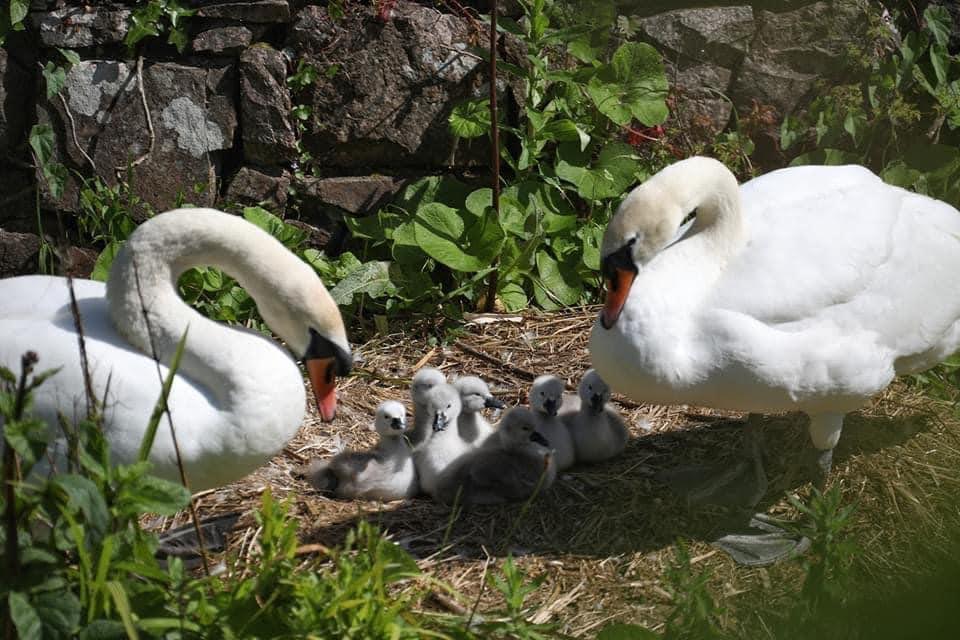
Swans and Cygnets. Galway, the 'city of the tribes', could just as easily be known as the 'city of the swans', we have so many of them on the waterways around town. But nature can be a cruel and heartless mistress. In the first photo, a grey crow is caught on camera snatching a young cygnet on a river in Cork (photo Finbar Buckley). The Grey crow, or Hooded crow (Corvus cornix) is a constant scavenger, eating everything from carrion to molluscs and everything in between. It is also an opportunistic predator and will eat mice, frogs, insects, young birds and even a baby swan.

Cygnets are at their most vulnerable in their first 8 weeks, when they are subject to being opportunistically preyed upon by grey-crows, herring gulls, herons, and even otters, mink or seals. The survival rate to adulthood of a swan clutch is less than 50% on Galway’s canals and Corrib river catchment each year. This clutch of 7 cygnets hatched on the canal behind the cathedral. Another clutch of 6 hatched on the canal at Mill Street.


Swan nests are usually on river banks or islands, a loose pile of reeds and grasses. The eggs, six or seven usually, though as many as ten, are laid in March/April and hatch in April/May. The female swan (pen) and the male swan (cob) take turns minding the nest, incubating the eggs. After 35 days of incubation, the cygnets all hatch within one day, and a day later they are swimming on the water beside their watchful parents. Sometimes they hitch a ride under the adults wings. The cygnet grows fast, but stays grey/brown for a year before their white plumage comes in, and then they have to learn to fly.


Galway hosts as many as 100 swans in the swan colony on the Corrib estuary by the Claddagh during the summer. We even have a swan-warden looking after their welfare. Please do not feed them white bread or mouldy bread as it gives the swans a condition known as Pink Feather which can prove fatal.
While they are numerous, only two or three pairs of swans nest in the city and raise young families each year. Most of the Galway swans over-winter on inland lakes where they have shelter from coastal storms and better grazing.


(Photos of swans and cygnets in Galway by Chaosheng Zhang who works at NUIG and takes and shares the most amazing photos. Photo of cygnets hitching a ride on the swan's back, by Andrea Whelan).

It is such a treat to see the swans each year, and I am truly fortunate to see them so often during my Walking Tours of Galway.