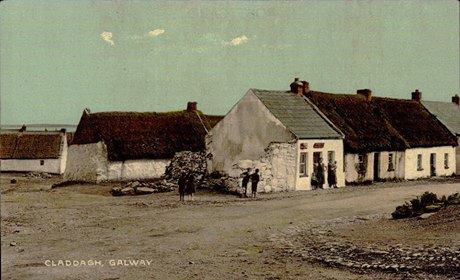
I know that many of you have been to Galway (or intend visiting ) and I am sure you have heard of the Claddagh village, which was on the west side of the mouth of the Corrib river, where it flows into Galway Bay. It was immortalised by Bing Crosby when he recorded the song 'Galway Bay' Remember the opening lines. 'If you ever go across the sea to Ireland, and maybe at the closing of your day, you can sit and watch the moon-rise over Claddagh, and watch the sun go down on Galway Bay'. There, I've got you singing already...yes, the lines are coming back to you now... 'the bare-foot gossuns at their play' ... young boys and girls, wearing no shoes, carefree, oblivious to the woes and tribulations that awaited them in their adult lives... aaah the innocence of it all.

Problem was, that by the time the song was being popularised all across America by the old crooner, back here in Galway, the city officials had decided to build Galway's first housing project, right where the iconic thatched cottages stood. To be fair, those cottages were already hundred of years old, stone-built, cold, damp and in many cases, because of poverty, they were in pretty poor condition and not fit for continued habitation in a modern Ireland, that was just shrugging off the yoke of the British empire.

So in due course over a period of twenty years or so, all the old whitewashed thatched cottages were demolished and replaced by modern, warm, if indifferent looking terraced houses. If there is a prize for the most-asked tourist question in Galway it surely has been 'Where is the Claddagh?' So many people ask that question everyday here that the locals were embarrassed to admit that there wasn't a single thatched cottage left. The wrecking ball had made a clean sweep of them all, the old Claddagh had become confined to black and white picture-postcards and vivid imaginations.
So you can imagine my delight when driving one day in the car, I noticed a guy unloading loads of thatching straw into a back-yard off Fairhill Road, in the Claddagh. My curiousity piqued, I paid the site a visit last week, accompanied by a good friend Tom O'Connor, owner of O'Connor's Famous Pub in Salthill. I brought Tom, not so much because I like him a lot, but really because he just bought some really cool camera equipment, and we made a little video blog which I called 'The first thatched cottage to be built in the Claddagh, Galway, in over a century'.

Like a phoenix rising from the ashes, we were fascinated to bear witness to the first thatched cottage in nearly a century being built in the Claddagh by a local family called Walsh. They intend to open it to the public in April 2016 and hope to call it Katie's Claddagh Cottage, after their grand-mother who had lived there a long time ago. Using entirely authentic traditional building and thatching methods, when it is finished, it will be an iconic gem in the heart of the old Claddagh village.
So, to cut a long story short, while we were there, picking our way through the building site, I got talking to the guy who was painstakingly weaving straw into the thatched roof, a master-thatcher called Eoin O'Neill, who came all the way from Waterford in the south east of Ireland to help get the new thatched-roof, just perfect. Eoin was really great fun to speak with and was a natural on camera too.
Eoin was using locally-grown wheat from Corandulla, county Galway to thatch the main roof and was using rye that was grown in Wexford for the comb or ridge of the thatched roof. He took a break from his work while I admired the roof-timbers before they were covered over by the rye and wheaten thatch.

The main beams on the roof were old scots-pine or bog-oak rescued from the bogs that cover much of Connemara. The rest of the roof is made of hundreds of ash plants, 2 metre long sticks or scallops, onto which the thatch will eventually be secured by means of twisted hazel wands, which are 'purloned' into the thatch and inter-laced with the ash cross-beams. The thatch is then tamped and pummelled by a special hammer and tied off with thin ropes, until it is as firm and as watertight as any slate roof, really warm, and with some maintenance good for thirty or more years. When looking at really old thatched cottages one can see a hundred years of thatch-layers one on top of the other, making for a delightfully artistic roof.
Looking up through the slatted scallops that comprised the rafters of the cottage I was struck by the frailty of the entire undertaking and was reminded of the old Irish saying, '
Ní hé
lá na gaoithe lá na scolb' - 'The windy day is not the day for thatching'.
The lattice-work of the inter-laced scallops dissecting the heavier cross-beams of the rafters reminded me of the warp and weft of the weavers loom. Soon the thatch will cover this natural web, and these patterns of light and heavy timbers will become the clothes of the house, not unlike a bolt of hand-woven tweed.
The shafts of winter sunlight filtering through the inter-woven sticks on the roof will soon be a distant memory, once the thick layer of rye and wheaten thatch is stitched onto the rafters by Eoin's skilled hands. When the cottage is fully thatched, this under-skeleton will be covered forever and in a month's time, really one could not imagine how such a thatched roof was constructed unless one witnessed a new-build such as this.

This is exactly as our fore-fathers would have made a cottage roof made from thatch, by gathering up locally available material, ash plants, hazel wands, bog-oak beams, driftwood etc. Most of the materials the older generations used were not bought from lumber yards or builders-suppliers, no, they were begged, borrowed, bartered and even liberated from bogs, woods, sea-shores etc. Collecting flotsam and jetsum from the shore would have been a common activity and hey, y'know, the best beams are ones that have been used before in another venture or vessel. Something with the patina of age, and the experience that goes with it, not brittle, but yielding and reliable.
Eoin made these 'bobbins', or 'skirts' by twisting and knotting sheaves of rye stalks, and then braiding them onto a hazel stick. These skirts will be pinned to the ridge to form the thicker top row of thatch at the apex of the roof and also to be additional protection around the chimney. Eoin's handiwork in fixing these bobbins to the roof is really evident when seen from above.


Here's a story! I remember hearing of one family who moved from a small tenant farm beyond Inverin, in west Connemara, to a slightly larger tenant farm, just east of Furbo, a little nearer to Galway city, in 1890. The two brothers, one wife and two children walked the 15 miles from Inverin to Furbo, carrying the roof-beams for their yet-to-be-built stone cottage, on their backs. Such was the value of a few long poles or spars back then! Their humble little thatched cottage saw 9 more children born and thereafter, 17 grand- and great-grand children, all born under the thatched roof that had been made by hand, using only locally grown or found materials, until the cottage was finally replaced in 2009 by a new slate-roofed bungalow.

I would have railed against a 'fake' Claddagh cottage, one built just for tourists to take selfies at. This is no fake. This is the real deal. I believe that this lovingly built, traditional, Claddagh cottage is set to become one of the must-see locations in Galway city for locals and tourists alike. Congratulations to the Walsh family and their hard-working friends on this unique venture to commemorate the iconic village of the Claddagh. Once the garden is in bloom and maybe with a few chickens in the 'street' this cottage will be a perfect example of how the Claddagh village houses would have looked.

They have a bog-oak studio at the rear of the cottage and intend selling bog-oak sculptures and tea and freshly-baked scones during the summer. You can sit in by the hob, and watch the busy cottage come to life. The turf-fire will be lighting in the big old fireplace and the half-door will be ajar, or half ajar, whichever! They hope to have various artists and crafts-people working in the cottage, perhaps even a claddagh-ring maker on site too, as well and having a warm, inviting cottage experience, showing how the people of the Claddagh lived and thrived on the shores of Lough Corrib and Galway Bay for the past five centuries.
I hope you enjoy the video. Click on this link to view Katies Claddagh Cottage;
https://www.youtube.com/watch?v=mP8klOF1vYo&feature=youtu.be&a
Tom and I hadn't planned making the video, and we certainly hadn't rehearsed my lines. If fact we did most of it in one staccato un-rehearsed take... so expect a few bloopers...and of course there was lots that we forgot to mention or talk about.
You can come on a walking tour of Galway with me anytime, just call or email me and we can meet up at a time to suit you and your family or friends. If it's wet and windy, I also give 'the shortest walking tour of Ireland, the fifty foot tour of O'Connors pub!' It's a Fireside tour that I give at 6pm any day at O'Connor's Pub, Salthill. A half-dozen or more people can come on that tour, winter or summer.
Thanks for reading. Come and walk with me sometime.
Brian Nolan. Galway Walks - Walking Tours of Galway
Website
www.galwaywalks.com Twitter @Galwaywalks
Facebook
https://www.facebook.com/Galwaywalks/
Phone 086-3273560 - email
galwaywalks@gmail.com
*Photo Credits - The photos are all my own, save for the shot of the bread being baked at the open fire, which I use with the kind permission of the Connemara Heritage and History centre.
 When St. Brendan got back from his travels discovering America in a small wooden and leather boat around 564 AD, he wrote a book in Latin, 'Navigatio Brendani' or 'The Voyage of Brendan', which, some 900 years later (1477) convinced Christopher Columbus that there might just be something out there beyond the western horizon.