Sometimes you just know that there are forces and energies all around us that we rarely experience, until the unexpected occurs. It all started with a mother's enduring love for her daughter and a promise kept. Cheryl Miller from Indiana walked into Liam Garvey's gift shop on Shop St. Galway on last Thursday and the die was cast.
It had been a wickedly wet day, her first day in Ireland, and having flown all night, driven in torrential rain across Ireland, she and her daughter and both their husbands checked into the Victoria Hotel, all of them exhausted. They hit the bed for an hour, to shake off the jet-lag, but they overslept, really overslept.. When they finally got their act together hours later, the rain had eased a bit, so they decided to chance a quick walk around the city and get some dinner. It was to be a fortuitous evening.
After they'd eaten, because of the late hour, only a very few shops were open. Cheryl was looking for a very simple Claddagh pendant, and luckily Liam's 'Galway Bay Gift Shop' stocked just what she wanted. As Liam wrapped Cheryl's purchase, he felt her subdued mood, not quite the usual tourist's high, and then he noticed her top, a printed T-shirt with a woman's photo on it. Liam inquired, to be told that it was the final photo Cheryl had taken of her 40 year old daughter Cynthia, just days before she'd succumbed to cancer, earlier this year.
Her wish, all during her chemotherapy was that once she'd recovered enough, she was going to fulfill her lifelong wish to visit Ireland, a desire she'd had since she was a teenager.
Alas, it was not to be. Life and chemotherapy can be cruel. Later on, Cheryl decided she would go on Cynthia's journey, a hard decision for a Mum grieving her dead daughter, and so it was she found herself in Liam's shop, telling her daughter's story.
Liam asked her what Cynthia really wanted to do in Ireland, and Cheryl told him that she'd talked incessantly about sitting in a pub, listening to an old man telling stories.
After she'd left, Liam called me, wondering could I give the family my 'Fireside Stories' tour in O'Connors bar in Salthill. I like Liam... he gets me, and my stories, so I said yes. It was already 10.30pm, but i called their hotel room anyway, only to be told that they were leaving Galway at ten am the following morning... heading for Killarney, so that was kinda that, no tour possible.
We talked a few minutes, hung up. That should have been it, but the next morning, I had an early walking tour.. at ten am.
When I awoke, at 7.30, I was still thinking about the conversation I'd had with the mum, so I called her back. Told her to be ready at the hotel door at 9am..reassured her I'd have her back to the hotel within an hour. I picked the four of them up... they were intrigued and bemused... and a little reluctant... but decided to go with the flow, and the nutty, enthusiastic stranger, safety in numbers.
I brought them to one of my favourite spots in the city, 'the circle of life' garden in Salthill Galway built two years ago by the Goggin family, after they'd lost their son in a car accident. It's a place of peace and salve, and a place that speaks many languages, heals many wounds.
It's a garden filled with gorgeous flowers and plants and stones, stones from all over Ireland. At the rear of the garden is a park, with a lovely pond. In the middle of the pond stands a bronze statue of a heron, a magical bird, a deadly hunter, but also a bird that represents the healing and other powers of the ancient Celtic druids.
I was telling Cheryl about just that when we crested the path that leads from the garden to the pond.
On another day, under the time constraints that we had, I might have skipped the pond, but something told me to tarry a little longer with Cheryl... no it wasn't a conscious decision, just an inevitable sequence.
Cheryl, I am sure, was just dragging along...half jet-lagged, half humouring the weirdo...and then there she was... waiting for us to visit... a real heron, standing by the heron statue.
Just like that! Bam!
Cheryl and I both stopped... drawn into the most amazing awareness of a 'presence' in the stillness at the pond's edge. The silence was broken only by Cheryl's heaving sob as she spoke her daughter's name.
There is no question.. no doubt in my mind, Cynthia, or her spirit, or her personified memory, was right here, waiting patiently for us, knowing that her mum had asked Liam, who'd asked me, to bring her mum and sister to see her, to get one last group photo, to breathe the same air together, to laugh and cry together, to embrace and hug and say hello, and goodbye together.
We were ten feet from the heron... she never moved... a message-bearer from four thousand miles away, from four thousand years ago, unmistakable, 'hello mom, I'm here, I'm safe, I'm not in pain, don't cry, I love you mom, enjoy your, our, trip to Ireland, I'm here with you, and we are going to have a fabulous time, thank you, thank you for bringing me, thank you, this means so much, I know you are hurting, don't, don't, it's going to be OK, you are going to be ok'.
Not kidding you... the hairs were standing straight up on the back of my neck, the goose-pimples dry, hard on my arms my mouth dry. This was real...yet surreal.
I see herons all the time... on the river, on the canals, on the salmon weir, in the drain at the back of my house. This one was different. This one was here for us.... with a message.
After what seemed like an age, I dropped them back to the hotel and went off to find my tour, but the buzz, the heart-warming sensation, stayed with me all day.
I've had this before, many times in fact, an awareness of a presence or a spirit, but rarely so powerful.
Maybe it was something entirely different... the heaviness of the air , a hurricane had just come through here, devastating Donegal, maybe it was that, a charge in the air, mother nature telling us she's here, or maybe I'd had an after-burn from a late-night whiskey....who knows...but I know... something happened on Friday ... and you know what... it was pure magic.
There are lots of Herons in Galway, testament to the rich, clean waters we have all around us in this beautiful city. Don't ignore them...they may be trying to tell us something. I see them all the time on my Walking Tours of Galway. www.galwaywalks.com galwaywalks@gmail.com Twitter and Instagram @galwaywalks 086-3273560
Walking Tours with a difference. Fun, witty and engaging. A combination of entertainment, history and local knowledge.... and not too serious! Hop-on guide. Pub Tours. Once off tailored tours. Check out my website at http://www.galwaywalks.com Follow me on Twitter @Galwaywalks Instagram @Galway_Walks Brian Nolan galwaywalks@gmail.com
Showing posts with label Salthill. Show all posts
Saturday, 2 September 2017
Wednesday, 25 January 2017
Prayer of St. Brendan, the Navigator
-Prayer of St. Brendan, the Navigator-
When St. Brendan got back from his travels discovering America in a small wooden and leather boat around 564 AD, he wrote a book in Latin, 'Navigatio Brendani' or 'The Voyage of Brendan', which, some 900 years later (1477) convinced Christopher Columbus that there might just be something out there beyond the western horizon.The rest is history!
After he got back to Ireland, Brendan, filled with a missionary zeal, sailed from his native Kerry, round by the Aran islands, in by Salthill to Galway and soon founded an Abbey at Annaghdown, five miles up the Corrib River from Galway City (which did not exist for another 700 years).
Later on, he founded the Cathedral at Clonfert, between Portumna and Athlone, on the banks of the River Shannon. Clonfert Cathedral is still in use as a church today and has a most magnificent Romanesque doorway that attracts visitors from all over the world each year. St. Brendan is the Patron Saint of the Diocese of Clonfert and I suppose, he really is our Irish patron saint of Journeys and Voyages.
He died at the Abbey in Annaghdown in the care of his sister, Briga and is buried at Clonfert.
This is his prayer. It can be applied to many journeys, including the spirit and the mind.
It is as meaningful today as it was 1500 years ago.
-Prayer of St. Brendan, the Navigator-
'Help me to journey beyond the familiar
and into the unknown.
Give me the faith to leave old ways
and break fresh ground with You.
Christ of the mysteries, I trust You
to be stronger than each storm within me.
I will trust in the darkness and know
that my times, even now, are in Your hand.
Tune my spirit to the music of heaven,
and somehow, make my obedience count for You'.
and into the unknown.
Give me the faith to leave old ways
and break fresh ground with You.
Christ of the mysteries, I trust You
to be stronger than each storm within me.
I will trust in the darkness and know
that my times, even now, are in Your hand.
Tune my spirit to the music of heaven,
and somehow, make my obedience count for You'.
One of the many stories I tell on my Walking Tours of Galway. If you ever go to Galway, come join me on a wonderful walk of discovery in Galway, the City of the Tribes, European Capital of Culture 2020. Follow me on Twitter @galwaywalks or on Facebook www.facebook.com/galwaywalks/
Photo - Image from 'Navigatio Brendani', St. Brendan encounters a whale.
Labels:
America,
Annaghdown,
Aran,
Brendan,
Clonfert,
Columbus,
Corrib,
galway,
ireland,
Kerry,
prayer,
Saint Brendan,
Salthill,
voyage,
Whale
Location:
Galway, Ireland
Thursday, 28 April 2016
The Old Man And The Sea
I'd been walking my usual route home after work, along the promenade by Grattan Beach, in Salthill, watching a few dogs playing in the tide, chasing each other and the tennis ball their owner threw for them, a typical scene on a typical afternoon in Galway. It was as I approached the junction with Lower Salthill that I noticed him, sitting alone on a bench, in his grey tweed coat and the flat cap, leaning slightly forward, looking out towards the Aran Islands. It was a universal pose, one of wistful thinking and remembering, one that all of our fathers and grand-fathers might have struck had they had an idle moment on a sunny afternoon by the sea, but perhaps also a pose that one may not have witnessed very often, or at all, depending if we were away ourselves, or perhaps our fathers had never made it to the respectable old age where such horizon-gazing is considered ok. Whatever his reason for taking his private moment on the bench that day, it struck a chord with me and I stopped the car for a moment, and snapped the photo. I was glad that I did.
Roll on the seasons, and a full year later, on another such afternoon, lo and behold if he wasn't there again, sitting on his now favourite seat, looking off into the afternoon haze. This time I parked the car and walked back to him, took a few photos and then sat beside him, for a chat. He was delighted to talk and before I knew It, he'd told me a story. Here's roughly how it went.
I said to him as I approached the seat, 'Do you mind if I sit here?' 'Why would I mind? It's a great day isn't it? We've had a woeful winter, I've hardly been out in months.' he answered. I'm Brian by the way' I said, settling down on the edge of the seat, trying not to make him nervous. 'Nice to meet you. My name is PJ, PJ Ruane', he answered. A noisy truck was passing and I asked him to repeat his name. 'PJ, Patrick Joseph is my real name, but everyone calls me PJ.
I nodded. 'Are you from here?' 'New Road, just back the ways' he answered, pointing back towards The Jes. I asked 'By the canal, up off Henry Street?' He nodded. 'All my life, in the one house there, still there, I'll be carried outa there in a pine box I suppose.'
'I saw you here a year or so ago, at this very seat,' I said, '...would it bother you if I took a photo of you? 'He hardly paid any notice to me. I asked him to look to his left and took a photograph with my phone. 'How old do you think I am?' he asked. ''Seventy maybe' I said. 'I'll be 84 on the 24th of May, can you believe that? 'Wow, really! You certainly don't look it. You look fit and healthy, God bless you' I said, honestly.
'I worked outdoors all me life. I finished school when I was 11, never liked it. Worked with horses every day of me life, until 2001 when the council said I'd to stop drawing away loads on the cart. Told me I'd have to pay for a licence and pay a fee for every cart-load. And wear a yella jacket and a hard-hat too, imagine, on a horse-cart?'
Just as he said that, I remembered him then. Years back, maybe 1981 or '82. I remembered taking a photograph of him drawing seaweed off Grattan beach. I said that to him, was that him? He nodded. 'After the winter storms I would bring the horse and cart down here, just there where the monument to the famine girl is now, and draw loads of the seaweed up to the gardens in Taylors Hill and Rockbarton. I drew seaweed as far as Shantalla for the allotments there, but they didn't pay as much as the big doctor's houses. I'd get two pound, or two pound and ten shillings a load in the seventies for seaweed. Great on the roses and on the potatoes. But no one buys seaweed now. It's all in packets now, nothing natural at all.'
'So you were born in 1930 or thereabouts? There wasn't much work in Galway back then, was there?' I asked. 'No, times were hard. My uncle Sonny lived with us in the little house, my mother and father, and me. Bartley bán, they called him, my father, he worked all his life in Palmer's Mills, and Sonny worked in McDonagh's yard. 'Bartley bán?' I quizzed,' bán?' 'Bán, y'know, white, he always had a head of white hair, all my life anyways, that's what they called him.'
'Would your father have known Eugene Daly, the man who was on the Titanic?' He snorted, 'Eugene, from St. John's Street, sure we all knew him, didn't he dress as a woman to get into the lifeboat! I'm not sure he did that, it was all a rumour about people dressing in women's clothes, but he survived it anyway, howsoever he did. I never heard him talking about it, I suppose he was ashamed, or in shock. I remember him well, a tall thin man, worked in Palmers Mills, and then he went off to America to his daughter, she was married out there, in Boston or New York, I suppose.'
He went on. 'Palmer's mills is where the Bridge Mills are now. It was a busy place, full of carts all sorts of carts, donkey carts and pony traps, and small lorrys, all drawing in grain, or drawing out flour and meal. Fierce strong men they were back then, able to load a cart with huge bags of meal or fertiliser, two hundred-weights in a bag, lift it straight up off the ground up onto a cart, no bother, and stay doing that all day, with hardly a mug a tae all day and a sandwich at the Angelus, if they were lucky. And never a word outa them.'
I was mentally trying to remember what a hundred-weight was. 'A hundred-weight, what's that, like twenty kilos?' He explained. 'One hundred and twelve pounds was a hundred-weight. A standard sack of grain or fertiliser, or coal would weigh two hundred-weights, that's two hundred and twenty four pounds, as big as yerself 'twould be, and there might be a dozen of them on a cart, to load or unload. I'd like to see a man do that nowadays.'
Aside from wondering how he knew my weight, I was thinking jeez, a bag weighing over 100 kilos. I'd just done a Manual Handling course, where we were told a safe weight to lift for a grown man was 25-30 kilos. The week before, I had just bought two 50 kilo bags of coal and I had to get help lifting them into my car-boot. I felt like a puny weakling. This man on the seat beside me was small, well not small, but certainly not Mr. Universe.
'What did you work at when you finished up in school?' I asked, changing the subject. 'I was always at the horses, from when I was a young fellah. I never had any land so I kept them in the commonage behind Shantalla, or on the old quarry railway line, or I let them graze the long acre, but you wouldn't know what that was, I suppose. That was when you grazed your horses on the ditches either side of the road, that was the long acre.' McDonaghs yard had 19 horses, and big stables so I worked there and I was always drawing stuff for people on the cart, y'know, builders rubble, top-soil, stones for foundations, sand, blocks, slates, whatever needed drawing, I carried it.'
'I'd go to Balinasloe Fair and buy a few horses. I had a fair good eye for a sound horse. Some of them I'd keep and some I'd sell on. You could make a few pounds on a good horse in a few weeks, and people would always ask me to keep an eye out for a good one for them.' You see that high point way over across the bay?' He pointed out Tawin to me, a promontory west of Oranmore. 'Yes' I said, 'I often see the light changing on Tawin Point from here, it's always got a different light to it, I'm sure the old folk could tell the weather for fishing from the light over Tawin.'
'That's as may be but I bought a horse there once, from a big farmer called Harty. The horse was one of the breed with the hairy fetlocks, like a quarter-bred draught-horse, a lovely mare she was. I cycled out and led her back through Oranmore and put her up in Shantalla for the night. Well wouldn't you know it, she was gone in the morning. There was nothing for it but to go all the way back through Oranmore, asking along the way for the mare, and sure enough, wasn't she there in the field I'd bought her in. I often thought she had something to do, something to finish and nothing would do her but to go back in the night. I walked her back again and she never strayed again, can you believe that?'
I laughed. 'There's no homing instincts in horses, I mean pigeons have it and maybe dogs, but I never heard of horses homing in!' ...and then I remembered the beautiful poem, 'Caoineadh Airt O'Learaigh' and how his horse came home to his wife, covered in his blood after the English murdered him. I said as much to him. 'I'll tell ya a better one. There was a big dealer, be the name of Dunne, came to Salthill from Dublin every year for the month of August. He stayed in a hotel over there, ah, it's long gone now, but I used buy the odd horse from him. He'd buy in Smithfield and sell down here. One year he had a horse to sell, a big draught mare she was and he had a buyer coming up from Gort for her. I had her kept with my horse up in Shantalla and wouldn't you know it, she went off in the night, with my horse and two others. I hadn't a clue where to look, but a man told me he'd heard tell of a few horses the night before, out in Barna. I found them after searching two day on the bicycle, a ways from Spiddal, up near the little lake there, Doughisce and I brought mine home and told Dunne where he'd find his mare. He thanked me and brought her back and sold her to the Gort man. Damn me if she didn't go missing again, and where do you think she turned up? Hah? Not Galway or Spiddal, but back up in Dublin in his yard. Now do you believe me? Sure horses are a wonder, a good one will make you, but a bad one will break you, my father used to say.'
'Did you ever work abroad? In England or America?' I asked. 'No, I never travelled. All my school friends went to England or America, but I had too much to be doing here. I never left. My uncle Sonny got me into working on the docks. It was hard work. They'd usually get a work gang together for unloading the ships that'd come in to McDonaghs. Sometimes you'd be picked, other times you'd be sent home. It all depended. I was often employed unloading the potash or some other fertiliser for Mairtin Mór McDonagh. He was a big man, died young, but he was tough. He owned half the town back then. The fertiliser was in sacks usually, but the potash had to be filled into big heavy buckets. The potash was fierce to be carrying. It got into your eyes and mouth, you'd be breathing it in all day, coughing and sneezing, but shure no one cared back then.'
I remember nineteen and fifty-five, it was a fierce hard winter, but that summer was sunny and warm. There were twelve us, all young and fit. Men from the Claddagh who hadn't any other work, times were hard, wirey men, tough as nails. They put two 30 foot planks up against the ship in the docks. Thick planks, maybe 4 inches thick and a foot wide, one plank to walk in by, and one to walk out off the ship. In one day we unloaded the whole ship, carrying bag after bag of the fertiliser on our backs, walking down the bendy plank, without even a rail to hold onto, up and down, all day without hardly a break, 690 tons, all stacked 6 bags high on the quayside!, Man alive but that was hard work, I was tired out that evening, and all for three pounds for the day. Money was scarce back then, not like now. And you couldn't say anything to the ganger, or Mairtin Mór might get to hear it and that was the end of it, out with ya.'
'Did you play football or soccer when you were younger', I asked. 'No, I never was into that. I kept ferrets most of my life. I'd be out after rabbits and selling them. You made good money on rabbits during the Emergency. They must have eaten a quare lot of rabbit meat in England during the war. I never really liked rabbit meat myself, but they put bread on the table.'
'Are you married', I asked. 'I never married. I just never met a one I could settle down with, and sure, where would we live anyway. There's wasn't room in the house on New Road, and I just stayed with the horses. I moved furniture for people if they were moving flats or getting a corporation house. I collected scrap and I brought loads to the dump. I was as good as my word, for that was all I had, my word. If I started a job, or promised to be somewhere, to do something, I would... I never let anyone down.'
'Has much changed along here?' He looked straight at me, with eyes that had seen it all.
'Changed, sure it's all changed. See the rocks here', pointing at the sea-wall along the prom, 'well that was only put in here in the sixties. Yes, before that the tide came right into where Kelleher's Garage is now, there would be water all the way across here, three, no four feet deep, for 500 yards.
'Y'know the swamp, at the Claddagh, where they play the football now, that was all a dump in my day. I didn't dump there, but near every business in town did. No one cared what was put in there. It's great now with the playing fields and the cycling path, but way back, it was awful, you wouldn't let your horse eat the grass there, it all smelled bad.'
He pointed down the road towards town, to where the big houses on Beach Court now are. 'That was all what we called 'The Boggers' in there, low, swampy land, always flooding. It belonged to Flaherty's, y'know the Supervalue, well that was Flaherty Motors back then and old Mr. Flaherty was always good to me. He didn't mind me dumping there, y'know, rubbish and back-fill from old yards in the town, and soil from digging out foundations. He wasn't keen on old bicycle frames and bed springs, but near anything else you could dump there. There was talk in the sixties that they were gong to build a greyhound track there, but that was just talk In the end they built those houses on it.'
'That road, Grattan Road, Bothar na deich pingin, was always there, but the sea would be one side of it and the flood the other. Just down there was the bathing shelter, near those steps there and the men and women would change into their swimming clothes in it. It was a wooden shed, swept away in the storm in 1960 I think. And there was Moon's pavilion too, it was an L shaped hut there, just below the famine plaque, but it got completely flooded. Moons, you know, the big shop, well they had it as a summer cabin, Grattan Lodge they called it, and it was beautiful, but then the roof blew off in a storm in the fifties, it was ruined. I helped move the housekeeper out of it up to Newcastle. She was a lovely lady.'
I wondered if he remembered the old Claddagh? 'What was it like', I asked him what he remembered. 'It was all thatched houses in the Claddagh back then. On a summer's day you'd look back from here and be blinded by the whitewashed walls of the Claddagh village. They were very proud of their village, a tight crowd, hard to be in with them. They owned the shore here. That all changed when they knocked the old houses and put up the corporation houses in the forties and fifties. The Claddagh was never the same after that. Well I suppose the fishing was all gone too, and the boats, man there would be dozens of fishing boats out on the bay here, with all different sails, especially when the herring were in. You'd rarely see a hooker out there now, it's a pity. They didn't have much back then, but they were great people, the Claddagh people, they stuck together.'
We commented on the sand and seaweed that the March storms had blown into piles across the road.
He said, 'in the Spring after the big tides, the Claddaghmen would be down here collecting the 'Laryck' for the iodine factory. That's the long seaweed rods that get washed in after the storms. They'd stack them and dry them there on the beach, and then load them onto a boat, and row them up the canal and then into the Corrib. Up to the iodine factory below Menlo. The ruins of it are still there. There'd be just two men rowing a big heavy boat, loaded to the gunwhales with seaweed. The boat would be near sunk with the weight of it, but it made no differ. They could manage big loads on those boats. They were great boatmen.'
I asked him about the lighthouse. 'They would be out around Mutton island where the lighthouse is, there was no road back then, you went there over the rocks when the tide went out. I remember a family living out there, at the lighthouse. And a young boy, maybe 16, from the Claddagh, drowned when his canoe turned over when the tide caught him by surprise. He was out there fishing for rockfish when the tide caught him. Terrible sad that was.'
I quizzed him about the winkle-picking that went on along the shore, now and back then.
'Yes, there were a few families in the Claddagh made their money selling periwinkles, They'd pick them, the winkles, especially at the very low tides, they'd be way out there, bent over the rock-pools, gathering winkles. They'd wash them and then boil them and sell them for tuppence a bag. They gave you a straight pin to eat them with. Some of them sold cockles and mussels too, all picked from the strand and the rocks here, when the tide was out. There was always something going on here, always men and women out there, working away.'
'That's why I like to sit here, y'know, remembering those days. Nobody works the shore now, sure you wouldn't see a sinner out there, barring a few walkers with their dogs and the odd German tourist walking in the tide. I don;t know when I last saw a man driving a horse and cart? Times have moved on and I suppose we must move with them.' He was getting up to go, we shook hands and said our goodbyes. Time had flown as we had spoken, the evening had turned chilly. I watched him walk away, still looking out towards the Clare coast, and the white horses on the bay.
Da.
He casts a lonely figure, silent, gazing... out to sea
Eyes fixed on a distant point unknown
to all but him, a secret place perhaps a memory
A fleeting glimpse of days before he’d grown
'
Roll on the seasons, and a full year later, on another such afternoon, lo and behold if he wasn't there again, sitting on his now favourite seat, looking off into the afternoon haze. This time I parked the car and walked back to him, took a few photos and then sat beside him, for a chat. He was delighted to talk and before I knew It, he'd told me a story. Here's roughly how it went.
I said to him as I approached the seat, 'Do you mind if I sit here?' 'Why would I mind? It's a great day isn't it? We've had a woeful winter, I've hardly been out in months.' he answered. I'm Brian by the way' I said, settling down on the edge of the seat, trying not to make him nervous. 'Nice to meet you. My name is PJ, PJ Ruane', he answered. A noisy truck was passing and I asked him to repeat his name. 'PJ, Patrick Joseph is my real name, but everyone calls me PJ.
I nodded. 'Are you from here?' 'New Road, just back the ways' he answered, pointing back towards The Jes. I asked 'By the canal, up off Henry Street?' He nodded. 'All my life, in the one house there, still there, I'll be carried outa there in a pine box I suppose.'
'I saw you here a year or so ago, at this very seat,' I said, '...would it bother you if I took a photo of you? 'He hardly paid any notice to me. I asked him to look to his left and took a photograph with my phone. 'How old do you think I am?' he asked. ''Seventy maybe' I said. 'I'll be 84 on the 24th of May, can you believe that? 'Wow, really! You certainly don't look it. You look fit and healthy, God bless you' I said, honestly.
'I worked outdoors all me life. I finished school when I was 11, never liked it. Worked with horses every day of me life, until 2001 when the council said I'd to stop drawing away loads on the cart. Told me I'd have to pay for a licence and pay a fee for every cart-load. And wear a yella jacket and a hard-hat too, imagine, on a horse-cart?'
Just as he said that, I remembered him then. Years back, maybe 1981 or '82. I remembered taking a photograph of him drawing seaweed off Grattan beach. I said that to him, was that him? He nodded. 'After the winter storms I would bring the horse and cart down here, just there where the monument to the famine girl is now, and draw loads of the seaweed up to the gardens in Taylors Hill and Rockbarton. I drew seaweed as far as Shantalla for the allotments there, but they didn't pay as much as the big doctor's houses. I'd get two pound, or two pound and ten shillings a load in the seventies for seaweed. Great on the roses and on the potatoes. But no one buys seaweed now. It's all in packets now, nothing natural at all.'
'So you were born in 1930 or thereabouts? There wasn't much work in Galway back then, was there?' I asked. 'No, times were hard. My uncle Sonny lived with us in the little house, my mother and father, and me. Bartley bán, they called him, my father, he worked all his life in Palmer's Mills, and Sonny worked in McDonagh's yard. 'Bartley bán?' I quizzed,' bán?' 'Bán, y'know, white, he always had a head of white hair, all my life anyways, that's what they called him.'
'Would your father have known Eugene Daly, the man who was on the Titanic?' He snorted, 'Eugene, from St. John's Street, sure we all knew him, didn't he dress as a woman to get into the lifeboat! I'm not sure he did that, it was all a rumour about people dressing in women's clothes, but he survived it anyway, howsoever he did. I never heard him talking about it, I suppose he was ashamed, or in shock. I remember him well, a tall thin man, worked in Palmers Mills, and then he went off to America to his daughter, she was married out there, in Boston or New York, I suppose.'
He went on. 'Palmer's mills is where the Bridge Mills are now. It was a busy place, full of carts all sorts of carts, donkey carts and pony traps, and small lorrys, all drawing in grain, or drawing out flour and meal. Fierce strong men they were back then, able to load a cart with huge bags of meal or fertiliser, two hundred-weights in a bag, lift it straight up off the ground up onto a cart, no bother, and stay doing that all day, with hardly a mug a tae all day and a sandwich at the Angelus, if they were lucky. And never a word outa them.'
I was mentally trying to remember what a hundred-weight was. 'A hundred-weight, what's that, like twenty kilos?' He explained. 'One hundred and twelve pounds was a hundred-weight. A standard sack of grain or fertiliser, or coal would weigh two hundred-weights, that's two hundred and twenty four pounds, as big as yerself 'twould be, and there might be a dozen of them on a cart, to load or unload. I'd like to see a man do that nowadays.'
Aside from wondering how he knew my weight, I was thinking jeez, a bag weighing over 100 kilos. I'd just done a Manual Handling course, where we were told a safe weight to lift for a grown man was 25-30 kilos. The week before, I had just bought two 50 kilo bags of coal and I had to get help lifting them into my car-boot. I felt like a puny weakling. This man on the seat beside me was small, well not small, but certainly not Mr. Universe.
'What did you work at when you finished up in school?' I asked, changing the subject. 'I was always at the horses, from when I was a young fellah. I never had any land so I kept them in the commonage behind Shantalla, or on the old quarry railway line, or I let them graze the long acre, but you wouldn't know what that was, I suppose. That was when you grazed your horses on the ditches either side of the road, that was the long acre.' McDonaghs yard had 19 horses, and big stables so I worked there and I was always drawing stuff for people on the cart, y'know, builders rubble, top-soil, stones for foundations, sand, blocks, slates, whatever needed drawing, I carried it.'
'I'd go to Balinasloe Fair and buy a few horses. I had a fair good eye for a sound horse. Some of them I'd keep and some I'd sell on. You could make a few pounds on a good horse in a few weeks, and people would always ask me to keep an eye out for a good one for them.' You see that high point way over across the bay?' He pointed out Tawin to me, a promontory west of Oranmore. 'Yes' I said, 'I often see the light changing on Tawin Point from here, it's always got a different light to it, I'm sure the old folk could tell the weather for fishing from the light over Tawin.'
'That's as may be but I bought a horse there once, from a big farmer called Harty. The horse was one of the breed with the hairy fetlocks, like a quarter-bred draught-horse, a lovely mare she was. I cycled out and led her back through Oranmore and put her up in Shantalla for the night. Well wouldn't you know it, she was gone in the morning. There was nothing for it but to go all the way back through Oranmore, asking along the way for the mare, and sure enough, wasn't she there in the field I'd bought her in. I often thought she had something to do, something to finish and nothing would do her but to go back in the night. I walked her back again and she never strayed again, can you believe that?'
I laughed. 'There's no homing instincts in horses, I mean pigeons have it and maybe dogs, but I never heard of horses homing in!' ...and then I remembered the beautiful poem, 'Caoineadh Airt O'Learaigh' and how his horse came home to his wife, covered in his blood after the English murdered him. I said as much to him. 'I'll tell ya a better one. There was a big dealer, be the name of Dunne, came to Salthill from Dublin every year for the month of August. He stayed in a hotel over there, ah, it's long gone now, but I used buy the odd horse from him. He'd buy in Smithfield and sell down here. One year he had a horse to sell, a big draught mare she was and he had a buyer coming up from Gort for her. I had her kept with my horse up in Shantalla and wouldn't you know it, she went off in the night, with my horse and two others. I hadn't a clue where to look, but a man told me he'd heard tell of a few horses the night before, out in Barna. I found them after searching two day on the bicycle, a ways from Spiddal, up near the little lake there, Doughisce and I brought mine home and told Dunne where he'd find his mare. He thanked me and brought her back and sold her to the Gort man. Damn me if she didn't go missing again, and where do you think she turned up? Hah? Not Galway or Spiddal, but back up in Dublin in his yard. Now do you believe me? Sure horses are a wonder, a good one will make you, but a bad one will break you, my father used to say.'
'Did you ever work abroad? In England or America?' I asked. 'No, I never travelled. All my school friends went to England or America, but I had too much to be doing here. I never left. My uncle Sonny got me into working on the docks. It was hard work. They'd usually get a work gang together for unloading the ships that'd come in to McDonaghs. Sometimes you'd be picked, other times you'd be sent home. It all depended. I was often employed unloading the potash or some other fertiliser for Mairtin Mór McDonagh. He was a big man, died young, but he was tough. He owned half the town back then. The fertiliser was in sacks usually, but the potash had to be filled into big heavy buckets. The potash was fierce to be carrying. It got into your eyes and mouth, you'd be breathing it in all day, coughing and sneezing, but shure no one cared back then.'
I remember nineteen and fifty-five, it was a fierce hard winter, but that summer was sunny and warm. There were twelve us, all young and fit. Men from the Claddagh who hadn't any other work, times were hard, wirey men, tough as nails. They put two 30 foot planks up against the ship in the docks. Thick planks, maybe 4 inches thick and a foot wide, one plank to walk in by, and one to walk out off the ship. In one day we unloaded the whole ship, carrying bag after bag of the fertiliser on our backs, walking down the bendy plank, without even a rail to hold onto, up and down, all day without hardly a break, 690 tons, all stacked 6 bags high on the quayside!, Man alive but that was hard work, I was tired out that evening, and all for three pounds for the day. Money was scarce back then, not like now. And you couldn't say anything to the ganger, or Mairtin Mór might get to hear it and that was the end of it, out with ya.''Did you play football or soccer when you were younger', I asked. 'No, I never was into that. I kept ferrets most of my life. I'd be out after rabbits and selling them. You made good money on rabbits during the Emergency. They must have eaten a quare lot of rabbit meat in England during the war. I never really liked rabbit meat myself, but they put bread on the table.'
'Are you married', I asked. 'I never married. I just never met a one I could settle down with, and sure, where would we live anyway. There's wasn't room in the house on New Road, and I just stayed with the horses. I moved furniture for people if they were moving flats or getting a corporation house. I collected scrap and I brought loads to the dump. I was as good as my word, for that was all I had, my word. If I started a job, or promised to be somewhere, to do something, I would... I never let anyone down.'
'Has much changed along here?' He looked straight at me, with eyes that had seen it all.
'Changed, sure it's all changed. See the rocks here', pointing at the sea-wall along the prom, 'well that was only put in here in the sixties. Yes, before that the tide came right into where Kelleher's Garage is now, there would be water all the way across here, three, no four feet deep, for 500 yards.
'Y'know the swamp, at the Claddagh, where they play the football now, that was all a dump in my day. I didn't dump there, but near every business in town did. No one cared what was put in there. It's great now with the playing fields and the cycling path, but way back, it was awful, you wouldn't let your horse eat the grass there, it all smelled bad.'He pointed down the road towards town, to where the big houses on Beach Court now are. 'That was all what we called 'The Boggers' in there, low, swampy land, always flooding. It belonged to Flaherty's, y'know the Supervalue, well that was Flaherty Motors back then and old Mr. Flaherty was always good to me. He didn't mind me dumping there, y'know, rubbish and back-fill from old yards in the town, and soil from digging out foundations. He wasn't keen on old bicycle frames and bed springs, but near anything else you could dump there. There was talk in the sixties that they were gong to build a greyhound track there, but that was just talk In the end they built those houses on it.'
'That road, Grattan Road, Bothar na deich pingin, was always there, but the sea would be one side of it and the flood the other. Just down there was the bathing shelter, near those steps there and the men and women would change into their swimming clothes in it. It was a wooden shed, swept away in the storm in 1960 I think. And there was Moon's pavilion too, it was an L shaped hut there, just below the famine plaque, but it got completely flooded. Moons, you know, the big shop, well they had it as a summer cabin, Grattan Lodge they called it, and it was beautiful, but then the roof blew off in a storm in the fifties, it was ruined. I helped move the housekeeper out of it up to Newcastle. She was a lovely lady.'
I wondered if he remembered the old Claddagh? 'What was it like', I asked him what he remembered. 'It was all thatched houses in the Claddagh back then. On a summer's day you'd look back from here and be blinded by the whitewashed walls of the Claddagh village. They were very proud of their village, a tight crowd, hard to be in with them. They owned the shore here. That all changed when they knocked the old houses and put up the corporation houses in the forties and fifties. The Claddagh was never the same after that. Well I suppose the fishing was all gone too, and the boats, man there would be dozens of fishing boats out on the bay here, with all different sails, especially when the herring were in. You'd rarely see a hooker out there now, it's a pity. They didn't have much back then, but they were great people, the Claddagh people, they stuck together.'We commented on the sand and seaweed that the March storms had blown into piles across the road.
He said, 'in the Spring after the big tides, the Claddaghmen would be down here collecting the 'Laryck' for the iodine factory. That's the long seaweed rods that get washed in after the storms. They'd stack them and dry them there on the beach, and then load them onto a boat, and row them up the canal and then into the Corrib. Up to the iodine factory below Menlo. The ruins of it are still there. There'd be just two men rowing a big heavy boat, loaded to the gunwhales with seaweed. The boat would be near sunk with the weight of it, but it made no differ. They could manage big loads on those boats. They were great boatmen.'
I quizzed him about the winkle-picking that went on along the shore, now and back then.
'Yes, there were a few families in the Claddagh made their money selling periwinkles, They'd pick them, the winkles, especially at the very low tides, they'd be way out there, bent over the rock-pools, gathering winkles. They'd wash them and then boil them and sell them for tuppence a bag. They gave you a straight pin to eat them with. Some of them sold cockles and mussels too, all picked from the strand and the rocks here, when the tide was out. There was always something going on here, always men and women out there, working away.'
'That's why I like to sit here, y'know, remembering those days. Nobody works the shore now, sure you wouldn't see a sinner out there, barring a few walkers with their dogs and the odd German tourist walking in the tide. I don;t know when I last saw a man driving a horse and cart? Times have moved on and I suppose we must move with them.' He was getting up to go, we shook hands and said our goodbyes. Time had flown as we had spoken, the evening had turned chilly. I watched him walk away, still looking out towards the Clare coast, and the white horses on the bay.
Da.
He casts a lonely figure, silent, gazing... out to sea
Eyes fixed on a distant point unknown
to all but him, a secret place perhaps a memory
A fleeting glimpse of days before he’d grown
A man alone among his thoughts perhaps it is his wife
That passed across the void those years ago
His son who sailed from this point to start a brand new life
Alone among his thoughts that we can’t know
He casts a lonely figure as he shuffles down the way
His mind fixed on a distant point unknown
Returning every morning, he will sit and gaze all day
Absorbed within those distant thoughts, his own
Marty Boyce April 2015 ©
An Australian cousin of mine, Marty Boyce, penned the above lines when he saw the photograph of PJ that I'd posted on my Facebook page, just over a year ago. I liked the poem then and still do today.
He, like me, recognised something of his own father (Tom) in the demeanour of the man on the seaside seat, gazing out to the Burren hills across Galway Bay.
----------------
I hope you enjoyed the story. If you see PJ on the bench be sure to sit and chat with him. You can catch me some evenings at O'Connors doing my 'Fireside Tales' or around town giving my Walking Tours of Galway. If you would like to join me some evening, or if you have a story to tell me, please call me at 086-3273560 or email galwaywalks@gmail.com
Thanks for reading...I hope you liked it.
Please feel free to share or comment.
Brian Nolan
NOTE: All photos are mine, taken by Brian Nolan and copyright to me, except for the photo of cart taken in 1973 on Shop Street, taken by Paddy Brittany, and used with his permission.
That passed across the void those years ago
His son who sailed from this point to start a brand new life
Alone among his thoughts that we can’t know
He casts a lonely figure as he shuffles down the way
His mind fixed on a distant point unknown
Returning every morning, he will sit and gaze all day
Absorbed within those distant thoughts, his own
Marty Boyce April 2015 ©
An Australian cousin of mine, Marty Boyce, penned the above lines when he saw the photograph of PJ that I'd posted on my Facebook page, just over a year ago. I liked the poem then and still do today.
He, like me, recognised something of his own father (Tom) in the demeanour of the man on the seaside seat, gazing out to the Burren hills across Galway Bay.
----------------
I hope you enjoyed the story. If you see PJ on the bench be sure to sit and chat with him. You can catch me some evenings at O'Connors doing my 'Fireside Tales' or around town giving my Walking Tours of Galway. If you would like to join me some evening, or if you have a story to tell me, please call me at 086-3273560 or email galwaywalks@gmail.com
Thanks for reading...I hope you liked it.
Please feel free to share or comment.
Brian Nolan
NOTE: All photos are mine, taken by Brian Nolan and copyright to me, except for the photo of cart taken in 1973 on Shop Street, taken by Paddy Brittany, and used with his permission.
'
Labels:
Bán,
Bartley,
Docks,
Duane,
Eugene Daly,
fertiliser,
Grattan road,
hundredweight,
McDonaghs,
Palmers mills,
periwinkles,
potash,
Salthill,
seaweed,
Sonny,
Titanic
Location:
Salthill, Co. Galway, Ireland
Thursday, 10 March 2016
Thatching a traditional cottage in the Claddagh, Galway, Ireland
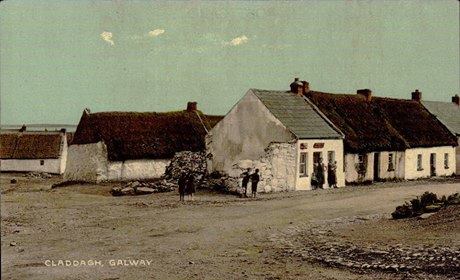
I know that many of you have been to Galway (or intend visiting ) and I am sure you have heard of the Claddagh village, which was on the west side of the mouth of the Corrib river, where it flows into Galway Bay. It was immortalised by Bing Crosby when he recorded the song 'Galway Bay' Remember the opening lines. 'If you ever go across the sea to Ireland, and maybe at the closing of your day, you can sit and watch the moon-rise over Claddagh, and watch the sun go down on Galway Bay'. There, I've got you singing already...yes, the lines are coming back to you now... 'the bare-foot gossuns at their play' ... young boys and girls, wearing no shoes, carefree, oblivious to the woes and tribulations that awaited them in their adult lives... aaah the innocence of it all.
Problem was, that by the time the song was being popularised all across America by the old crooner, back here in Galway, the city officials had decided to build Galway's first housing project, right where the iconic thatched cottages stood. To be fair, those cottages were already hundred of years old, stone-built, cold, damp and in many cases, because of poverty, they were in pretty poor condition and not fit for continued habitation in a modern Ireland, that was just shrugging off the yoke of the British empire.
So in due course over a period of twenty years or so, all the old whitewashed thatched cottages were demolished and replaced by modern, warm, if indifferent looking terraced houses. If there is a prize for the most-asked tourist question in Galway it surely has been 'Where is the Claddagh?' So many people ask that question everyday here that the locals were embarrassed to admit that there wasn't a single thatched cottage left. The wrecking ball had made a clean sweep of them all, the old Claddagh had become confined to black and white picture-postcards and vivid imaginations.
So you can imagine my delight when driving one day in the car, I noticed a guy unloading loads of thatching straw into a back-yard off Fairhill Road, in the Claddagh. My curiousity piqued, I paid the site a visit last week, accompanied by a good friend Tom O'Connor, owner of O'Connor's Famous Pub in Salthill. I brought Tom, not so much because I like him a lot, but really because he just bought some really cool camera equipment, and we made a little video blog which I called 'The first thatched cottage to be built in the Claddagh, Galway, in over a century'.
Like a phoenix rising from the ashes, we were fascinated to bear witness to the first thatched cottage in nearly a century being built in the Claddagh by a local family called Walsh. They intend to open it to the public in April 2016 and hope to call it Katie's Claddagh Cottage, after their grand-mother who had lived there a long time ago. Using entirely authentic traditional building and thatching methods, when it is finished, it will be an iconic gem in the heart of the old Claddagh village.
So, to cut a long story short, while we were there, picking our way through the building site, I got talking to the guy who was painstakingly weaving straw into the thatched roof, a master-thatcher called Eoin O'Neill, who came all the way from Waterford in the south east of Ireland to help get the new thatched-roof, just perfect. Eoin was really great fun to speak with and was a natural on camera too.
Eoin was using locally-grown wheat from Corandulla, county Galway to thatch the main roof and was using rye that was grown in Wexford for the comb or ridge of the thatched roof. He took a break from his work while I admired the roof-timbers before they were covered over by the rye and wheaten thatch.
The main beams on the roof were old scots-pine or bog-oak rescued from the bogs that cover much of Connemara. The rest of the roof is made of hundreds of ash plants, 2 metre long sticks or scallops, onto which the thatch will eventually be secured by means of twisted hazel wands, which are 'purloned' into the thatch and inter-laced with the ash cross-beams. The thatch is then tamped and pummelled by a special hammer and tied off with thin ropes, until it is as firm and as watertight as any slate roof, really warm, and with some maintenance good for thirty or more years. When looking at really old thatched cottages one can see a hundred years of thatch-layers one on top of the other, making for a delightfully artistic roof.
Looking up through the slatted scallops that comprised the rafters of the cottage I was struck by the frailty of the entire undertaking and was reminded of the old Irish saying, 'Ní hé lá na gaoithe lá na scolb' - 'The windy day is not the day for thatching'.
The lattice-work of the inter-laced scallops dissecting the heavier cross-beams of the rafters reminded me of the warp and weft of the weavers loom. Soon the thatch will cover this natural web, and these patterns of light and heavy timbers will become the clothes of the house, not unlike a bolt of hand-woven tweed.
The shafts of winter sunlight filtering through the inter-woven sticks on the roof will soon be a distant memory, once the thick layer of rye and wheaten thatch is stitched onto the rafters by Eoin's skilled hands. When the cottage is fully thatched, this under-skeleton will be covered forever and in a month's time, really one could not imagine how such a thatched roof was constructed unless one witnessed a new-build such as this.
This is exactly as our fore-fathers would have made a cottage roof made from thatch, by gathering up locally available material, ash plants, hazel wands, bog-oak beams, driftwood etc. Most of the materials the older generations used were not bought from lumber yards or builders-suppliers, no, they were begged, borrowed, bartered and even liberated from bogs, woods, sea-shores etc. Collecting flotsam and jetsum from the shore would have been a common activity and hey, y'know, the best beams are ones that have been used before in another venture or vessel. Something with the patina of age, and the experience that goes with it, not brittle, but yielding and reliable.
Eoin made these 'bobbins', or 'skirts' by twisting and knotting sheaves of rye stalks, and then braiding them onto a hazel stick. These skirts will be pinned to the ridge to form the thicker top row of thatch at the apex of the roof and also to be additional protection around the chimney. Eoin's handiwork in fixing these bobbins to the roof is really evident when seen from above.
Here's a story! I remember hearing of one family who moved from a small tenant farm beyond Inverin, in west Connemara, to a slightly larger tenant farm, just east of Furbo, a little nearer to Galway city, in 1890. The two brothers, one wife and two children walked the 15 miles from Inverin to Furbo, carrying the roof-beams for their yet-to-be-built stone cottage, on their backs. Such was the value of a few long poles or spars back then! Their humble little thatched cottage saw 9 more children born and thereafter, 17 grand- and great-grand children, all born under the thatched roof that had been made by hand, using only locally grown or found materials, until the cottage was finally replaced in 2009 by a new slate-roofed bungalow.
I would have railed against a 'fake' Claddagh cottage, one built just for tourists to take selfies at. This is no fake. This is the real deal. I believe that this lovingly built, traditional, Claddagh cottage is set to become one of the must-see locations in Galway city for locals and tourists alike. Congratulations to the Walsh family and their hard-working friends on this unique venture to commemorate the iconic village of the Claddagh. Once the garden is in bloom and maybe with a few chickens in the 'street' this cottage will be a perfect example of how the Claddagh village houses would have looked.
They have a bog-oak studio at the rear of the cottage and intend selling bog-oak sculptures and tea and freshly-baked scones during the summer. You can sit in by the hob, and watch the busy cottage come to life. The turf-fire will be lighting in the big old fireplace and the half-door will be ajar, or half ajar, whichever! They hope to have various artists and crafts-people working in the cottage, perhaps even a claddagh-ring maker on site too, as well and having a warm, inviting cottage experience, showing how the people of the Claddagh lived and thrived on the shores of Lough Corrib and Galway Bay for the past five centuries.
I hope you enjoy the video. Click on this link to view Katies Claddagh Cottage;
https://www.youtube.com/watch?v=mP8klOF1vYo&feature=youtu.be&a
Tom and I hadn't planned making the video, and we certainly hadn't rehearsed my lines. If fact we did most of it in one staccato un-rehearsed take... so expect a few bloopers...and of course there was lots that we forgot to mention or talk about.
You can come on a walking tour of Galway with me anytime, just call or email me and we can meet up at a time to suit you and your family or friends. If it's wet and windy, I also give 'the shortest walking tour of Ireland, the fifty foot tour of O'Connors pub!' It's a Fireside tour that I give at 6pm any day at O'Connor's Pub, Salthill. A half-dozen or more people can come on that tour, winter or summer.
Thanks for reading. Come and walk with me sometime.
Brian Nolan. Galway Walks - Walking Tours of Galway
Website www.galwaywalks.com Twitter @Galwaywalks
Facebook https://www.facebook.com/Galwaywalks/
Phone 086-3273560 - email galwaywalks@gmail.com
*Photo Credits - The photos are all my own, save for the shot of the bread being baked at the open fire, which I use with the kind permission of the Connemara Heritage and History centre.
Problem was, that by the time the song was being popularised all across America by the old crooner, back here in Galway, the city officials had decided to build Galway's first housing project, right where the iconic thatched cottages stood. To be fair, those cottages were already hundred of years old, stone-built, cold, damp and in many cases, because of poverty, they were in pretty poor condition and not fit for continued habitation in a modern Ireland, that was just shrugging off the yoke of the British empire.
So in due course over a period of twenty years or so, all the old whitewashed thatched cottages were demolished and replaced by modern, warm, if indifferent looking terraced houses. If there is a prize for the most-asked tourist question in Galway it surely has been 'Where is the Claddagh?' So many people ask that question everyday here that the locals were embarrassed to admit that there wasn't a single thatched cottage left. The wrecking ball had made a clean sweep of them all, the old Claddagh had become confined to black and white picture-postcards and vivid imaginations.
So you can imagine my delight when driving one day in the car, I noticed a guy unloading loads of thatching straw into a back-yard off Fairhill Road, in the Claddagh. My curiousity piqued, I paid the site a visit last week, accompanied by a good friend Tom O'Connor, owner of O'Connor's Famous Pub in Salthill. I brought Tom, not so much because I like him a lot, but really because he just bought some really cool camera equipment, and we made a little video blog which I called 'The first thatched cottage to be built in the Claddagh, Galway, in over a century'.
Like a phoenix rising from the ashes, we were fascinated to bear witness to the first thatched cottage in nearly a century being built in the Claddagh by a local family called Walsh. They intend to open it to the public in April 2016 and hope to call it Katie's Claddagh Cottage, after their grand-mother who had lived there a long time ago. Using entirely authentic traditional building and thatching methods, when it is finished, it will be an iconic gem in the heart of the old Claddagh village.
So, to cut a long story short, while we were there, picking our way through the building site, I got talking to the guy who was painstakingly weaving straw into the thatched roof, a master-thatcher called Eoin O'Neill, who came all the way from Waterford in the south east of Ireland to help get the new thatched-roof, just perfect. Eoin was really great fun to speak with and was a natural on camera too.
Eoin was using locally-grown wheat from Corandulla, county Galway to thatch the main roof and was using rye that was grown in Wexford for the comb or ridge of the thatched roof. He took a break from his work while I admired the roof-timbers before they were covered over by the rye and wheaten thatch.
The main beams on the roof were old scots-pine or bog-oak rescued from the bogs that cover much of Connemara. The rest of the roof is made of hundreds of ash plants, 2 metre long sticks or scallops, onto which the thatch will eventually be secured by means of twisted hazel wands, which are 'purloned' into the thatch and inter-laced with the ash cross-beams. The thatch is then tamped and pummelled by a special hammer and tied off with thin ropes, until it is as firm and as watertight as any slate roof, really warm, and with some maintenance good for thirty or more years. When looking at really old thatched cottages one can see a hundred years of thatch-layers one on top of the other, making for a delightfully artistic roof.
Looking up through the slatted scallops that comprised the rafters of the cottage I was struck by the frailty of the entire undertaking and was reminded of the old Irish saying, 'Ní hé lá na gaoithe lá na scolb' - 'The windy day is not the day for thatching'.
The lattice-work of the inter-laced scallops dissecting the heavier cross-beams of the rafters reminded me of the warp and weft of the weavers loom. Soon the thatch will cover this natural web, and these patterns of light and heavy timbers will become the clothes of the house, not unlike a bolt of hand-woven tweed.
The shafts of winter sunlight filtering through the inter-woven sticks on the roof will soon be a distant memory, once the thick layer of rye and wheaten thatch is stitched onto the rafters by Eoin's skilled hands. When the cottage is fully thatched, this under-skeleton will be covered forever and in a month's time, really one could not imagine how such a thatched roof was constructed unless one witnessed a new-build such as this.
This is exactly as our fore-fathers would have made a cottage roof made from thatch, by gathering up locally available material, ash plants, hazel wands, bog-oak beams, driftwood etc. Most of the materials the older generations used were not bought from lumber yards or builders-suppliers, no, they were begged, borrowed, bartered and even liberated from bogs, woods, sea-shores etc. Collecting flotsam and jetsum from the shore would have been a common activity and hey, y'know, the best beams are ones that have been used before in another venture or vessel. Something with the patina of age, and the experience that goes with it, not brittle, but yielding and reliable.
Eoin made these 'bobbins', or 'skirts' by twisting and knotting sheaves of rye stalks, and then braiding them onto a hazel stick. These skirts will be pinned to the ridge to form the thicker top row of thatch at the apex of the roof and also to be additional protection around the chimney. Eoin's handiwork in fixing these bobbins to the roof is really evident when seen from above.
Here's a story! I remember hearing of one family who moved from a small tenant farm beyond Inverin, in west Connemara, to a slightly larger tenant farm, just east of Furbo, a little nearer to Galway city, in 1890. The two brothers, one wife and two children walked the 15 miles from Inverin to Furbo, carrying the roof-beams for their yet-to-be-built stone cottage, on their backs. Such was the value of a few long poles or spars back then! Their humble little thatched cottage saw 9 more children born and thereafter, 17 grand- and great-grand children, all born under the thatched roof that had been made by hand, using only locally grown or found materials, until the cottage was finally replaced in 2009 by a new slate-roofed bungalow.
I would have railed against a 'fake' Claddagh cottage, one built just for tourists to take selfies at. This is no fake. This is the real deal. I believe that this lovingly built, traditional, Claddagh cottage is set to become one of the must-see locations in Galway city for locals and tourists alike. Congratulations to the Walsh family and their hard-working friends on this unique venture to commemorate the iconic village of the Claddagh. Once the garden is in bloom and maybe with a few chickens in the 'street' this cottage will be a perfect example of how the Claddagh village houses would have looked.
I hope you enjoy the video. Click on this link to view Katies Claddagh Cottage;
https://www.youtube.com/watch?v=mP8klOF1vYo&feature=youtu.be&a
Tom and I hadn't planned making the video, and we certainly hadn't rehearsed my lines. If fact we did most of it in one staccato un-rehearsed take... so expect a few bloopers...and of course there was lots that we forgot to mention or talk about.
You can come on a walking tour of Galway with me anytime, just call or email me and we can meet up at a time to suit you and your family or friends. If it's wet and windy, I also give 'the shortest walking tour of Ireland, the fifty foot tour of O'Connors pub!' It's a Fireside tour that I give at 6pm any day at O'Connor's Pub, Salthill. A half-dozen or more people can come on that tour, winter or summer.
Thanks for reading. Come and walk with me sometime.
Brian Nolan. Galway Walks - Walking Tours of Galway
Website www.galwaywalks.com Twitter @Galwaywalks
Facebook https://www.facebook.com/Galwaywalks/
Phone 086-3273560 - email galwaywalks@gmail.com
*Photo Credits - The photos are all my own, save for the shot of the bread being baked at the open fire, which I use with the kind permission of the Connemara Heritage and History centre.
Location:
The Claddagh, Galway, Ireland
Monday, 4 May 2015
Sometimes I see a Heron in the Corrib river when on my Walking Tours
Here in Galway, you can often see Cranes at Salthill, in the rock-pools opposite Leisureland, at Long Walk, near the aptly named B&B Heron's Rest, and often when on my 'walking tours', I see a Heron at the little weir below the Fisheries Tower or at the weir below Nuns Island.
Keep a wary eye out for them...hah!
![]() |
| Heron sculpture at Nuns Island, Galway. |
Monday, 20 April 2015
The Winkle-Pickers Tale.
I started this blog as background piece for a journalism student/friend of mine in Galway University, researching for a radio feature she was doing on Periwinkles. I know, what of them, those little sea-snails? So one day, around the spring equinox, when the tide was at its lowest ebb, I walked to Salthill and watched some winkle pickers far out on the reef at Blackrock, Salthill, where winkles grow aplenty and they grow big, blue and tasty on the wave-swept rocks there. The picked winkles would be bagged and left at the high-tide mark in a rock-pool for a few days, before being picked up by a 'winkle wholesaler' and shipped off to France, presumably at a tidy profit to the seller, though probably not for the pickers.
I walked out there myself, to the end of the reef, carefully picking my way across the slippery seaweed and hidden rock pools, feeling very self-conscious in my fashionable walking gear and tried to get one older grumpy man to talk about his experiences picking and harvesting the blue pearls that are the Atlantic periwinkle. He was bundled up from the cold, his weather-beaten face and wrinkled, blue hands a testament to the hard life of a sea-shore harvester. He hardly stopped to look at me, let alone speak so I didn't get much information out of him. He was busy, stooped over, one hand in the water, one clutching an onion sack, brimming with hundreds of blue-black shells, anxious to get the most of the sea's bounty before the tide turned. He ignored me, grunted and waved me away. One look at his big blue hands convinced me that this conversation would wait! On my way back to shore, I cast my mind back to Kilkee, County Clare, just for a moment in time and remembered how I fell in love with these little beauties.
Y'see my Dad was born in Kilkee way back in 1914, although by his own admission, he fled that windswept coastal village as soon as he could pay for a ticket on Percy French's famous West-Clare Railway. He found the 44 weeks of deserted Kilkee too depressing to bear. and the hectic bustle of the 8-week tourist season too busy to enjoy, so he left. He became a primary school teacher, initially in Dublin, then in Raheen near Killimor in East Galway, and finally he settled down, got married to my mum, raised a family of seven children and ultimately taught for 45 years in a three-room country school in Duniry, near Woodford, at the foot of the land-locked Slieve Aughty mountains, far from the spume of the waves, the cry of the seagulls and the smell of storm-stranded seaweed and bloated bladder-wrack.
The draw of the sea is irresistible though and Dad was drawn back more often than he cared to admit. Thus in the sixties and seventies we spent every summer there, in a rented 'lodge', all nine of us, cramped like sardines yes, but the accommodation was not important, for we had different priorities then...like building sand-castles on Kilkee's golden horseshoe beach, tight-rope walking the endless strand-line wall, swimming 'au natural' at Newfoundout, the naturist swimming hole under Georges Head, idly fishing for cobblers and crabs, using barnacs for bait on a threaded twisted pin, barefooting the rocks 'back west' at the Pollack holes, de-spineing jet-black spiky sea-urchins to make ashtrays out them and sell to the tourists, playing pin-ball in Perks Amusements.

And yes, the 'piece de resistance', eating winkles with a straight pin, off with the little round lid, out with the whorley snail, down the hatch, toss the shell, reach for another, and on and on, no tv back then, just the beach and the winkles...simple pleasures, impossible to recreate nowadays as an adult. Kilkee and winkles were an inseparable fact of life for us...and as I grew older the taste for them never waned. As a boy-racer you could follow my car tracks from Kilkee to Loughrea by tracking the trail of empty winkle shells from Clare to Galway. The archaeologists of tomorrow will surely be confused at the proliferation of sea snails so far inland.
Winkles are not for the faint-hearted mind you...eating a periwinkle is an acquired taste, and you never, ever look at it before swallowing...or you will never eat one at all. Oysters and mussels are easy pickings by comparison. The winkle's nutritional value is probably tiny, the sodium content high, but the pleasure connection from eating these booger-like delicacies...priceless!
What is odd is that to my knowledge, no one in my family ever picked a winkle and boiled it...it wasn't like the done thing...I don't even know how long to boil them...kind of a trade secret..is it 10 minutes, or as we believed as kids, 10 hours? I still don't know, but the one thing I do know is that no one sells periwinkles on the street here in Galway, you still gotta go to Kilkee or Lahinch to satisfy that craving...so that's an even bigger mystery.
One day I was at a little hotel in Kinvara, on the south shore of Galway Bay, meeting some friends for a drink. I was wearing what were then fashionable, pointy-toe shoes, or winkle-pickers. My friends pointed out that the hotel itself was called Winkles, after the family that owned it. We had a good laugh. Seems one is never far from a periwinkle in Galway. Sadly, the hotel is gone now, a supermarket stands in its stead.Funny thing, I have never seen winkles on a restaurant menu, not even in Winkles Hotel.
A friend of mine, Bob Fane, wrote me from the States about the periwinkle, yes, the same Atlantic blues we ate here on the other side of the sea.
'Ah childhood, 'Boy Land', 'Never Never Land', once you cross its borders you may never return again. When I was a lad of 8 or 9 my father had a place in Connecticut on the then pristine Long Island Sound. We would dive off the rocks, root through the seaweed, find the periwinkles and, like yourself, would take out a safety pin from our bathing suit and eat then down, maybe 1/2 dozen, I never really chewed them, just let them slide down with the salty brine as the taste. We felt like Jon Hall from some exotic South Pacific movie. Then my brother told me they were nasty little buggers, full of excrement and other things too hellish to stomach, the source of hepatitis, yellow fever, polio, and bubonic plague. My peri-days were over.'
Today, the periwinkle industry in Ireland is quietly thriving. It is an invisible industry, with the harvesting of this naturally occurring seafood mainly carried out by migrant workers way out on the foreshore, or on the small off-shore islands, far away from prying eyes. Many of the workers are illegals or at best, working off-the-books. Conservatively some 5,000 tonnes of periwinkles are exported from Ireland annually, and the business is worth some €15 million annually. The players in the market fly way under the radar and the industry is completely unregulated. Curiously it is almost impossible to buy cooked or raw winkles in Ireland. Almost all are exported.
My memories of winkles are very much the stuff of boyhood adventures and endless summers. I see from the Clare Champion that winkle sellers on Kilkee beach will now have to register with the county council, the health board and take out a traders licence, as well as providing €2 million in public liability insurance. The Periwinkle kept people alive during the Famine and has provided a simple living for the west Clare winkle sellers. These are not in 'big business'. Selling a couple dozen winkles for a Euro won't make one wealthy, but it is such a tradition, part of our culture.. Winkle sellers were a fixture in Kilkee, our 'supplier' of our fix. Aah for those innocent childhood days of carefree, endless play and afterwards, dangling your barefoot legs over the strand wall, needling a damp bag of periwinkles,watching the sun setting on Kilkee bay. A little bit of heaven. Perhaps it is gone now, another victim of draconian regulations gone mad in this little island off an island off Europe.
Labels:
blackrock,
galway,
galway bay,
hotel,
ireland,
Kilkee,
kinvara,
lahinch,
periwinkles,
reef,
restaurant,
Salthill,
sea-snails,
seaweed,
snail,
summer,
Winkle-pickers,
Winkles
Location:
Galway, Ireland
Thursday, 21 August 2014
Erin's Lament - Galway's Gain! Galway Titanic Connections
GALWAY'S CONNECTION TO TITANIC
RMS Titanic was the greatest ship of her age. Thought to be unsinkable, Titanic was 882 feet long (this replica model, pictured above on the Prom in Salthill, was built by a Men's Shed project in Lahardane, County Mayo, to mark Titanic's 100th anniversary in 2012 is 1/10th scale). The real Titanic was built in Belfast to be the fastest liner in the world. Titanic struck an iceberg some 200 miles off Newfoundland, at 11.20pm on the night of the 14th of April 1912. She sank at 2.20 am on the morning of 15th April 1912, while on her maiden voyage to New York, from Southampton, England, via Cherbourg, France and Cobh (Queenstown), Ireland.
There were 2,223 passengers and crew aboard Titanic when she sailed from Queenstown (899 crew and 1,324 passengers) on the morning 12th of April 1912.
In total, 1,517 people died when Titanic sank (685 crew and 832 passengers). 120 Irish passengers boarded Titanic at Queenstown (42 survived, 78 died). 37 of the Irish passengers were from Connacht.
Nine passengers on Titanic were from County Galway. 2 others aboard had a very strong Galway connection.
Hanora "Nora" Healy, 29, of Athenry, Co Galway boarded the Titanic at Queenstown as a third class passenger. Her ticket cost £7-15s. Nora escaped the sinking in lifeboat 16. She died 11 March 1919 aged 36.
Andrew ‘Andy’ Keane, 20, Derrydonnell, Athenry, Co. Galway. He was a keen hurler and brought 2 county medals and a dozen hurley sticks with him on Titanic. He died in the sinking. His body, if recovered, was never identified.
Margaret Mannion, Loughanboy, Caltra. Co. Galway. She survived the sinking and returned to Ireland in 1919. She married Martin Hopkins of Ahascaragh. She died in Clontuskert on 15 May 1970.
Ellie Mockler, 23, Caltra, Co. Galway. She survived the sinking and in 1917 became a Mercy Nun in New York. She died in 1984, aged 95.
Martin Gallagher - Currafarry, Caltra, Co. Galway. A hero of the tragedy, he saved several women to escape certain death by helping them into lifeboats. He died in the sinking. His body, if recovered, was never identified.
Thomas Smyth – Chapelfinnerty, Caltra, Co Galway. He died in the sinking. His body, if recovered, was never identified.
Thomas Kilgannon - Currafarry, Caltra, Co Galway. He died in the sinking. His body, if recovered, was never identified.
John Flynn, Carrowhakin, Clonbur, County Galway. He emigrated to America some years previously and was only home on a visit. He died in the sinking. His body, if recovered, was never identified.
Patrick Shaughnessy, 24, Tynagh, Co Galway. He died in the sinking. His body, if recovered, was never identified.
Other Galway Connections;
Bruce Ismay, head of the White Star Line, the company that owned ‘Titanic’, was a captain of industry, an extraordinary entrepreneur, and the driving force behind the new breed of luxury liners purpose built to race across the Atlantic. He was vilified after Titanic sank and shunned as a social pariah. He left his life in London and moved to Connemara where he mostly lived from 1913
Eugene Daly -Athlone, Co.Westmeath. A weaver and a talented piper, sailed on Titanic. Luckily he survived the sinking by clinging to an upturned liferaft. He testified at the Titanic hearings in New York. He married in New York and in 1921 returned to Ireland initially to Athlone. Later, he settled in Galway city and after his wife died in 1961, he flew back to America where he lived with his only child, Marion Joyce, in Missouri. He died on 30 October 1965. (see his story, Erin's Lament, below)
The Piper on the Titanic;
Erin’s Lament, Galway’s Gain - A Titanic tale

In April 1912, Eugene Patrick Daly, then aged 29, (born 1883), a weaver from Athlone, County Westmeath, Ireland, was travelling to New York City, just one of 113 Irish passengers who unfortunately chose the Titanic to emigrate to the USA. He boarded the Titanic on the 11th of April, 1912, at Queenstown (ticket number 382651). The ticket cost him £7. 15s, or almost 6 months pay for a working man.
It has been confirmed in eye witness accounts of the Titanic’s call to Cobh, that Daly played "Erin's Lament", "A Nation Once Again", "Boolavogue" and other well known nationalist tunes on his uilleann (elbow) pipes (a traditional Irish instrument) for his fellow steerage passengers, as America, one of the two tenders to the Titanic steamed away from Queenstown harbour, bound for the gleaming liner that lay at anchor far out in Cork harbour, near Roches Point. It was both a heartening and a poignant moment listening to those traditional airs as the passengers left Ireland, most of them for the last time.
Amazingly Daly survived the Titanic’s tragic sinking by clinging to an upturned collapsible lifeboat (Collapsible 2). He credited his survival to his heavy overcoat. Though frost-bitten and near death, he was rescued, but he lost his precious uileann pipes, which he claimed he'd played as the ship sank, saying he'd never heard the orchestra play. He would later file a claim against the White Star Line’ for $50 for their loss. Similar pipes, possibly Eugene Daly's, were recently salvaged from the Titanic wreck and are now in the Titanic Museum collection.
Eugene Daly got married in America to Lil Caulfield from Co. Mayo, and whether he was homesick or inspired by the Irish Free State, he returned to Ireland in 1921. He suffered terribly from paranoia on the return ship journey, so much so that his wife paid a crew-member to sit with him at night while the others slept and he vowed never again to set foot aboard a ship once they arrived home.
With his new wife he moved to Galway where he found work in the Galway Woolen Mills and later in Palmers Mill, now the Bridge mill, which was then a busy flour mill. He lived with his wife and daughter, (born in 1925) Mary Kate, but known as Marion, at 7 St. Johns Terrace in Galway and was a popular musician in the city, playing pipes and flute in ceili bands around the city.
In 1961, after his wife had died, and after he'd retired from the now obsolete flour mill, he emigrated one last time to the USA, but this time by plane, to Washington Heights in New York, to live out his last days there with his only child, his now married daughter Marion Joyce.
Marion had emigrated some ten years earlier with her husband, a locally renowned tenor, John Joyce. He worked in Manhattan and Marion looked after her growing family, where she also was superintendent of the building they lived in. While living with his daughter, Eugene was a regular mass-goer, a volunteer at the church and a doting grand-father to his grand-children. He was tight-lipped about his near-death experience. He died there age 82, in 1965.
His daughter and her husband later moved to Branson Missouri, to be near their youngest son, who was serving as a police officer there. They are buried in Branson.
To his credit, Eugene testified at the Titanic Hearings in New York and his description of the sinking, the inadequate lifeboats and especially his eye witness testimony of a ship’s officer shooting third class passengers who were trying to board a lifeboat has been relied on heavily by historians of the Titanic and is the stuff of film legend now.
His credible eye witness testimony of the chaotic scenes and passenger discrimination onboard Titanic was instrumental in the passing of new Lifeboat laws for passenger ships. He helped save many lives in subsequent ship wrecks because of the new Lifeboat laws.
His account of the tragedy was used as research in many movies and stories about the great liner. He was interviewed by Walter Lord while he was writing his book on Titanic, 'A night to remember', which was later in 1958 made into the famous movie of the same name. That book and movie informed the makers of the modern movie 'Titanic'.
Initially Eugene was unique amongst survivors in his willingness to recount the story whenever asked, as most other survivors, no doubt suffering from post-traumatic shock, or grief, rarely ever uttered a word on their brush with death when Titanic sank. Later as he grew older, he stopped talking about Titanic entirely, so painful was the memory.
Eugene Daly died on 30 October 1965 aged 82. He is buried in St. Raymond’s Cemetery in the BronxNotes;
Eugene lived at 7 Johns Terrace in Galway's 'West' district. He played music in Galway at various halls, but strangely rarely played the uileann pipes again, preferring to play the concert flute instead. He was invited as a guest of honour to the opening of the film about the Titanic, 'A night to remember' at The Claddagh Palace theatre in Galway and it is said he attended the showing every night of it's run there.
Recently, I heard a story of how local children in the early sixties would chide him as having been a coward and dressing up in womens clothing, confusing him with Bruce Ismay, perhaps and not knowing the full story of his bravery and character. They taunted him with cries of 'Did ya get a white feather for your birthday from the Queen?' and worse I am sure. His house in John Street is still there today.
I tell this story and many more about Galway and its interesting past on my 'Walking Tours of Galway' and my 'Fireside Tours' at O'Connors Pub in Salthill. For more information see the Galway Walking Tours website www.galwaywalks.com or email me at galwaywalks@gmail.com for tour times and booking. Galway Walks - more than just a leisurely stroll!
The above notes and story were prepared by me for the exhibit of the replica Titanic at the Prom opposite the Aquarium in August 2012, a hundred year on from the sinking..
Here's what was on show then:
From Mayo to Galway - with love, ' The Titanic' on the Prom!
Visitors to Galway, and locals alike, might be surprised this week by the graceful presence of the Titanic, 'moored' on Salthill's promenade, one of Ireland's best known seaside resorts. The replica 1/10 scale model of the famous ship, is on loan to Galway from the Mayo community of Addergoole, who celebrated the centenary of the ship's sinking last April. The commemorative events in the tiny Mayo village of Laherdane were the focus of national and international media coverage, and 'the boat on the bay' is already attracting hundreds of curious onlookers to Salthill. The Titanic replica is 88 feet long, and is accurate in every detail, down to the portholes, smokestacks and anchors, and the decks are fully illuminated at night.
Eleven young emigrants from Mayo lost their lives on the ship, a tragedy which devastated the local community, and prompted a group of local men from Addergoole to build a model of the liner. They worked tirelessly and in secret over a period of eight weeks, to ensure that the replica was in place for the opening ceremony in April this year. The 'gift' from Mayo is an acknowledgement and mark of respect to the nine Galwegians who boarded 'The Titanic' at Cobh in April 1912, six of whom lost their lives. "It was a real labour of love," according to Brian Nolan from Salthill, who is also a founding member of the Addergoole Titanic Society, "and while the locals are missing it terribly, it's great to be able to recognise Galway's loss on the Titanic too," he said.
Martin Gallagher, from Galway, was one of those who selflessly helped up to nine women into lifeboats before he lost his life. Another of the more well known Galway connections to the ship is Eugene Patrick Daly, a weaver, originally from Athlone, but who subsequently settled in St John's Terrace, Galway., where he worked at the Galway Woolen Mills, and was also a popular local musician. Eugene testified at the Titanic Hearings in New York, and his credible eye witness testimony of the chaotic scenes and passenger discrimination onboard the Titanic was instrumental in the passing of new Lifeboat laws for passenger ships.
The West of Ireland connection to the ship extends to Connemara where Bruce Ismay, owner of the White Star Line, lived for thirty years. He escaped the stricken ship on the last lifeboat, but his reputation never recovered.
In spite of it's tragic history, the Titanic and it's present-day replica continue to fascinate and attract the interest of passersby. Managing Director of Salthill Tourist Board Roger O' Sullivan, was impressed by the efforts of the Mayo community to keep the story alive, and he took the initiative to bring the ship to Salthill in memory of the lost Galwegians. "The Titanic is just one of many welcome visitors to Galway this week, and is a continued boost for local business who are delighted with the increase in trade," he said. The arrival of the ship was celebrated at a launch in the Galway Business School in Salthill on Friday, where the Mayor of Galway Terry O'Flaherty welcomed the local tourist initiative.(pics in circulation)
Volunteers who would like to take part in promoting Galway's historic link with the ship, are invited to contact Brian Nolan directly on 086 327 3560.
The replica is now housed in a warehouse in Castlebar, awaiting sailing orders. Who knows where it will go next, after necessary repairs and refurbishment! Watch this space.
Labels:
Athenry,
Athlone,
Brian Nolan,
Bruce Ismay,
Caltra,
Cobh,
Eugene Daly,
galway,
Galway Walks,
Queenstown,
Salthill,
sight-seeing tour,
Titanic,
Uileann Pipes,
walking tours
Location:
Galway, Ireland
Subscribe to:
Posts (Atom)