Showing posts with label claddagh. Show all posts

Thursday, 1 August 2019

If you liked it, then you should've put a ring on it....

"If you liked it, then you should've put a ring on it...." 

A Galway short story from Liam Garvey who owns Galway Bay Gifts on Williamsgate Street. 

If you want wit and wisdom with your gift shopping, then this is the shop for you, right beside Powell's Four Corners, opposite Garavans. 

Liam is one very funny guy, an acute observer of the coming and going on the streets of Galway, and a great story-writer to boot. 

His most recent tale reminded me so much of Brendan Grace, but unfortunately he never got to tell it, what a pity.


"The Races
Galway Races have been happening for a long time – 150 years in this year of 2019.
The horses, for some, are an annoying inconvenience – they would prefer not to have to bother with the equine side of things and just concentrate on the drinking and their attempts to have it off with a person of their desired gender.
I met a man this evening who had been out for a while – he stood for a time beside the wall of the shop opposite – unfortunately his equilibrium suffered anytime he moved away from the wall – it was if there was a gravity in the concrete blocks that kept him upright.
Eventually he lurched across the street and asked me in a confidential bellow if we had a toilet – I told him we have to use the pub facilities but this was no use to him as he had been ejected from the same pub, he had tried to convince the bouncer of his sobriety for some time and had received little sympathy.
“I’ll just go roun’ the corner and hava quick slash”
He came back after a few minutes and looked a little less pained.
“D’ya have any of them Claddagh rings?”
I answered in the positive – “Muchardey?” was his reply.
My price was acceptable to him and he indicated that he would purchase one for his loving wife.
“What size is she?” was a question for which he was unprepared.
“Sheezbigenuff” wasn’t a ring size that I recognised and I told him that he could be better off waiting until tomorrow – he might have a better idea of dimensions after consulting his beloved.
“No, wanna surprise her tonight” was an admirable aspiration but one I felt was a touch doomed. I could sense that his welcome home might be a silent one.
“Size sixteen, that’s what she is!” he uttered. I told him that maybe that was a dress size “Yep, thazzer size, givvus a ring”
He took out a lump of money from his pocket that could have bought most of the rings in the shop. As he was likely to make a scene if he didn’t get a ring I chose one I thought might fit, took a couple of notes from his pile and gave him the ring in a box.
“Youra gentleman an a Scholar” were his parting words.
I wonder if the ring ever made it as far as his happy abode and if so how impressed was his lucky spouse.
Race Week!"

Saturday, 2 September 2017

The Heron

Sometimes you just know that there are forces and energies all around us that we rarely experience, until the unexpected occurs. It all started with a mother's enduring love for her daughter and a promise kept. Cheryl Miller from Indiana walked into Liam Garvey's gift shop on Shop St. Galway on last Thursday and the die was cast. 

It had been a wickedly wet day, her first day in Ireland, and having flown all night, driven in torrential rain across Ireland, she and her daughter and both their husbands checked into the Victoria Hotel, all of them exhausted. They hit the bed for an hour, to shake off the jet-lag, but they overslept, really overslept.. When they finally got their act together hours later, the rain had eased a bit, so they decided to chance a quick walk around the city and get some dinner. It was to be a fortuitous evening.

After they'd eaten, because of the late hour, only a very few shops were open. Cheryl was looking for a very simple Claddagh pendant, and luckily Liam's 'Galway Bay Gift Shop' stocked just what she wanted. As Liam wrapped Cheryl's purchase, he felt her subdued mood, not quite the usual tourist's high, and then he noticed her top, a printed T-shirt with a woman's photo on it. Liam inquired, to be told that it was the final photo Cheryl had taken of her 40 year old daughter Cynthia, just days before she'd succumbed to cancer, earlier this year. 

Her wish, all during her chemotherapy was that once she'd recovered enough, she was going to fulfill her lifelong wish to visit Ireland, a desire she'd had since she was a teenager. 
Alas, it was not to be. Life and chemotherapy can be cruel. Later on, Cheryl decided she would go on Cynthia's journey, a hard decision for a Mum grieving her dead daughter, and so it was she found herself in Liam's shop, telling her daughter's story. 

Liam asked her what Cynthia really wanted to do in Ireland, and Cheryl told him that she'd talked incessantly about sitting in a pub, listening to an old man telling stories. 

After she'd left, Liam called me, wondering could I give the family my 'Fireside Stories' tour in O'Connors bar in Salthill. I like Liam... he gets me, and my stories, so I said yes. It was already 10.30pm, but i called their hotel room anyway, only to be told that they were leaving Galway at ten am the following morning... heading for Killarney, so that was kinda that, no tour possible. 

We talked a few minutes, hung up. That should have been it, but the next morning, I had an early walking tour.. at ten am. 

When I awoke, at 7.30, I was still thinking about the conversation I'd had with the mum, so I called her back. Told her to be ready at the hotel door at 9am..reassured her I'd have her back to the hotel within an hour. I picked the four of them up... they were intrigued and bemused... and a little reluctant... but decided to go with the flow, and the nutty, enthusiastic stranger, safety in numbers. 

I brought them to one of my favourite spots in the city, 'the circle of life' garden in Salthill Galway built two years ago by the Goggin family, after they'd lost their son in a car accident. It's a place of peace and salve, and a place that speaks many languages, heals many wounds.

It's a garden filled with gorgeous flowers and plants and stones, stones from all over Ireland. At the rear of the garden is a park, with a lovely pond. In the middle of the pond stands a bronze statue of a heron, a magical bird, a deadly hunter, but also a bird that represents the healing and other powers of the ancient Celtic druids. 

I was telling Cheryl about just that when we crested the path that leads from the garden to the pond. 
On another day, under the time constraints that we had, I might have skipped the pond, but something told me to tarry a little longer with Cheryl... no it wasn't a conscious decision, just an inevitable sequence. 

Cheryl, I am sure, was just dragging along...half jet-lagged, half humouring the weirdo...and then there she was... waiting for us to visit... a real heron, standing by the heron statue. 
Just like that! Bam!

Cheryl and I both stopped... drawn into the most amazing awareness of a 'presence' in the stillness at the pond's edge. The silence was broken only by Cheryl's heaving sob as she spoke her daughter's name. 

There is no question.. no doubt in my mind, Cynthia, or her spirit, or her personified memory, was right here, waiting patiently for us, knowing that her mum had asked Liam, who'd asked me, to bring her mum and sister to see her, to get one last group photo, to breathe the same air together, to laugh and cry together, to embrace and hug and say hello, and goodbye together. 

We were ten feet from the heron... she never moved... a message-bearer from four thousand miles away, from four thousand years ago, unmistakable, 'hello mom, I'm here, I'm safe, I'm not in pain, don't cry, I love you mom, enjoy your, our, trip to Ireland, I'm here with you, and we are going to have a fabulous time, thank you, thank you for bringing me, thank you, this means so much, I know you are hurting, don't, don't, it's going to be OK, you are going to be ok'.

Not kidding you... the hairs were standing straight up on the back of my neck, the goose-pimples dry, hard on my arms my mouth dry. This was real...yet surreal.

I see herons all the time... on the river, on the canals, on the salmon weir, in the drain at the back of my house. This one was different. This one was here for us.... with a message. 
After what seemed like an age, I dropped them back to the hotel and went off to find my tour, but the buzz, the heart-warming sensation, stayed with me all day. 

I've had this before, many times in fact, an awareness of a presence or a spirit, but rarely so powerful. 
Maybe it was something entirely different... the heaviness of the air , a hurricane had just come through here, devastating Donegal, maybe it was that, a charge in the air, mother nature telling us she's here, or maybe I'd had an after-burn from a late-night whiskey....who knows...but I know... something happened on Friday ... and you know what... it was pure magic.


There are lots of Herons in Galway, testament to the rich, clean waters we have all around us in this beautiful city. Don't ignore them...they may be trying to tell us something. I see them all the time on my Walking Tours of Galway. www.galwaywalks.com galwaywalks@gmail.com Twitter and Instagram @galwaywalks 086-3273560

Thursday, 10 March 2016

Thatching a traditional cottage in the Claddagh, Galway, Ireland

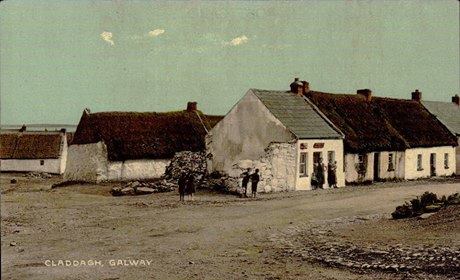
I know that many of you have been to Galway (or intend visiting ) and I am sure you have heard of the Claddagh village, which was on the west side of the mouth of the Corrib river, where it flows into Galway Bay. It was immortalised by Bing Crosby when he recorded the song 'Galway Bay' Remember the opening lines. 'If you ever go across the sea to Ireland, and maybe at the closing of your day, you can sit and watch the moon-rise over Claddagh, and watch the sun go down on Galway Bay'. There, I've got you singing already...yes, the lines are coming back to you now... 'the bare-foot gossuns at their play' ... young boys and girls, wearing no shoes, carefree, oblivious to the woes and tribulations that awaited them in their adult lives... aaah the innocence of it all.


Problem was, that by the time the song was being popularised all across America by the old crooner, back here in Galway, the city officials had decided to build Galway's first housing project, right where the iconic thatched cottages stood. To be fair, those cottages were already hundred of years old, stone-built, cold, damp and in many cases, because of poverty, they were in pretty poor condition and not fit for continued habitation in a modern Ireland, that was just shrugging off the yoke of the British empire.


So in due course over a period of twenty years or so, all the old whitewashed thatched cottages were demolished and replaced by modern, warm, if indifferent looking terraced houses. If there is a prize for the most-asked tourist question in Galway it surely has been 'Where is the Claddagh?' So many people ask that question everyday here that the locals were embarrassed to admit that there wasn't a single thatched cottage left. The wrecking ball had made a clean sweep of them all, the old Claddagh had become confined to black and white picture-postcards and vivid imaginations.

So you can imagine my delight when driving one day in the car, I noticed a guy unloading loads of thatching straw into a back-yard off Fairhill Road, in the Claddagh. My curiousity piqued, I paid the site a visit last week, accompanied by a good friend Tom O'Connor, owner of O'Connor's Famous Pub in Salthill. I brought Tom, not so much because I like him a lot, but really because he just bought some really cool camera equipment, and we made a little video blog which I called 'The first thatched cottage to be built in the Claddagh, Galway, in over a century'.


Like a  phoenix rising from the ashes, we were fascinated to bear witness to the first thatched cottage in nearly a century being built in the Claddagh by a local family called Walsh. They intend to open it to the public in April 2016 and hope to call it Katie's Claddagh Cottage, after their grand-mother who had lived there a long time ago. Using entirely authentic traditional building and thatching methods, when it is finished, it will be an iconic gem in the heart of the old Claddagh village.

So, to cut a long story short, while we were there, picking our way through the building site, I got talking to the guy who was painstakingly weaving straw into the thatched roof, a master-thatcher called Eoin O'Neill, who came all the way from Waterford in the south east of Ireland to help get the new thatched-roof, just perfect. Eoin was really great fun to speak with and was a natural on camera too.


Eoin was using locally-grown wheat from Corandulla, county Galway to thatch the main roof and was using rye that was grown in Wexford for the comb or ridge of the thatched roof. He took a break from his work while I admired the roof-timbers before they were covered over by the rye and wheaten thatch.

The main beams on the roof were old scots-pine or bog-oak rescued from the bogs that cover much of Connemara. The rest of the roof is made of hundreds of ash plants, 2 metre long sticks or scallops, onto which the thatch will eventually be secured by means of twisted hazel wands, which are 'purloned' into the thatch and inter-laced with the ash cross-beams. The thatch is then tamped and pummelled by a special hammer and tied off with thin ropes, until it is as firm and as watertight as any slate roof, really warm, and with some maintenance good for thirty or more years. When looking at really old thatched cottages one can see a hundred years of thatch-layers one on top of the other, making for a delightfully artistic roof.


Looking up through the slatted scallops that comprised the rafters of the cottage I was struck by the frailty of the entire undertaking and was reminded of the old Irish saying, 'lá na gaoithe lá na scolb' - 'The windy day is not the day for thatching'.

The lattice-work of the inter-laced scallops dissecting the heavier cross-beams of the rafters reminded me of the warp and weft of the weavers loom. Soon the thatch will cover this natural web, and these patterns of light and heavy timbers will become the clothes of the house, not unlike a bolt of hand-woven tweed.

The shafts of winter sunlight filtering through the inter-woven sticks on the roof will soon be a distant memory, once the thick layer of rye and wheaten thatch is stitched onto the rafters by Eoin's skilled hands. When the cottage is fully thatched, this under-skeleton will be covered forever and in a month's time, really one could not imagine how such a thatched roof was constructed unless one witnessed a new-build such as this.


This is exactly as our fore-fathers would have made a cottage roof made from thatch, by gathering up locally available material, ash plants, hazel wands, bog-oak beams, driftwood etc. Most of the materials the older generations used were not bought from lumber yards or builders-suppliers, no, they were begged, borrowed, bartered and even liberated from bogs, woods, sea-shores etc. Collecting flotsam and jetsum from the shore would have been a common activity and hey, y'know, the best beams are ones that have been used before in another venture or vessel. Something with the patina of age, and the experience that goes with it, not brittle, but yielding and reliable.

Eoin made these 'bobbins', or 'skirts' by twisting and knotting sheaves of rye stalks, and then braiding them onto a hazel stick. These skirts will be pinned to the ridge to form the thicker top row of thatch at the apex of the roof and also to be additional protection around the chimney. Eoin's handiwork in fixing these bobbins to the roof is really evident when seen from above.


Here's a story! I remember hearing of one family who moved from a small tenant farm beyond Inverin, in west Connemara, to a slightly larger tenant farm, just east of Furbo, a little nearer to Galway city, in 1890. The two brothers, one wife and two children walked the 15 miles from Inverin to Furbo, carrying the roof-beams for their yet-to-be-built stone cottage, on their backs. Such was the value of a few long poles or spars back then! Their humble little thatched cottage saw 9 more children born and thereafter, 17 grand- and great-grand children, all born under the thatched roof that had been made by hand, using only locally grown or found materials, until the cottage was finally replaced in 2009 by a new slate-roofed bungalow.


I would have railed against a 'fake' Claddagh cottage, one built just for tourists to take selfies at. This is no fake. This is the real deal. I believe that this lovingly built, traditional, Claddagh cottage is set to become one of the must-see locations in Galway city for locals and tourists alike. Congratulations to the Walsh family and their hard-working friends on this unique venture to commemorate the iconic village of the Claddagh. Once the garden is in bloom and maybe with a few chickens in the 'street' this cottage will be a perfect example of how the Claddagh village houses would have looked.

 
They have a bog-oak studio at the rear of the cottage and intend selling bog-oak sculptures and tea and freshly-baked scones during the summer. You can sit in by the hob, and watch the busy cottage come to life. The turf-fire will be lighting in the big old fireplace and the half-door will be ajar, or half ajar, whichever! They hope to have various artists and crafts-people working in the cottage, perhaps even a claddagh-ring maker on site too, as well and having a warm, inviting cottage experience, showing how the people of the Claddagh lived and thrived on the shores of Lough Corrib and Galway Bay for the past five centuries.


I hope you enjoy the video. Click on this link to view Katies Claddagh Cottage;
https://www.youtube.com/watch?v=mP8klOF1vYo&feature=youtu.be&a
Tom and I hadn't planned making the video, and we certainly hadn't rehearsed my lines. If fact we did most of it in one staccato un-rehearsed take... so expect a few bloopers...and of course there was lots that we forgot to mention or talk about.

You can come on a walking tour of Galway with me anytime, just call or email me and we can meet up at a time to suit you and your family or friends. If it's wet and windy, I also give 'the shortest walking tour of Ireland, the fifty foot tour of O'Connors pub!' It's a Fireside tour that I give at 6pm any day at O'Connor's Pub, Salthill. A half-dozen or more people can come on that tour, winter or summer.


Thanks for reading. Come and walk with me sometime.
Brian Nolan. Galway Walks - Walking Tours of Galway
Website www.galwaywalks.com Twitter @Galwaywalks
Facebook https://www.facebook.com/Galwaywalks/
Phone 086-3273560 - email galwaywalks@gmail.com

*Photo Credits - The photos are all my own, save for the shot of the bread being baked at the open fire, which I use with the kind permission of the Connemara Heritage and History centre.

Walking Tour of Galway - Eyre Square, Galway

All in a Galway Walk;
 
A freshening breeze breathes life into the iconic Galway Hooker's sails billowing against a cottoned-blue sky in Eyre Square, the main square in the centre of Galway City, on the west coast of Ireland.
 
Galway was founded by the Norman invaders around 1230 AD and the growing fortified medieval town of Galway was granted a City Charter by none other than King Richard III (of Leister fame) in 1484. Galway Corporation commissioned Northern-Ireland sculptor Eamonn O'Doherty to make the sails sculpture in 1984, for the city's 500th anniversary, or our city's Quincentenary or Quincentennial Celebration.


The sculpture represents the sails of a Galway Hooker, a traditional sail-boat that was used for trade and fishing up and down the Atlantic coast of Ireland for centuries. The sails were traditionally red or dun-coloured and the rusty sculpted steel sails are a life-like representation of the sails that are still used on Hookers on Galway Bay. You will see the Hookers sailing off Salthill, or berthed in the Claddagh.
 
The sculpture  was from the very get-go, a simultaneous source of joy and annoyance for Galwegians. Some see it as an eyesore, others think it looks rather Picasso-esque and love it. It is nominally a fountain, but whether for budget reasons or conservation, or to stop college kids chucking soap-powder into it, the water jets are now rarely turned on, and even when they do the water jets are barely knee-high.
 
On the flag-poles behind the sculpture fly the banners and coats of arms of the fourteen 'Tribes of Galway', the 14 Norman families who more or less dominated trade in this bustling medieval city until they too were dispossessed by the army of Oliver Cromwell in 1652, when they captured the city and confiscated all the land, houses and wealth that these enterprising families, and other Irish families had amassed in the previous 400 years.
 
Galway city went into decline under English rule and much of the Spanish influence that the Normans brought to bear on the city's architecture is now visible in the many preserved medieval windows and doorways that survived the siege and occupation. Today Galway is a modern city with many successful industries, a strong tourism sector, beautiful beaches and mountain scenery, and some 20,000 third-level students in our University. It has been voted the friendliest city in Europe and is bidding to be the European City of Culture in 2020 ( +Galway 2020 or @Galway2020 )
 
Eamonn O'Doherty is far more famous these days for his 'Armoured Pram for Derry' sculpture, but sometimes in Galway's Eyre Square, on a suddenly-Spring day, one can almost hear the crack of the gallants, the jibs, the mizzens and the moonrakers as the wind picks up and the herring are running, and the captain calls for canvas!
 
---------------------------------------
Join me, Brian Nolan, on one of my walking tours of Galway, whether on the streets of the city or at O'Connors Fanmous Pub in Salthill, where I entertain locals and visitors alike with my 'Fireside Tour' of O'Connors Pub. www.galwaywalks.com galwaywalks@gmail.com  Phone 086-3273560

Tuesday, 6 May 2014

Lynch's Castle, Galway

Lynch's Castle in Galway is probably the most iconic image of the city's rich Medieval and Norman past.

Judging on the photo, (perhaps by Warner) it is from the close of the 19th century, maybe c. 1890, four decades before the Munster Bank opened up their branch there around 1930, which in time became Allied Irish Bank, which it still is today at the intersection of Shop Street and Abbeygate Street in Galway City.

Other than the chimney, and the shops downstairs, nothing much has changed. A truly beautiful building, covered in carved stonework, coats of arms, memorials, gargoyles, and even a turtle being eaten by an otter. All this embellishment on what was originally a fortified 'tower house' aptly epitomises the fabulous wealth of the Anglo-Norman and Norman-Irish Trading 'Tribes of Galway' between the 15th and 17th centuries.

The beautiful scroll-work over the window above the main doorway is clearly visible here, though covered now in timber shuttering, since it was damaged during the cleaning of the castle's stonework last year. Hopefully we will soon be able to see the restored window.

On another note, I would love to be able to view the castle's garden, which I believe contains a Lynch burial vault. (no money in that bank vault, just the bones of the noble Lynch families). It would be cool to have a video of the castle, front, back and inside, with historical perspective and views from the roof etc, showing on a screen in the bank.

Personally, I love the 'shawlies' on the path in this photo. they are wearing a traditional shawl, perhaps a paisley or other design, so popular in Galway and in the Claddagh in the 19th century, and indeed right up to the 1960's, was not an uncommon sight here on the streets of Galway. I wonder what the name over the door is? Was it a bar, or a grocery perhaps?

For more of these stories come join me on one of my Galway Walks.
Check out www.galwaywalks.com or 'LIKE' my page 'Walking Tours of Galway' on Facebook.