Thursday, 10 March 2016

Thatching a traditional cottage in the Claddagh, Galway, Ireland

I know that many of you have been to Galway (or intend visiting ) and I am sure you have heard of the Claddagh village, which was on the west side of the mouth of the Corrib river, where it flows into Galway Bay. It was immortalised by Bing Crosby when he recorded the song 'Galway Bay' Remember the opening lines. 'If you ever go across the sea to Ireland, and maybe at the closing of your day, you can sit and watch the moon-rise over Claddagh, and watch the sun go down on Galway Bay'. There, I've got you singing already...yes, the lines are coming back to you now... 'the bare-foot gossuns at their play' ... young boys and girls, wearing no shoes, carefree, oblivious to the woes and tribulations that awaited them in their adult lives... aaah the innocence of it all.


Problem was, that by the time the song was being popularised all across America by the old crooner, back here in Galway, the city officials had decided to build Galway's first housing project, right where the iconic thatched cottages stood. To be fair, those cottages were already hundred of years old, stone-built, cold, damp and in many cases, because of poverty, they were in pretty poor condition and not fit for continued habitation in a modern Ireland, that was just shrugging off the yoke of the British empire.
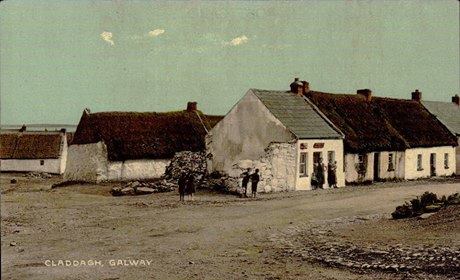

So in due course over a period of twenty years or so, all the old whitewashed thatched cottages were demolished and replaced by modern, warm, if indifferent looking terraced houses. If there is a prize for the most-asked tourist question in Galway it surely has been 'Where is the Claddagh?' So many people ask that question everyday here that the locals were embarrassed to admit that there wasn't a single thatched cottage left. The wrecking ball had made a clean sweep of them all, the old Claddagh had become confined to black and white picture-postcards and vivid imaginations.

So you can imagine my delight when driving one day in the car, I noticed a guy unloading loads of thatching straw into a back-yard off Fairhill Road, in the Claddagh. My curiousity piqued, I paid the site a visit last week, accompanied by a good friend Tom O'Connor, owner of O'Connor's Famous Pub in Salthill. I brought Tom, not so much because I like him a lot, but really because he just bought some really cool camera equipment, and we made a little video blog which I called 'The first thatched cottage to be built in the Claddagh, Galway, in over a century'.


Like a  phoenix rising from the ashes, we were fascinated to bear witness to the first thatched cottage in nearly a century being built in the Claddagh by a local family called Walsh. They intend to open it to the public in April 2016 and hope to call it Katie's Claddagh Cottage, after their grand-mother who had lived there a long time ago. Using entirely authentic traditional building and thatching methods, when it is finished, it will be an iconic gem in the heart of the old Claddagh village.

So, to cut a long story short, while we were there, picking our way through the building site, I got talking to the guy who was painstakingly weaving straw into the thatched roof, a master-thatcher called Eoin O'Neill, who came all the way from Waterford in the south east of Ireland to help get the new thatched-roof, just perfect. Eoin was really great fun to speak with and was a natural on camera too.


Eoin was using locally-grown wheat from Corandulla, county Galway to thatch the main roof and was using rye that was grown in Wexford for the comb or ridge of the thatched roof. He took a break from his work while I admired the roof-timbers before they were covered over by the rye and wheaten thatch.

The main beams on the roof were old scots-pine or bog-oak rescued from the bogs that cover much of Connemara. The rest of the roof is made of hundreds of ash plants, 2 metre long sticks or scallops, onto which the thatch will eventually be secured by means of twisted hazel wands, which are 'purloned' into the thatch and inter-laced with the ash cross-beams. The thatch is then tamped and pummelled by a special hammer and tied off with thin ropes, until it is as firm and as watertight as any slate roof, really warm, and with some maintenance good for thirty or more years. When looking at really old thatched cottages one can see a hundred years of thatch-layers one on top of the other, making for a delightfully artistic roof.


Looking up through the slatted scallops that comprised the rafters of the cottage I was struck by the frailty of the entire undertaking and was reminded of the old Irish saying, 'lá na gaoithe lá na scolb' - 'The windy day is not the day for thatching'.

The lattice-work of the inter-laced scallops dissecting the heavier cross-beams of the rafters reminded me of the warp and weft of the weavers loom. Soon the thatch will cover this natural web, and these patterns of light and heavy timbers will become the clothes of the house, not unlike a bolt of hand-woven tweed.

The shafts of winter sunlight filtering through the inter-woven sticks on the roof will soon be a distant memory, once the thick layer of rye and wheaten thatch is stitched onto the rafters by Eoin's skilled hands. When the cottage is fully thatched, this under-skeleton will be covered forever and in a month's time, really one could not imagine how such a thatched roof was constructed unless one witnessed a new-build such as this.


This is exactly as our fore-fathers would have made a cottage roof made from thatch, by gathering up locally available material, ash plants, hazel wands, bog-oak beams, driftwood etc. Most of the materials the older generations used were not bought from lumber yards or builders-suppliers, no, they were begged, borrowed, bartered and even liberated from bogs, woods, sea-shores etc. Collecting flotsam and jetsum from the shore would have been a common activity and hey, y'know, the best beams are ones that have been used before in another venture or vessel. Something with the patina of age, and the experience that goes with it, not brittle, but yielding and reliable.

Eoin made these 'bobbins', or 'skirts' by twisting and knotting sheaves of rye stalks, and then braiding them onto a hazel stick. These skirts will be pinned to the ridge to form the thicker top row of thatch at the apex of the roof and also to be additional protection around the chimney. Eoin's handiwork in fixing these bobbins to the roof is really evident when seen from above.


Here's a story! I remember hearing of one family who moved from a small tenant farm beyond Inverin, in west Connemara, to a slightly larger tenant farm, just east of Furbo, a little nearer to Galway city, in 1890. The two brothers, one wife and two children walked the 15 miles from Inverin to Furbo, carrying the roof-beams for their yet-to-be-built stone cottage, on their backs. Such was the value of a few long poles or spars back then! Their humble little thatched cottage saw 9 more children born and thereafter, 17 grand- and great-grand children, all born under the thatched roof that had been made by hand, using only locally grown or found materials, until the cottage was finally replaced in 2009 by a new slate-roofed bungalow.


I would have railed against a 'fake' Claddagh cottage, one built just for tourists to take selfies at. This is no fake. This is the real deal. I believe that this lovingly built, traditional, Claddagh cottage is set to become one of the must-see locations in Galway city for locals and tourists alike. Congratulations to the Walsh family and their hard-working friends on this unique venture to commemorate the iconic village of the Claddagh. Once the garden is in bloom and maybe with a few chickens in the 'street' this cottage will be a perfect example of how the Claddagh village houses would have looked.

 
They have a bog-oak studio at the rear of the cottage and intend selling bog-oak sculptures and tea and freshly-baked scones during the summer. You can sit in by the hob, and watch the busy cottage come to life. The turf-fire will be lighting in the big old fireplace and the half-door will be ajar, or half ajar, whichever! They hope to have various artists and crafts-people working in the cottage, perhaps even a claddagh-ring maker on site too, as well and having a warm, inviting cottage experience, showing how the people of the Claddagh lived and thrived on the shores of Lough Corrib and Galway Bay for the past five centuries.


I hope you enjoy the video. Click on this link to view Katies Claddagh Cottage;
https://www.youtube.com/watch?v=mP8klOF1vYo&feature=youtu.be&a
Tom and I hadn't planned making the video, and we certainly hadn't rehearsed my lines. If fact we did most of it in one staccato un-rehearsed take... so expect a few bloopers...and of course there was lots that we forgot to mention or talk about.

You can come on a walking tour of Galway with me anytime, just call or email me and we can meet up at a time to suit you and your family or friends. If it's wet and windy, I also give 'the shortest walking tour of Ireland, the fifty foot tour of O'Connors pub!' It's a Fireside tour that I give at 6pm any day at O'Connor's Pub, Salthill. A half-dozen or more people can come on that tour, winter or summer.


Thanks for reading. Come and walk with me sometime.
Brian Nolan. Galway Walks - Walking Tours of Galway
Website www.galwaywalks.com Twitter @Galwaywalks
Facebook https://www.facebook.com/Galwaywalks/
Phone 086-3273560 - email galwaywalks@gmail.com

*Photo Credits - The photos are all my own, save for the shot of the bread being baked at the open fire, which I use with the kind permission of the Connemara Heritage and History centre.

Walking Tour of Galway - Eyre Square, Galway

All in a Galway Walk;
 
A freshening breeze breathes life into the iconic Galway Hooker's sails billowing against a cottoned-blue sky in Eyre Square, the main square in the centre of Galway City, on the west coast of Ireland.
 
Galway was founded by the Norman invaders around 1230 AD and the growing fortified medieval town of Galway was granted a City Charter by none other than King Richard III (of Leister fame) in 1484. Galway Corporation commissioned Northern-Ireland sculptor Eamonn O'Doherty to make the sails sculpture in 1984, for the city's 500th anniversary, or our city's Quincentenary or Quincentennial Celebration.


The sculpture represents the sails of a Galway Hooker, a traditional sail-boat that was used for trade and fishing up and down the Atlantic coast of Ireland for centuries. The sails were traditionally red or dun-coloured and the rusty sculpted steel sails are a life-like representation of the sails that are still used on Hookers on Galway Bay. You will see the Hookers sailing off Salthill, or berthed in the Claddagh.
 
The sculpture  was from the very get-go, a simultaneous source of joy and annoyance for Galwegians. Some see it as an eyesore, others think it looks rather Picasso-esque and love it. It is nominally a fountain, but whether for budget reasons or conservation, or to stop college kids chucking soap-powder into it, the water jets are now rarely turned on, and even when they do the water jets are barely knee-high.
 
On the flag-poles behind the sculpture fly the banners and coats of arms of the fourteen 'Tribes of Galway', the 14 Norman families who more or less dominated trade in this bustling medieval city until they too were dispossessed by the army of Oliver Cromwell in 1652, when they captured the city and confiscated all the land, houses and wealth that these enterprising families, and other Irish families had amassed in the previous 400 years.
 
Galway city went into decline under English rule and much of the Spanish influence that the Normans brought to bear on the city's architecture is now visible in the many preserved medieval windows and doorways that survived the siege and occupation. Today Galway is a modern city with many successful industries, a strong tourism sector, beautiful beaches and mountain scenery, and some 20,000 third-level students in our University. It has been voted the friendliest city in Europe and is bidding to be the European City of Culture in 2020 ( +Galway 2020 or @Galway2020 )
 
Eamonn O'Doherty is far more famous these days for his 'Armoured Pram for Derry' sculpture, but sometimes in Galway's Eyre Square, on a suddenly-Spring day, one can almost hear the crack of the gallants, the jibs, the mizzens and the moonrakers as the wind picks up and the herring are running, and the captain calls for canvas!
 
---------------------------------------
Join me, Brian Nolan, on one of my walking tours of Galway, whether on the streets of the city or at O'Connors Fanmous Pub in Salthill, where I entertain locals and visitors alike with my 'Fireside Tour' of O'Connors Pub. www.galwaywalks.com galwaywalks@gmail.com  Phone 086-3273560

Monday, 12 October 2015

Fair Days In Ireland

Fairs played a vital role in the rural economy. Farm income depended on the seasonal sale of stock or crops and the fairs were where these transactions took place. Some fairs were just for cattle, or sheep or pigs, others were more general, and items sold included hay, turf and potatoes, as well as turkeys, geese, calves and bonhams.
Fairs were held in most towns and even in the cities. The top part of Eyre Square has been a market-place for probably five hundred years or more.

Each fair was held on a set day, and that day was marked on the farmers calendar, and the life of the farm revolved around having the stock ready for each fair. Fair days were held for centuries on the same day of the month, so tradition was of huge importance, and the fair days were oriented to the seasonal production of stock and crops, unlike today, where the mart is open most days of the week. While they all read the 'Farmers Almanac', they knew their fair day dates off by heart.
I remember the fair days in Loughrea in the early 1960's, before the mart was built. We got the day off school on fair days, so we loved the tradition, though not the inconvenience of the fairs. Personal safety aside, we got the day off because of the amount of liquid slurry that lined the streets and the footpaths and made walking around town on a fair day, a rather mucky, smelly business for a young 'townie'.

Pig, geese, turkey and calf fairs were smaller than the big sheep and cattle fairs and most of the animals were brought to town, confined by the creels of the cart, which was drawn by a horse or a donkey, though I remember several mules and ginettes pulling carts as well.

The sheep and cattle fairs were much bigger affairs. The animals began arriving for the big cattle fairs from around 9pm the night before, with canny farmers and their bleary-eyed sons staking out traditional pitches, where generations of each family had always sold their beasts. Such a territorial spot was important and also considered 'lucky' so it was always on their minds to get to town early and secure their 'sweet spot' for selling their cattle or sheep.

Sheep fairs were a sight to behold. Unlike cattle, sheep had to be penned, or they would simply disappear into the night. To achieve this, men brought wooden hurdles with them to town and tied them to the fronts of houses, shops, gateways, whatever they could find, and wherever they could, and made a three-sided pen into which they herded their sheep and lambs. I remember seeing the full length of main street on both sides, penned off in this manner, with perhaps a half mile in total of sheep pens up and down Main Street, strapped to the fronts of each and every business premises on the street. There were probably thousands of sheep in town for those fair days.

 My mother owned a ladies drapery shop, which had two big plate glass display windows, perhaps 3 metres wide on the front of the shop and an elegant, wide, glass doorway in the middle. The sheep pens were tied right up against the shop windows, filled to bursting with huge woolly bleating sheep with panic in their eyes and escape on their minds. Dad had special wrought iron grids made to protect the shop windows from being stove in by the press of the sheep in the pens.


After the fair, I would be given the task of hosing down the footpath and the walls of the shop, brushing away the yards of sheep-poo. Then I had to get the lanolin oil off the windows and have them gleaming for the morning. I don't think I'll ever forget the smells.

Cattle fairs were very different. Cattle can stand in groups for hours without wandering off, with a little minding, so no pens were needed. Hundreds of cattle would fill every street in town, and while to the stranger it must have looked chaotic, it was in actual fact, quite organised, with each farmer's cattle being watchfully guarded and herded so they weren't just in one huge herd. This 'minding' of the cattle was done by the boys and they had a difficult task of it, but they were used to minding cattle, unlike me, who was terrified they might bite!

Once the cattle were in place, the men went off the gauge the market, or meet the cattle jobbers, leaving their sons in charge of the cattle they'd just driven into town. For all of them it had already been a long, tiring night, walking the cattle as much as ten miles in the dark, possibly in the rain and certainly in the cold, running ahead to stop the cattle turning off the road, down bohareens, or into front gardens of road-side houses.


They may have been tired, but they were excited too, at the responsibility they now had for their farm's valuable stock, and at the notion of being in 'town' for the fair, with it's change of scenery from their rural pastures. The cattle too sensed the excitement, looing and mooing, scittishly threatening to break from the herd at any moment, prodded back into line by the boys, yelling and 'hullahing'.


The streets were a mad cacophony of animal and man sounds, echoing around the dim, foggy streets of the town. There always seemed to be mist, whether thats my dimming memory, or the combination of cold, damp steam rising from backs of the cattle, their soft, musty breath condensing in the cold night air, and the blue wisps of smoke from the coal and turf fires wafting down through the throng. The smells were incredibly vital, fresh, dungy, wet, musty, but to a very high volume, if smells can have a decibel level.


The boys wore their working clothes, many wore duffle coats, the 1950's hoodie, but their hands and faces, and their bare legs over the tops of their too-big wellingtons, were raw from the moist cold. The men were the same, though many of them were dressed for town, a serviceable suit or jacket, and a heavy overcoat, and of course they too wore wellingtons, or big boots. The jobbers, distinctively dressed, were dapper in their broad-brimmed hats, velvet-collared crombie coats and bright ox-blood slip-on boots.

By 2 or 3 am the fair was in full swing with buyers, jobbers and sellers all engaged in their deal-making. The big cattle-jobbers moved very efficiently through the fair, buying huge numbers of cattle, strippers, heifers, bullocks, bulls, all destined for further fattening in the midlands, or for abattoirs in Dublin. Many cattle, just like generations of our people, were destined for England. Those just-sold cattle were herded off by drovers and were held in track-side pens, for later loading onto dozens of cattle-cars that had been shunted into place the day before, for onward shipping, to catch the boat to Hollyhead and on to the English markets. Other cattle were loaded onto cattle lorries with high creels, and off they trundled to their destinations across Ireland.
By mid-day, palms had been spat upon and slapped,.deals had done and settled, money exchanged. The boys were given a tanner or a few bob for their services and they made a bee-line to the sweet shops. The men were not done yet. They met up with their wives who had come to town in the pony and trap at a more civilised hour. They settled a few bills around the town, the hardware shop, the grocery, the drapery and the insurance office. In later years they went to the bank, to pay off an overdraft or lodge some money to the farm account.
Almost universally, before they headed home, they went to the pub, usually a pub-grocery, where they bought some shop goods, biscuits and sausages, a side of bacon. The men stood at the bar, the boys waited in the 'lounge', while the wives went about town, buying some necessities for the house or for themselves, a dress, a coat, some wool for knitting, a luxury or two, perhaps. It was also a time to match-make and many's a farmer came to town with a few cattle and returned home with a wife!

Finally, after enjoying a few pints of stout, with their friends, or neighbors, they made their way home, in the pony and trap, home to the farm they'd left almost 24 hours previously. Back on the farm, the cycle of farm life started again, while over in the town, the big clean up was under way, and the smells only got worse before they got better!

Copywright - Brian Nolan, Galway Walks - Walking Tours of Galway  http://www.galwaywalks.com
12 October 2015.
With Thanks to Mount Talbot- A Journey Through the ages for the Ballygar Fair photos, dating from 1953, and the Lawrence Collection for some of the older b&w's.

Thursday, 13 August 2015

The Way They Went - How the Irish 'got about' in 1850!

The Irish, while extremely fond of their horses, tended to walk everywhere, most of them not having the means nor the land to support a horse. Public Transport was inefficient, to say the least. The Railways had only just arrived in Ireland but were confined to short lines in Dublin. River boats and canals carried goods and passengers, though very, very slowly. The Mail Coach from Galway to Dublin took 2 to 3 days, stopping frequently to change horses and rest. 

Charles Bianconi changed all that. He was the Michael O'Leary of his day. Having arrived here in 1800 as a door-to-door salesman of Italian engravings, he soon saw the need for faster coach transport. His Bianconi Coach business had humble beginnings. in 1815 he started with just two coaches (called Bians), each carrying 8 passengers, sitting back to back, face out to the roadside, in 2 rows of 4 longitudinally on a hard bench, plying between Clonmel and Cahir. 

By 1850 he had revolutionised public transport around Ireland, managing some 100 vehicles, which traveled an astonishing 3,800 miles daily, calling at 120 towns, and 140 stations for changing horses. Each of these 'stations', many of which were hotels, inns or public houses, employed several grooms and a farrier, not to mention the catering and other people involved. With over 500 drivers on the payroll and 200 'Bians' in the fleet, they kept over 1,300 horses to pull the cars, that ate around 3,500 tons of hay a year, plus 35,000 barrels of oats. Bianconi also owned a coach-builders company in Clonmel where they made and repaired their own fleet of coaches, and also contracted to dozens of tradesmen and harness-makers, as well as establishing a network of over a thousand ticket-vendors all over the country. 

Blacks Hotel in Eyre Square Galway, Ireland was the Bianconi station in the city (now the Imperial Hotel). The Central Hotel In Loughrea, owned by J. Salmon was the Marconi depot there. A laden Bianconi Royal Mail Day Car or Coach covered about 8 miles per hour and passengers were charged one penny and a farthing per mile (about a 1/2 cent nowadays). 

The fare from Galway to Clifden was 7 shillings and six pence (about 30 cents today) and took 11 to 12 hours to cover the fifty-odd miles! And you sat outside, in all weather! Coaches to Dublin took 2 days, with passengers staying overnight in places like Athlone or Kilbeggan. 
 

They carried mail, passengers and trade-goods. Bianconi's coaches helped the revive the fishing industry by allowing fish caught today in Galway or Cork, to be sold in Dublin within 24 hours, by driving 24 hours straight with perishable cargo.

The mass migration of the Irish people ignited by The Great Famine brought huge increases in passengers, who used Bianconi's services to reach the ports from which they emigrated to England, Canada, America and Australia. The departing emigrants would have passed harrowing scenes of poverty, beggars, evicted families, demolished or uninhabitable homes and lean-to's on the sides of the roads, no doubt reinforcing their decision to leave their native land. 


The Railways finally put the Coaches out of business in the final years of the 19th century, though these new rail-lines, while they provided huge employment in their building, only helped spur and enable more emigration from Ireland..
Today you can still see some Bianconi Coaches in use as jaunting cars on Killarney. 


Charles 'Carlo' Bianconi, who brought cheap public transport to Ireland, died in 1875 and left his company to his employees. A truly modern, innovative and patriotic Irishman, though he was born 130 years ago in a little village called Tregolo, in northern Italy, in 1785.

Hope you enjoyed this post. If you'd like to hear more Galway stories, check out my website www.galwaywalks.com or my Facebook page www.facebook.com/galwaywalks or follow me on Twitter @galwaywalks 
Regards
Brian Nolan
Galway Walks 
Galwaywalks@gmail.com

Monday, 10 August 2015

A True Story

A True Story -
'No blacks, no Irish, no dogs.
I read the rooms to let near
Gloucester Road, brushed my hackles
Flat and continued my search. Then
It wasn't the jibe of race but
The spot between black and dog.
My blood burned and my thick
Tongue filled my gob, blocking the
Words of release, black Irish dog.
I found a room, a den between two
Floors, a curtain to draw behind
And a bed for the neutral light. I
Found love too, more than my ire deserved.
She poured ointment on my tongue. I
Lapped affection, licked kisses on her face.
The dogs were rehabilitated first. The
Blacks legalised on penny postcards on shop
Fronts. I trimmed my words for the Anglo-
Saxon ear. Nothing remains but a green
Passport. Recently on returning from Paris
A customs official, concerned about rabies,
Asked if I were bringing in a dog.'
I read this poem by Leitrim-born poet Joe Sheerin (1941 - ) around 1979, copied it, tucked it into a book (Maurice Walsh's Black Cock's Feather) and forgot about it until yesterday when it fell out on my lap, while I listened to a debate on Gays being allowed to donate blood. I thought it an unusual coincidence. (There are lots more quirky tales on my 'Walking Tours of Galway', if anyone's interested. 
Please 'Like' my pagehttps://www.facebook.com/Galwaywalks if you like these stories! Brian)

Tuesday, 2 June 2015

The Knife Sharpener

Every couple of years this man would come to Loughrea, County Galway and set up shop on the foot-path outside Molloy's Harp Bar on Main Street. He was an itinerant blade-grinder, or knife sharpener. Folks would get wind he was in town and quickly a queue would form, of people waiting to have their 'sharps' sharpened.

All manner of blades were whetted. Scissors, shears, scythes, chisels, sickles, lawn-mower blades, axes, carving knives, plane-blades, scrapers, even razors, he sharpened them all. Sparks would fly when he applied the blade to the spinning whetstone, turning the blade to whet both sides, changing the angle he held it at, almost flat for knives, fully right-angled for scissors. He moved in reverie with the blade, caressing the blade's fine edge to the stone, teasing it to a polished finish as he gently varied the speed of the stone by pedaling the foot-spindles faster or slower. He was an artist really, a craftsman for whom steel was his brush.

He would finish with a smile, rubbing the now gleaming blade with an oily rag to keep the rust off. I can't remember what he charged, something fairly nominal and affordable I imagine, for everyone needed their knives sharpened, rich and poor alike, and he didn't discriminate. He would finish up when the last blade was tested. Deftly he'd flip the cart onto it's one wheel, and using two handles which he had folded into the frame, he wheeled the grinding barrow off to his night's lodgings.

He towed the cart behind his bicycle and like the poet Antoine Raftery, he went from village to village, town to town, farm to farm, working his magic on the cutting edges of Irish life, continuing a tradition that probably went all the way back to medieval times. I wonder if he had a set route, or just took a notion, north today, tomorrow west with the sun? I took these two photographs in August 1973 and had 'lost' the images until this weekend when tidying out my mum's house.  

I was working in Sligo in 1979 when one day I took a drive to Drumcliff to see Yeat's grave. There I saw the little blue and white cart for the last time, tucked in behind a caravan, parked off the road. I stopped, but there was no one about. I often wondered what ever became of the little man with the sharpest wit in Ireland. I never saw him again. I didn't even know his name!

Monday, 4 May 2015

Sometimes I see a Heron in the Corrib river when on my Walking Tours

The word for Heron is 'Corr' in Gaelic. It is also the Irish word for Crane and is used interchangeably. In Celtic mythology, if a sacred place or taboo is disrespected, the effected Druid would adopt a 'corrghuíneacht' - or Heron stance, to put a curse on the transgressor. They reputedly stood on one leg, with one arm skyward, wrist at right-angles over their head, pointing at their enemy, transfixing them with one eye,  chanting or satirising him. Such a spell resulted in everything from blisters on the person's skin, blindness of the enemy, even their death! Irish Herons, not to be messed with. Timeless guardians of our heritage! 

Here in Galway, you can often see Cranes at Salthill, in the rock-pools opposite Leisureland, at Long Walk, near the aptly named B&B Heron's Rest, and often when on my 'walking tours', I see a Heron at the little weir below the Fisheries Tower or at the weir below Nuns Island. 
Keep a wary eye out for them...hah! 

Heron sculpture at Nuns Island, Galway.