I'd been walking my usual route home after work, along the promenade by Grattan Beach, in Salthill, watching a few dogs playing in the tide, chasing each other and the tennis ball their owner threw for them, a typical scene on a typical afternoon in Galway. It was as I approached the junction with Lower Salthill that I noticed him, sitting alone on a bench, in his grey tweed coat and the flat cap, leaning slightly forward, looking out towards the Aran Islands. It was a universal pose, one of wistful thinking and remembering, one that all of our fathers and grand-fathers might have struck had they had an idle moment on a sunny afternoon by the sea, but perhaps also a pose that one may not have witnessed very often, or at all, depending if we were away ourselves, or perhaps our fathers had never made it to the respectable old age where such horizon-gazing is considered ok. Whatever his reason for taking his private moment on the bench that day, it struck a chord with me and I stopped the car for a moment, and snapped the photo. I was glad that I did.

Roll on the seasons, and a full year later, on another such afternoon, lo and behold if he wasn't there again, sitting on his now favourite seat, looking off into the afternoon haze. This time I parked the car and walked back to him, took a few photos and then sat beside him, for a chat. He was delighted to talk and before I knew It, he'd told me a story. Here's roughly how it went.
I said to him as I approached the seat, 'Do you mind if I sit here?' 'Why would I mind? It's a great day isn't it? We've had a woeful winter, I've hardly been out in months.' he answered. I'm Brian by the way' I said, settling down on the edge of the seat, trying not to make him nervous. 'Nice to meet you. My name is PJ, PJ Ruane', he answered. A noisy truck was passing and I asked him to repeat his name. 'PJ, Patrick Joseph is my real name, but everyone calls me PJ.
I nodded. 'Are you from here?' 'New Road, just back the ways' he answered, pointing back towards The Jes. I asked 'By the canal, up off Henry Street?' He nodded. 'All my life, in the one house there, still there, I'll be carried outa there in a pine box I suppose.'

'I saw you here a year or so ago, at this very seat,' I said, '...would it bother you if I took a photo of you? 'He hardly paid any notice to me. I asked him to look to his left and took a photograph with my phone. 'How old do you think I am?' he asked. ''Seventy maybe' I said. 'I'll be 84 on the 24th of May, can you believe that? 'Wow, really! You certainly don't look it. You look fit and healthy, God bless you' I said, honestly.
'I worked outdoors all me life. I finished school when I was 11, never liked it. Worked with horses every day of me life, until 2001 when the council said I'd to stop drawing away loads on the cart. Told me I'd have to pay for a licence and pay a fee for every cart-load. And wear a yella jacket and a hard-hat too, imagine, on a horse-cart?'
Just as he said that, I remembered him then. Years back, maybe 1981 or '82. I remembered taking a photograph of him drawing seaweed off Grattan beach. I said that to him, was that him? He nodded. 'After the winter storms I would bring the horse and cart down here, just there where the monument to the famine girl is now, and draw loads of the seaweed up to the gardens in Taylors Hill and Rockbarton. I drew seaweed as far as Shantalla for the allotments there, but they didn't pay as much as the big doctor's houses. I'd get two pound, or two pound and ten shillings a load in the seventies for seaweed. Great on the roses and on the potatoes. But no one buys seaweed now. It's all in packets now, nothing natural at all.'

'So you were born in 1930 or thereabouts? There wasn't much work in Galway back then, was there?' I asked. 'No, times were hard. My uncle Sonny lived with us in the little house, my mother and father, and me. Bartley bán, they called him, my father, he worked all his life in Palmer's Mills, and Sonny worked in McDonagh's yard. 'Bartley bán?' I quizzed,' bán?' 'Bán, y'know, white, he always had a head of white hair, all my life anyways, that's what they called him.'
'Would your father have known Eugene Daly, the man who was on the Titanic?' He snorted, 'Eugene, from St. John's Street, sure we all knew him, didn't he dress as a woman to get into the lifeboat! I'm not sure he did that, it was all a rumour about people dressing in women's clothes, but he survived it anyway, howsoever he did. I never heard him talking about it, I suppose he was ashamed, or in shock. I remember him well, a tall thin man, worked in Palmers Mills, and then he went off to America to his daughter, she was married out there, in Boston or New York, I suppose.'
He went on. 'Palmer's mills is where the Bridge Mills are now. It was a busy place, full of carts all sorts of carts, donkey carts and pony traps, and small lorrys, all drawing in grain, or drawing out flour and meal. Fierce strong men they were back then, able to load a cart with huge bags of meal or fertiliser, two hundred-weights in a bag, lift it straight up off the ground up onto a cart, no bother, and stay doing that all day, with hardly a mug a tae all day and a sandwich at the Angelus, if they were lucky. And never a word outa them.'
I was mentally trying to remember what a hundred-weight was. 'A hundred-weight, what's that, like twenty kilos?' He explained. 'One hundred and twelve pounds was a hundred-weight. A standard sack of grain or fertiliser, or coal would weigh two hundred-weights, that's two hundred and twenty four pounds, as big as yerself 'twould be, and there might be a dozen of them on a cart, to load or unload. I'd like to see a man do that nowadays.'
Aside from wondering how he knew my weight, I was thinking jeez, a bag weighing over 100 kilos. I'd just done a Manual Handling course, where we were told a safe weight to lift for a grown man was 25-30 kilos. The week before, I had just bought two 50 kilo bags of coal and I had to get help lifting them into my car-boot. I felt like a puny weakling. This man on the seat beside me was small, well not small, but certainly not Mr. Universe.
 'What did you work at when you finished up in school?' I asked, changing the subject. 'I was always at the horses, from when I was a young fellah. I never had any land so I kept them in the commonage behind Shantalla, or on the old quarry railway line, or I let them graze the long acre, but you wouldn't know what that was, I suppose. That was when you grazed your horses on the ditches either side of the road, that was the long acre.' McDonaghs yard had 19 horses, and big stables so I worked there and I was always drawing stuff for people on the cart, y'know, builders rubble, top-soil, stones for foundations, sand, blocks, slates, whatever needed drawing, I carried it.'
'I'd go to Balinasloe Fair and buy a few horses. I had a fair good eye for a sound horse. Some of them I'd keep and some I'd sell on. You could make a few pounds on a good horse in a few weeks, and people would always ask me to keep an eye out for a good one for them.' You see that high point way over across the bay?' He pointed out Tawin to me, a promontory west of Oranmore. 'Yes' I said, 'I often see the light changing on Tawin Point from here, it's always got a different light to it, I'm sure the old folk could tell the weather for fishing from the light over Tawin.'
'That's as may be but I bought a horse there once, from a big farmer called Harty. The horse was one of the breed with the hairy fetlocks, like a quarter-bred draught-horse, a lovely mare she was. I cycled out and led her back through Oranmore and put her up in Shantalla for the night. Well wouldn't you know it, she was gone in the morning. There was nothing for it but to go all the way back through Oranmore, asking along the way for the mare, and sure enough, wasn't she there in the field I'd bought her in. I often thought she had something to do, something to finish and nothing would do her but to go back in the night. I walked her back again and she never strayed again, can you believe that?'
I laughed. 'There's no homing instincts in horses, I mean pigeons have it and maybe dogs, but I never heard of horses homing in!' ...and then I remembered the beautiful poem, 'Caoineadh Airt O'Learaigh' and how his horse came home to his wife, covered in his blood after the English murdered him. I said as much to him. 'I'll tell ya a better one. There was a big dealer, be the name of Dunne, came to Salthill from Dublin every year for the month of August. He stayed in a hotel over there, ah, it's long gone now, but I used buy the odd horse from him. He'd buy in Smithfield and sell down here. One year he had a horse to sell, a big draught mare she was and he had a buyer coming up from Gort for her. I had her kept with my horse up in Shantalla and wouldn't you know it, she went off in the night, with my horse and two others. I hadn't a clue where to look, but a man told me he'd heard tell of a few horses the night before, out in Barna. I found them after searching two day on the bicycle, a ways from Spiddal, up near the little lake there, Doughisce and I brought mine home and told Dunne where he'd find his mare. He thanked me and brought her back and sold her to the Gort man. Damn me if she didn't go missing again, and where do you think she turned up? Hah? Not Galway or Spiddal, but back up in Dublin in his yard. Now do you believe me? Sure horses are a wonder, a good one will make you, but a bad one will break you, my father used to say.'
'Did you ever work abroad? In England or America?' I asked. 'No, I never travelled. All my school friends went to England or America, but I had too much to be doing here. I never left. My uncle Sonny got me into working on the docks. It was hard work. They'd usually get a work gang together for unloading the ships that'd come in to McDonaghs. Sometimes you'd be picked, other times you'd be sent home. It all depended. I was often employed unloading the potash or some other fertiliser for Mairtin Mór McDonagh. He was a big man, died young, but he was tough. He owned half the town back then. The fertiliser was in sacks usually, but the potash had to be filled into big heavy buckets. The potash was fierce to be carrying. It got into your eyes and mouth, you'd be breathing it in all day, coughing and sneezing, but shure no one cared back then.'
 I remember nineteen and fifty-five, it was a fierce hard winter, but that summer was sunny and warm. There were twelve us, all young and fit. Men from the Claddagh who hadn't any other work, times were hard, wirey men, tough as nails. They put two 30 foot planks up against the ship in the docks. Thick planks, maybe 4 inches thick and a foot wide, one plank to walk in by, and one to walk out off the ship. In one day we unloaded the whole ship, carrying bag after bag of the fertiliser on our backs, walking down the bendy plank, without even a rail to hold onto, up and down, all day without hardly a break, 690 tons, all stacked 6 bags high on the quayside!, Man alive but that was hard work, I was tired out that evening, and all for three pounds for the day. Money was scarce back then, not like now. And you couldn't say anything to the ganger, or Mairtin Mór might get to hear it and that was the end of it, out with ya.'
'Did you play football or soccer when you were younger', I asked. 'No, I never was into that. I kept ferrets most of my life. I'd be out after rabbits and selling them. You made good money on rabbits during the Emergency. They must have eaten a quare lot of rabbit meat in England during the war. I never really liked rabbit meat myself, but they put bread on the table.'
'Are you married', I asked. 'I never married. I just never met a one I could settle down with, and sure, where would we live anyway. There's wasn't room in the house on New Road, and I just stayed with the horses. I moved furniture for people if they were moving flats or getting a corporation house. I collected scrap and I brought loads to the dump. I was as good as my word, for that was all I had, my word. If I started a job, or promised to be somewhere, to do something, I would... I never let anyone down.'

'Has much changed along here?' He looked straight at me, with eyes that had seen it all.
'Changed, sure it's all changed. See the rocks here', pointing at the sea-wall along the prom, 'well that was only put in here in the sixties. Yes, before that the tide came right into where Kelleher's Garage is now, there would be water all the way across here, three, no four feet deep, for 500 yards.
 'Y'know the swamp, at the Claddagh, where they play the football now, that was all a dump in my day. I didn't dump there, but near every business in town did. No one cared what was put in there. It's great now with the playing fields and the cycling path, but way back, it was awful, you wouldn't let your horse eat the grass there, it all smelled bad.'
He pointed down the road towards town, to where the big houses on Beach Court now are. 'That was all what we called 'The Boggers' in there, low, swampy land, always flooding. It belonged to Flaherty's, y'know the Supervalue, well that was Flaherty Motors back then and old Mr. Flaherty was always good to me. He didn't mind me dumping there, y'know, rubbish and back-fill from old yards in the town, and soil from digging out foundations. He wasn't keen on old bicycle frames and bed springs, but near anything else you could dump there. There was talk in the sixties that they were gong to build a greyhound track there, but that was just talk In the end they built those houses on it.'
'That road, Grattan Road, Bothar na deich pingin, was always there, but the sea would be one side of it and the flood the other. Just down there was the bathing shelter, near those steps there and the men and women would change into their swimming clothes in it. It was a wooden shed, swept away in the storm in 1960 I think. And there was Moon's pavilion too, it was an L shaped hut there, just below the famine plaque, but it got completely flooded. Moons, you know, the big shop, well they had it as a summer cabin, Grattan Lodge they called it, and it was beautiful, but then the roof blew off in a storm in the fifties, it was ruined. I helped move the housekeeper out of it up to Newcastle. She was a lovely lady.'
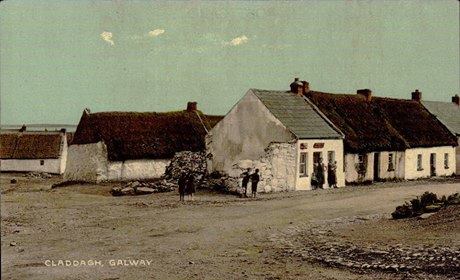
 I wondered if he remembered the old Claddagh? 'What was it like', I asked him what he remembered. 'It was all thatched houses in the Claddagh back then. On a summer's day you'd look back from here and be blinded by the whitewashed walls of the Claddagh village. They were very proud of their village, a tight crowd, hard to be in with them. They owned the shore here. That all changed when they knocked the old houses and put up the corporation houses in the forties and fifties. The Claddagh was never the same after that. Well I suppose the fishing was all gone too, and the boats, man there would be dozens of fishing boats out on the bay here, with all different sails, especially when the herring were in. You'd rarely see a hooker out there now, it's a pity. They didn't have much back then, but they were great people, the Claddagh people, they stuck together.'
We commented on the sand and seaweed that the March storms had blown into piles across the road.
 He said, 'in the Spring after the big tides, the Claddaghmen would be down here collecting the 'Laryck' for the iodine factory. That's the long seaweed rods that get washed in after the storms. They'd stack them and dry them there on the beach, and then load them onto a boat, and row them up the canal and then into the Corrib. Up to the iodine factory below Menlo. The ruins of it are still there. There'd be just two men rowing a big heavy boat, loaded to the gunwhales with seaweed. The boat would be near sunk with the weight of it, but it made no differ. They could manage big loads on those boats. They were great boatmen.'
I asked him about the lighthouse. 'They would be out around Mutton island where the lighthouse is, there was no road back then, you went there over the rocks when the tide went out. I remember a family living out there, at the lighthouse. And a young boy, maybe 16, from the Claddagh, drowned when his canoe turned over when the tide caught him by surprise. He was out there fishing for rockfish when the tide caught him. Terrible sad that was.'
 I quizzed him about the winkle-picking that went on along the shore, now and back then.
'Yes, there were a few families in the Claddagh made their money selling periwinkles, They'd pick them, the winkles, especially at the very low tides, they'd be way out there, bent over the rock-pools, gathering winkles. They'd wash them and then boil them and sell them for tuppence a bag. They gave you a straight pin to eat them with. Some of them sold cockles and mussels too, all picked from the strand and the rocks here, when the tide was out. There was always something going on here, always men and women out there, working away.'
'That's why I like to sit here, y'know, remembering those days. Nobody works the shore now, sure you wouldn't see a sinner out there, barring a few walkers with their dogs and the odd German tourist walking in the tide. I don;t know when I last saw a man driving a horse and cart? Times have moved on and I suppose we must move with them.' He was getting up to go, we shook hands and said our goodbyes. Time had flown as we had spoken, the evening had turned chilly. I watched him walk away, still looking out towards the Clare coast, and the white horses on the bay.

Da.
He casts a lonely figure, silent, gazing... out to sea
Eyes fixed on a distant point unknown
to all but him, a secret place perhaps a memory
A fleeting glimpse of days before he’d grown
'

Roll on the seasons, and a full year later, on another such afternoon, lo and behold if he wasn't there again, sitting on his now favourite seat, looking off into the afternoon haze. This time I parked the car and walked back to him, took a few photos and then sat beside him, for a chat. He was delighted to talk and before I knew It, he'd told me a story. Here's roughly how it went.
I said to him as I approached the seat, 'Do you mind if I sit here?' 'Why would I mind? It's a great day isn't it? We've had a woeful winter, I've hardly been out in months.' he answered. I'm Brian by the way' I said, settling down on the edge of the seat, trying not to make him nervous. 'Nice to meet you. My name is PJ, PJ Ruane', he answered. A noisy truck was passing and I asked him to repeat his name. 'PJ, Patrick Joseph is my real name, but everyone calls me PJ.
I nodded. 'Are you from here?' 'New Road, just back the ways' he answered, pointing back towards The Jes. I asked 'By the canal, up off Henry Street?' He nodded. 'All my life, in the one house there, still there, I'll be carried outa there in a pine box I suppose.'

'I saw you here a year or so ago, at this very seat,' I said, '...would it bother you if I took a photo of you? 'He hardly paid any notice to me. I asked him to look to his left and took a photograph with my phone. 'How old do you think I am?' he asked. ''Seventy maybe' I said. 'I'll be 84 on the 24th of May, can you believe that? 'Wow, really! You certainly don't look it. You look fit and healthy, God bless you' I said, honestly.
'I worked outdoors all me life. I finished school when I was 11, never liked it. Worked with horses every day of me life, until 2001 when the council said I'd to stop drawing away loads on the cart. Told me I'd have to pay for a licence and pay a fee for every cart-load. And wear a yella jacket and a hard-hat too, imagine, on a horse-cart?'
Just as he said that, I remembered him then. Years back, maybe 1981 or '82. I remembered taking a photograph of him drawing seaweed off Grattan beach. I said that to him, was that him? He nodded. 'After the winter storms I would bring the horse and cart down here, just there where the monument to the famine girl is now, and draw loads of the seaweed up to the gardens in Taylors Hill and Rockbarton. I drew seaweed as far as Shantalla for the allotments there, but they didn't pay as much as the big doctor's houses. I'd get two pound, or two pound and ten shillings a load in the seventies for seaweed. Great on the roses and on the potatoes. But no one buys seaweed now. It's all in packets now, nothing natural at all.'

'So you were born in 1930 or thereabouts? There wasn't much work in Galway back then, was there?' I asked. 'No, times were hard. My uncle Sonny lived with us in the little house, my mother and father, and me. Bartley bán, they called him, my father, he worked all his life in Palmer's Mills, and Sonny worked in McDonagh's yard. 'Bartley bán?' I quizzed,' bán?' 'Bán, y'know, white, he always had a head of white hair, all my life anyways, that's what they called him.'
'Would your father have known Eugene Daly, the man who was on the Titanic?' He snorted, 'Eugene, from St. John's Street, sure we all knew him, didn't he dress as a woman to get into the lifeboat! I'm not sure he did that, it was all a rumour about people dressing in women's clothes, but he survived it anyway, howsoever he did. I never heard him talking about it, I suppose he was ashamed, or in shock. I remember him well, a tall thin man, worked in Palmers Mills, and then he went off to America to his daughter, she was married out there, in Boston or New York, I suppose.'
He went on. 'Palmer's mills is where the Bridge Mills are now. It was a busy place, full of carts all sorts of carts, donkey carts and pony traps, and small lorrys, all drawing in grain, or drawing out flour and meal. Fierce strong men they were back then, able to load a cart with huge bags of meal or fertiliser, two hundred-weights in a bag, lift it straight up off the ground up onto a cart, no bother, and stay doing that all day, with hardly a mug a tae all day and a sandwich at the Angelus, if they were lucky. And never a word outa them.'
I was mentally trying to remember what a hundred-weight was. 'A hundred-weight, what's that, like twenty kilos?' He explained. 'One hundred and twelve pounds was a hundred-weight. A standard sack of grain or fertiliser, or coal would weigh two hundred-weights, that's two hundred and twenty four pounds, as big as yerself 'twould be, and there might be a dozen of them on a cart, to load or unload. I'd like to see a man do that nowadays.'
Aside from wondering how he knew my weight, I was thinking jeez, a bag weighing over 100 kilos. I'd just done a Manual Handling course, where we were told a safe weight to lift for a grown man was 25-30 kilos. The week before, I had just bought two 50 kilo bags of coal and I had to get help lifting them into my car-boot. I felt like a puny weakling. This man on the seat beside me was small, well not small, but certainly not Mr. Universe.

'I'd go to Balinasloe Fair and buy a few horses. I had a fair good eye for a sound horse. Some of them I'd keep and some I'd sell on. You could make a few pounds on a good horse in a few weeks, and people would always ask me to keep an eye out for a good one for them.' You see that high point way over across the bay?' He pointed out Tawin to me, a promontory west of Oranmore. 'Yes' I said, 'I often see the light changing on Tawin Point from here, it's always got a different light to it, I'm sure the old folk could tell the weather for fishing from the light over Tawin.'
'That's as may be but I bought a horse there once, from a big farmer called Harty. The horse was one of the breed with the hairy fetlocks, like a quarter-bred draught-horse, a lovely mare she was. I cycled out and led her back through Oranmore and put her up in Shantalla for the night. Well wouldn't you know it, she was gone in the morning. There was nothing for it but to go all the way back through Oranmore, asking along the way for the mare, and sure enough, wasn't she there in the field I'd bought her in. I often thought she had something to do, something to finish and nothing would do her but to go back in the night. I walked her back again and she never strayed again, can you believe that?'
I laughed. 'There's no homing instincts in horses, I mean pigeons have it and maybe dogs, but I never heard of horses homing in!' ...and then I remembered the beautiful poem, 'Caoineadh Airt O'Learaigh' and how his horse came home to his wife, covered in his blood after the English murdered him. I said as much to him. 'I'll tell ya a better one. There was a big dealer, be the name of Dunne, came to Salthill from Dublin every year for the month of August. He stayed in a hotel over there, ah, it's long gone now, but I used buy the odd horse from him. He'd buy in Smithfield and sell down here. One year he had a horse to sell, a big draught mare she was and he had a buyer coming up from Gort for her. I had her kept with my horse up in Shantalla and wouldn't you know it, she went off in the night, with my horse and two others. I hadn't a clue where to look, but a man told me he'd heard tell of a few horses the night before, out in Barna. I found them after searching two day on the bicycle, a ways from Spiddal, up near the little lake there, Doughisce and I brought mine home and told Dunne where he'd find his mare. He thanked me and brought her back and sold her to the Gort man. Damn me if she didn't go missing again, and where do you think she turned up? Hah? Not Galway or Spiddal, but back up in Dublin in his yard. Now do you believe me? Sure horses are a wonder, a good one will make you, but a bad one will break you, my father used to say.'
'Did you ever work abroad? In England or America?' I asked. 'No, I never travelled. All my school friends went to England or America, but I had too much to be doing here. I never left. My uncle Sonny got me into working on the docks. It was hard work. They'd usually get a work gang together for unloading the ships that'd come in to McDonaghs. Sometimes you'd be picked, other times you'd be sent home. It all depended. I was often employed unloading the potash or some other fertiliser for Mairtin Mór McDonagh. He was a big man, died young, but he was tough. He owned half the town back then. The fertiliser was in sacks usually, but the potash had to be filled into big heavy buckets. The potash was fierce to be carrying. It got into your eyes and mouth, you'd be breathing it in all day, coughing and sneezing, but shure no one cared back then.'
 I remember nineteen and fifty-five, it was a fierce hard winter, but that summer was sunny and warm. There were twelve us, all young and fit. Men from the Claddagh who hadn't any other work, times were hard, wirey men, tough as nails. They put two 30 foot planks up against the ship in the docks. Thick planks, maybe 4 inches thick and a foot wide, one plank to walk in by, and one to walk out off the ship. In one day we unloaded the whole ship, carrying bag after bag of the fertiliser on our backs, walking down the bendy plank, without even a rail to hold onto, up and down, all day without hardly a break, 690 tons, all stacked 6 bags high on the quayside!, Man alive but that was hard work, I was tired out that evening, and all for three pounds for the day. Money was scarce back then, not like now. And you couldn't say anything to the ganger, or Mairtin Mór might get to hear it and that was the end of it, out with ya.'
'Did you play football or soccer when you were younger', I asked. 'No, I never was into that. I kept ferrets most of my life. I'd be out after rabbits and selling them. You made good money on rabbits during the Emergency. They must have eaten a quare lot of rabbit meat in England during the war. I never really liked rabbit meat myself, but they put bread on the table.'
'Are you married', I asked. 'I never married. I just never met a one I could settle down with, and sure, where would we live anyway. There's wasn't room in the house on New Road, and I just stayed with the horses. I moved furniture for people if they were moving flats or getting a corporation house. I collected scrap and I brought loads to the dump. I was as good as my word, for that was all I had, my word. If I started a job, or promised to be somewhere, to do something, I would... I never let anyone down.'

'Has much changed along here?' He looked straight at me, with eyes that had seen it all.
'Changed, sure it's all changed. See the rocks here', pointing at the sea-wall along the prom, 'well that was only put in here in the sixties. Yes, before that the tide came right into where Kelleher's Garage is now, there would be water all the way across here, three, no four feet deep, for 500 yards.
 'Y'know the swamp, at the Claddagh, where they play the football now, that was all a dump in my day. I didn't dump there, but near every business in town did. No one cared what was put in there. It's great now with the playing fields and the cycling path, but way back, it was awful, you wouldn't let your horse eat the grass there, it all smelled bad.'
He pointed down the road towards town, to where the big houses on Beach Court now are. 'That was all what we called 'The Boggers' in there, low, swampy land, always flooding. It belonged to Flaherty's, y'know the Supervalue, well that was Flaherty Motors back then and old Mr. Flaherty was always good to me. He didn't mind me dumping there, y'know, rubbish and back-fill from old yards in the town, and soil from digging out foundations. He wasn't keen on old bicycle frames and bed springs, but near anything else you could dump there. There was talk in the sixties that they were gong to build a greyhound track there, but that was just talk In the end they built those houses on it.'
'That road, Grattan Road, Bothar na deich pingin, was always there, but the sea would be one side of it and the flood the other. Just down there was the bathing shelter, near those steps there and the men and women would change into their swimming clothes in it. It was a wooden shed, swept away in the storm in 1960 I think. And there was Moon's pavilion too, it was an L shaped hut there, just below the famine plaque, but it got completely flooded. Moons, you know, the big shop, well they had it as a summer cabin, Grattan Lodge they called it, and it was beautiful, but then the roof blew off in a storm in the fifties, it was ruined. I helped move the housekeeper out of it up to Newcastle. She was a lovely lady.'
 I wondered if he remembered the old Claddagh? 'What was it like', I asked him what he remembered. 'It was all thatched houses in the Claddagh back then. On a summer's day you'd look back from here and be blinded by the whitewashed walls of the Claddagh village. They were very proud of their village, a tight crowd, hard to be in with them. They owned the shore here. That all changed when they knocked the old houses and put up the corporation houses in the forties and fifties. The Claddagh was never the same after that. Well I suppose the fishing was all gone too, and the boats, man there would be dozens of fishing boats out on the bay here, with all different sails, especially when the herring were in. You'd rarely see a hooker out there now, it's a pity. They didn't have much back then, but they were great people, the Claddagh people, they stuck together.'
We commented on the sand and seaweed that the March storms had blown into piles across the road.


'Yes, there were a few families in the Claddagh made their money selling periwinkles, They'd pick them, the winkles, especially at the very low tides, they'd be way out there, bent over the rock-pools, gathering winkles. They'd wash them and then boil them and sell them for tuppence a bag. They gave you a straight pin to eat them with. Some of them sold cockles and mussels too, all picked from the strand and the rocks here, when the tide was out. There was always something going on here, always men and women out there, working away.'
'That's why I like to sit here, y'know, remembering those days. Nobody works the shore now, sure you wouldn't see a sinner out there, barring a few walkers with their dogs and the odd German tourist walking in the tide. I don;t know when I last saw a man driving a horse and cart? Times have moved on and I suppose we must move with them.' He was getting up to go, we shook hands and said our goodbyes. Time had flown as we had spoken, the evening had turned chilly. I watched him walk away, still looking out towards the Clare coast, and the white horses on the bay.

Da.
He casts a lonely figure, silent, gazing... out to sea
Eyes fixed on a distant point unknown
to all but him, a secret place perhaps a memory
A fleeting glimpse of days before he’d grown
A man alone among his thoughts perhaps it is his wife
That passed across the void those years ago
His son who sailed from this point to start a brand new life
Alone among his thoughts that we can’t know
He casts a lonely figure as he shuffles down the way
His mind fixed on a distant point unknown
Returning every morning, he will sit and gaze all day
Absorbed within those distant thoughts, his own
Marty Boyce April 2015 ©

An Australian cousin of mine, Marty Boyce, penned the above lines when he saw the photograph of PJ that I'd posted on my Facebook page, just over a year ago. I liked the poem then and still do today.
He, like me, recognised something of his own father (Tom) in the demeanour of the man on the seaside seat, gazing out to the Burren hills across Galway Bay.
----------------
I hope you enjoyed the story. If you see PJ on the bench be sure to sit and chat with him. You can catch me some evenings at O'Connors doing my 'Fireside Tales' or around town giving my Walking Tours of Galway. If you would like to join me some evening, or if you have a story to tell me, please call me at 086-3273560 or email galwaywalks@gmail.com
Thanks for reading...I hope you liked it.
Please feel free to share or comment.
Brian Nolan
NOTE: All photos are mine, taken by Brian Nolan and copyright to me, except for the photo of cart taken in 1973 on Shop Street, taken by Paddy Brittany, and used with his permission.
That passed across the void those years ago
His son who sailed from this point to start a brand new life
Alone among his thoughts that we can’t know
He casts a lonely figure as he shuffles down the way
His mind fixed on a distant point unknown
Returning every morning, he will sit and gaze all day
Absorbed within those distant thoughts, his own
Marty Boyce April 2015 ©
An Australian cousin of mine, Marty Boyce, penned the above lines when he saw the photograph of PJ that I'd posted on my Facebook page, just over a year ago. I liked the poem then and still do today.
He, like me, recognised something of his own father (Tom) in the demeanour of the man on the seaside seat, gazing out to the Burren hills across Galway Bay.
----------------
I hope you enjoyed the story. If you see PJ on the bench be sure to sit and chat with him. You can catch me some evenings at O'Connors doing my 'Fireside Tales' or around town giving my Walking Tours of Galway. If you would like to join me some evening, or if you have a story to tell me, please call me at 086-3273560 or email galwaywalks@gmail.com
Thanks for reading...I hope you liked it.
Please feel free to share or comment.
Brian Nolan
NOTE: All photos are mine, taken by Brian Nolan and copyright to me, except for the photo of cart taken in 1973 on Shop Street, taken by Paddy Brittany, and used with his permission.
'